
Auto Electrical Repair in Englewood, CO
Modern cars run on electricity as much as on fuel. When a battery keeps dying, the car won't start, or the windows, lights or gauges stop working, you need a shop that actually traces the fault. eForce Automotive Service is an auto electrical repair shop in the south Denver area with a focus on diagnosis: if you've been searching for auto electrical repair near me or car electrical repair near me in the south Denver area, bring your car to us. We find the cause with proper testing, explain it in plain language, and fix it in-house — from parasitic drains and charging problems to wiring, connectors and electronic modules.
Car electrical problems we fix
Electrical faults rarely announce themselves clearly. Here are the problems drivers bring to us most often:
- A battery that goes flat overnight or after a few days parked
- A car that won't start, cranks slowly or only clicks
- Battery or charging warning light on the dash
- Lights that flicker, dim or stop working
- Power windows, door locks, mirrors or seats that work sometimes — or not at all
- Gauges, the instrument cluster or the infotainment screen acting up
- Blown fuses that keep blowing
- Warning lights caused by low voltage or a failed module
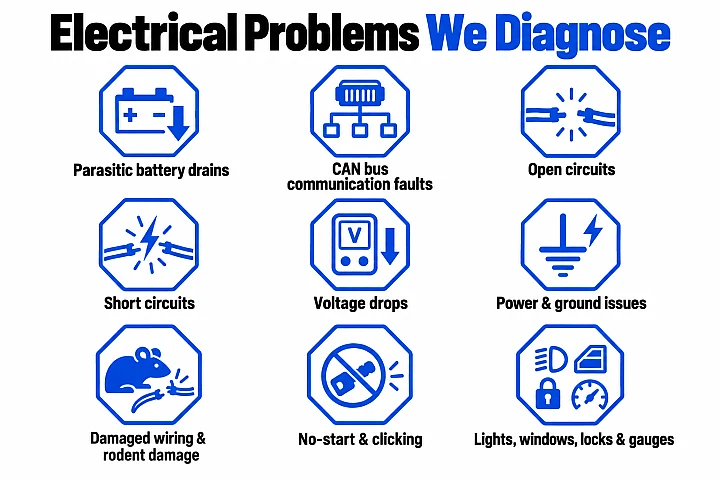
- CAN bus communication faults and module communication problems
- Open circuits, short circuits, voltage drops, and power and ground issues
Whatever the symptom, the process is the same: test, find the cause, quote, repair. Many electrical symptoms also turn on warning lights — our car diagnostics service covers the check engine light and other dash warnings.
Battery keeps dying? Parasitic drain testing
If your battery keeps dying, the battery itself may be fine. Often something in the car keeps drawing power after you turn it off. That's called a parasitic draw, and finding it is one of the most common jobs in auto electrical repair.
What causes a drain
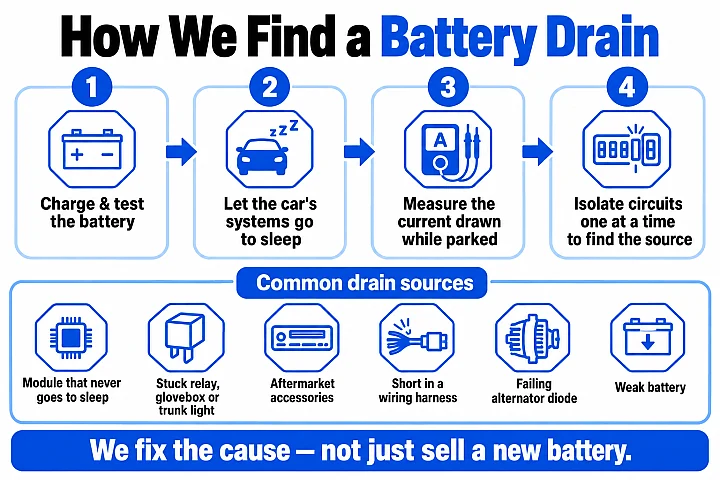
- A module that never "goes to sleep" after the car is shut off
- A stuck relay, glovebox or trunk light, or a faulty switch
- Aftermarket accessories: remote starters, alarms, dash cams, stereos
- A short in a wiring harness, often after previous repairs or water entry
- A failing alternator diode that lets current leak back
- An old or weak battery that can no longer hold a charge
How we find it
Parasitic draw testing takes patience. We fully charge and test the battery first, then let the car's systems shut down and measure the current it draws while parked. If the draw is too high, we isolate circuits one at a time — and, on cars with many modules, check which module is staying awake — until we pinpoint the source. Then we repair the circuit, switch or module that is causing it, rather than just selling you a new battery.
Car won't start or clicks
A car that won't start, cranks slowly or makes a single click can point to several different parts. Replacing the wrong one wastes money, so we test before we replace.
Battery, starter, alternator & charging tests (repairs done in-house)
- Battery test — we check state of charge and the battery's real ability to deliver current, not just its voltage.
- Starter and starter circuit — we check the starter motor, solenoid, relay and cables for voltage drop.
- Alternator and charging system — we measure charging output under load to confirm whether the alternator is doing its job. Alternator repair or replacement is done in-house.
- Cables, grounds and terminals — corroded or loose connections are a frequent, inexpensive cause of no-start problems.
- Immobilizer and key faults — if the car cranks but won't fire, the key or immobilizer may be the issue; see module programming.
When we know which part has failed, we repair it here. Starter replacement cost depends on the vehicle and the part — you get a quote first.
Wiring & connector repair (shorts, corrosion, rodent damage)
Damaged wiring causes some of the hardest-to-find faults. We repair:
- Shorts to ground that blow fuses or drain the battery
- Corroded connectors and grounds, common with Colorado road salt and winter moisture
- Rodent damage — mice and other rodents often chew engine-bay and under-car wiring, especially on cars parked for a while
- Broken wires in door hinges and trunk lids, where harnesses flex every day
- Previous repairs or aftermarket installs that were spliced poorly
We trace the damaged section, then repair it with proper splices and connectors and protect it so it lasts. When a harness section is too damaged to repair, we tell you and quote the replacement.
Lights, power windows, locks, gauges & accessories
Many electrical "small" problems make daily driving frustrating. We diagnose and fix:
- Headlights, taillights, brake lights and interior lights
- Power windows, door locks, mirrors and power seats
- Instrument cluster and gauge faults
- Horns, wipers, blower motors and HVAC controls
- Central locking and comfort functions controlled by body modules
On newer cars, many of these features are controlled by modules on a data network, so a dead window can be a switch, a motor, a wire or a module. We test until we know which.
Modules & electronics
Today's cars have dozens of control modules. When one fails, it may need replacement and programming to the car. We program new and used modules — ECU, BCM, TCM, ABS and more — in-house. Learn more about our module programming service. For hybrid systems see hybrid repair, and for mechanical work see auto repair.
Pricing after diagnostics: cause first, then a clear quote
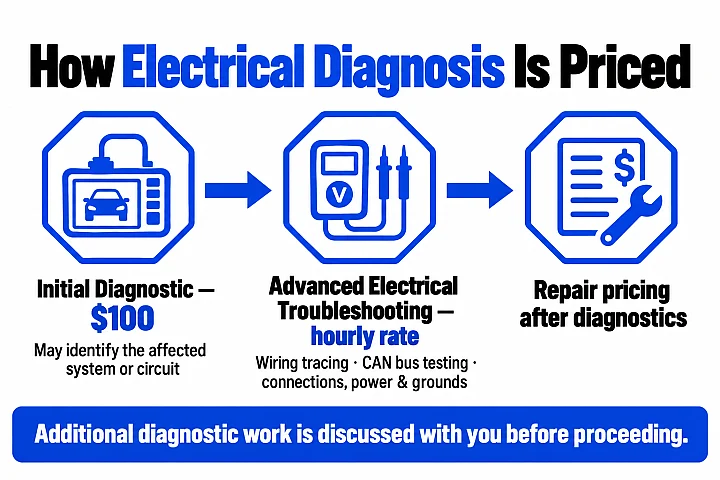
The initial $100 diagnostic may identify the affected system or circuit. If further electrical troubleshooting is required, such as tracing wiring, testing CAN bus circuits, checking individual connections, power supplies and grounds, the additional work is charged hourly. Complex electrical problems can require significant diagnostic time, so the technician will evaluate the issue and discuss the additional diagnostic work with you before proceeding.
- Initial Diagnostic — $100
- Advanced Electrical Troubleshooting — hourly rate
Repair pricing comes after diagnostics. Electrical repair costs depend on what we find: a corroded ground, a failed alternator and a chewed harness are very different jobs. The make and model, how easy it is to reach the part and whether a module needs programming also matter. You approve the quote before we start.
All makes, German specialists
We repair electrical systems on all makes, and German cars are our specialty:
- BMW
- Mercedes-Benz
- Audi
- Volkswagen
- Porsche
These cars use complex networks of modules and are sensitive to battery and voltage issues — including battery registration after a replacement on many models. Our technicians are OEM manufacturer-certified.
Programming capabilities for newer European vehicles, particularly certain Audi, Mercedes-Benz and BMW platforms, may be more limited and must be verified for the specific vehicle and requested service — contact us with your VIN and we'll confirm support before scheduling an appointment.
Denver metro service area
Bring your car to our shop at 1713 W Baltic Pl, Englewood, CO 80110. We don't offer mobile or on-site service — all electrical work is done in our shop, where we have the equipment to test properly.
eForce Automotive Service · 1713 W Baltic Pl, Englewood, CO 80110 · (720) 790-5857
Hours: Mon–Fri 8 AM–6 PM, Sat 10 AM–4 PM, Sun closed · By appointment only — call to schedule
Get directions · 5.0 on Google (9 reviews) — read them on Google
We serve the Denver area, including Sheridan, Littleton, Centennial, Greenwood Village, Cherry Hills Village, south Denver and Aurora. See all our services. Learn more about eForce Automotive Service.
FAQ
Why does my battery keep dying?
The three most common reasons are a parasitic drain (something stays on after you turn off the car), a charging problem (the alternator isn't recharging the battery), or a battery that's simply worn out. Short trips and long periods of parking make all three worse. Testing tells us which one it is.
How long does a parasitic drain test take?
Many modern cars need time for their modules to go to sleep before an accurate reading is possible, and intermittent drains can take longer to catch. The initial $100 diagnostic may identify the affected system or circuit; further troubleshooting is charged hourly and discussed with you before we proceed.
Can cold weather kill a battery?
Cold weather doesn't usually kill a healthy battery by itself, but it reduces the battery's available power while the engine needs more to start. A battery that is already weak, or a car with a small drain, often fails on the first cold Colorado morning.
Is it the battery or the alternator?
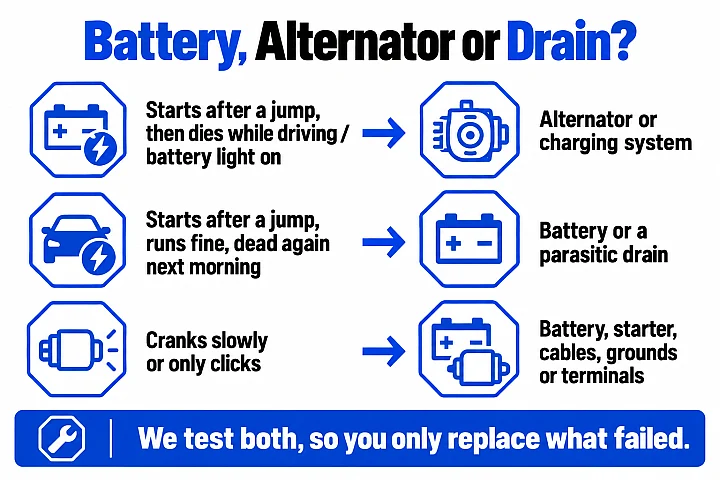
If the car starts after a jump and then dies again while driving, or the battery light comes on, the alternator or charging system is a likely suspect. If the car starts after a jump and runs fine but is dead again the next morning, the battery or a drain is more likely. We test both so you only replace what failed.
Do you repair wiring after rodent damage?
Yes. We find every damaged section, repair it with proper splices and connectors, and check the affected systems afterward. If damage is extensive, we'll explain whether repair or harness replacement makes more sense.
Do you come to me?
No — we don't offer mobile service. Please bring your car to our shop at 1713 W Baltic Pl. If it doesn't start, you'll need to arrange transport to us.