Module Programming & Coding in Englewood, CO
Replacing a control module is only half the job — the new module has to be programmed and coded to your car before it works properly. eForce Automotive Service provides ECU programming and module programming for ECU, ECM, PCM, BCM, TCM, ABS, instrument cluster and airbag modules at our shop near Littleton and Sheridan. If you've been looking for module programming near me or ECU programming near me in the south Denver area, we program new and used modules, install software updates, and perform the coding and adaptations your car needs after a repair.
When a module needs programming
Most modern cars have dozens of control modules talking to each other over a data network. A module typically needs programming or coding when:
- It has been replaced — a new module usually arrives blank or with generic software and must be loaded with the right software and your car's configuration.
- You're installing a used module — a used module carries the VIN, immobilizer data and settings of its donor car and must be adapted to yours.
- A software update is needed — manufacturers release updates that fix drivability issues, warning lights and communication faults.
- After a repair — work on the engine, transmission, steering, brakes or electrical system often requires adaptations, resets or calibrations afterward.
- Battery replacement — on many cars, a new battery must be registered to the charging system.
If a module isn't programmed correctly, symptoms range from warning lights and communication errors to a car that won't start or shift.
Signs a module may be failing or needs software
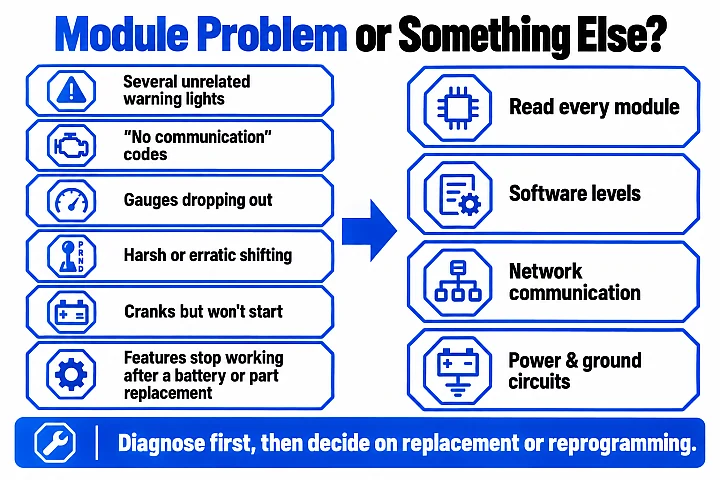
Module problems often look like other faults. Typical symptoms include several unrelated warning lights at once, "no communication" codes, gauges that drop out, harsh or erratic shifting, a car that cranks but won't start, or features that stop working after a battery or part replacement. Because these symptoms overlap with wiring, power and sensor faults, diagnosis at a dealer level of depth matters: reading every module, checking software levels and network communication, and testing power and ground circuits before deciding a module must be replaced or reprogrammed.
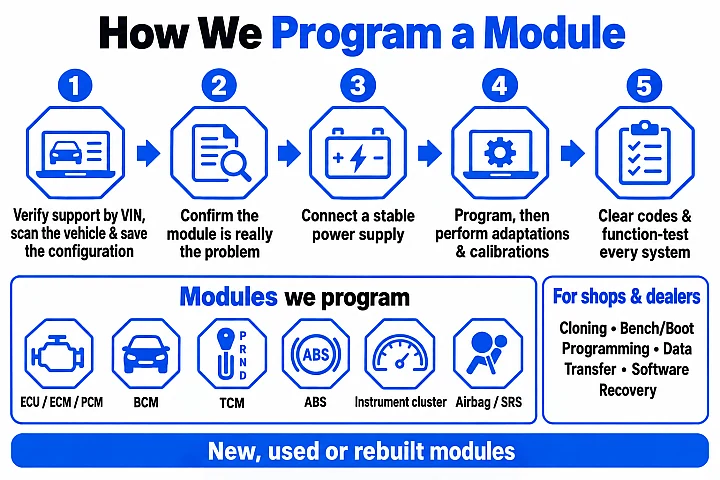
Modules we program
ECU / ECM / PCM
The engine control unit (ECU, also called ECM, or PCM when it controls engine and transmission together) runs fuel, ignition and emissions. We handle ECU flashing and PCM flashing with updated software, ECU coding to your car's configuration, VIN programming and immobilizer matching so the engine will start. When a unit has failed, we handle ECM replacement, data transfer from the original unit and programming. We do not provide circuit-board or component-level module repair.
BCM
The body control module runs lighting, locks, windows, wipers, alarm and comfort functions — and often the immobilizer. BCM programming includes configuration for your car's options and key data.
TCM & transmission adaptations
A replacement transmission control module needs programming and, just as important, adaptations so it learns clutch packs and shift points. Skipping adaptations causes harsh or slipping shifts. TCM replacement cost depends on the vehicle and module — we quote after checking your car.
ABS
The ABS module controls anti-lock braking and stability systems. ABS module replacement usually requires programming or coding, and some cars require steering angle sensor calibration afterward.
Instrument cluster
We diagnose instrument cluster faults and program replacement clusters to your car's configuration.
Airbag/SRS
Airbag control modules need programming after replacement and often a crash-data reset after an accident. See airbag / SRS light repair.
How we approach a programming job
Every job follows the same steps. First we scan the whole vehicle and save the current configuration, so nothing is lost. Then we confirm the module is really the problem — a surprising number of "bad modules" turn out to be wiring, power or ground faults. Before programming we connect a stable power supply, because a voltage drop in the middle of a flash can damage a module. After programming we perform the required adaptations and calibrations, clear codes, and test-drive or function-test the car to confirm every system talks to each other correctly. You get a short summary of what was programmed and why.
New, used or rebuilt modules — what we can and can't program
Used modules: yes. We program and adapt used modules — a practical way to save on parts for many vehicles. We also program new and rebuilt modules.
What determines whether a module can be used:
- Exact part compatibility — the hardware number must suit your car. A module from a different engine, transmission or option package may not be compatible even when it fits physically.
- Locked or protected modules — some modules are locked to their original vehicle by the manufacturer and can be difficult or impossible to reuse.
- Physical condition — water damage, burnt circuits or crash damage can't be fixed by programming.
Before you buy a used module, call Viktor with the part number. We'll tell you whether it's a good candidate for your car.
Coding & adaptations
Beyond replacement work, modules can be coded to change how features behave or to activate options your car's hardware supports. Learn more on our feature coding and retrofits pages.
For shops & dealers
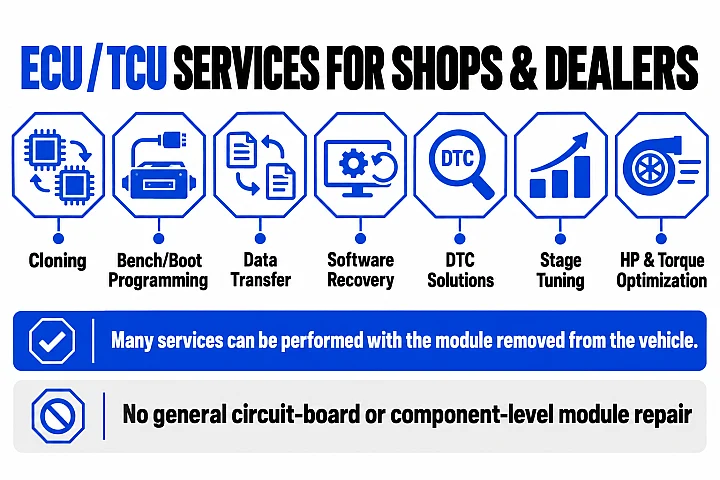
ECU / TCU SERVICES FOR SHOPS & DEALERS
Cloning • Bench/Boot Programming • Data Transfer • Software Recovery • DTC Solutions • Stage Tuning • HP & Torque Optimization
We provide module programming, cloning and calibration services for repair shops, technicians and dealers. Many services can be performed with the module removed from the vehicle, so the complete vehicle may not always be required — bring the removed module or the vehicle to our shop by appointment (we don't make mobile visits).
Depending on the module and application, our services include:
- ECU / PCM / TCM Cloning
- Bench & Boot Mode Programming
- Flash & EEPROM Data Transfer
- Original-to-Replacement Module Data Transfer
- Used Replacement Module Preparation
- Module Backup & Software Recovery
- Chip / Memory Transfer Between Modules — when applicable
- DTC Removal — for supported applications and appropriate repair situations
- ECU Performance / Stage Tuning
- Horsepower & Torque Optimization
- TCU / Transmission Tuning
We can also perform certain hardware data-transfer procedures, including transferring memory chips or other required components between compatible original and donor modules when technically appropriate.
We do not provide general circuit-board or component-level module repair. Our primary focus is programming, cloning, data transfer, software recovery and calibration. Call Viktor to discuss module programming for your shop or dealership.
Pricing after diagnostics: quote by vehicle + module
Module work starts with a diagnostic: the initial diagnostic is $100, and if a specific system or module needs additional in-depth testing, we discuss it with you first; additional testing starts at $50 per system/module. Repair pricing comes after diagnostics. Module programming price depends on the vehicle make, model and year, which module is involved, whether it's new or used, whether adaptations and calibrations are needed afterward, and whether we first need to confirm the module itself is the problem. We check, then quote. If the root cause is still unknown, start with car diagnostics.
OEM software for GM, Ford, Mazda & Nissan
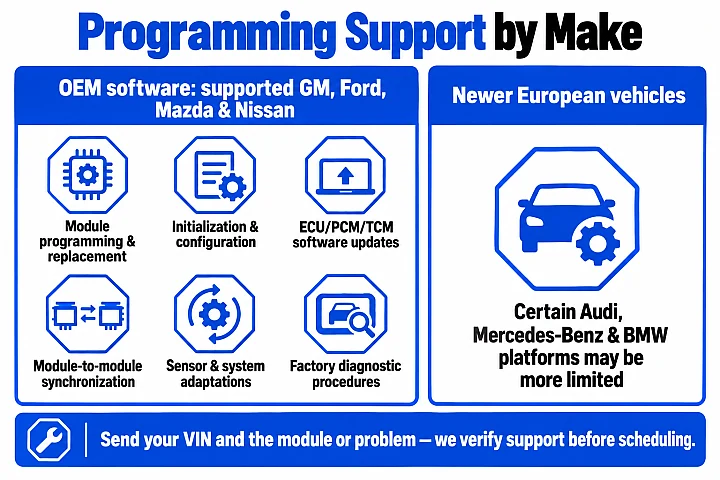
We also have access to OEM manufacturer software for supported GM, Ford, Mazda and Nissan vehicles, allowing us to perform many factory-level procedures such as:
- Module programming and replacement
- Module initialization and configuration
- ECU/PCM/TCM software updates
- Module-to-module initialization / synchronization
- Sensor and system adaptations
- Factory diagnostic procedures
Many makes; German coding & programming focus
We work with a wide range of vehicle makes, and German cars are our main focus:
- BMW
- Mercedes-Benz
- Audi
- Volkswagen
- Porsche
German vehicles rely heavily on coding, with many modules that must agree on the car's configuration. Our technicians are OEM manufacturer-certified. We also program key-related modules — see key fob & car key programming.
Programming capabilities for newer European vehicles, particularly certain Audi, Mercedes-Benz and BMW platforms, may be more limited and must be verified for the specific vehicle and requested service — contact us with your VIN and we'll confirm support before scheduling an appointment.
Visit our shop
Bring your car — or, for many services, the removed module — to our shop at 1713 W Baltic Pl, Englewood, CO 80110. We don't offer mobile or on-site service.
eForce Automotive Service · 1713 W Baltic Pl, Englewood, CO 80110 · (720) 790-5857
Hours: Mon–Fri 8 AM–6 PM, Sat 10 AM–4 PM, Sun closed · By appointment only — call to schedule
Get directions · 5.0 on Google (9 reviews) — read them on Google
We serve the Denver area, including Sheridan, Littleton, Centennial, Greenwood Village, Cherry Hills Village, south Denver and Aurora. See all our services. Learn more about eForce Automotive Service.
FAQ
Do I need programming after replacing an ECU?
Almost always. A replacement ECU must be loaded with the correct software, coded to your car's configuration and matched to the immobilizer, or the engine may not start or run correctly.
Can you program a used module?
Yes. We program and adapt used modules for many vehicles, as long as the part is compatible with your car and not locked or damaged.
How long does module programming take?
It depends on the module, the vehicle and whether adaptations are needed afterward. We give you an estimate with your quote.
Are there any vehicle brands or modules you cannot program?
We work with a wide range of vehicle makes, control modules, sensors and electronic systems. Our capabilities include ECU/PCM, TCM, BCM, ABS and SRS modules, as well as sensor calibration, module adaptation, initialization, software updates, DTC-related diagnostics and module replacement procedures.
Programming capability depends on the vehicle year, model, module type and required procedure. Some newer vehicles use additional security and manufacturer authorization that may limit certain programming operations. We also have access to OEM manufacturer software for supported GM, Ford, Mazda and Nissan vehicles. For newer European vehicles, particularly certain Audi, Mercedes-Benz and BMW platforms, programming capabilities may be more limited and must be verified for the specific vehicle and requested service.
Contact us with your VIN and the module or problem you need serviced, and we can verify programming support before scheduling an appointment.
Do you program modules on the bench for repair shops and dealers?
Yes. We provide module programming, cloning and calibration services for repair shops, technicians and dealers. Many services can be performed with the module removed from the vehicle, so the complete vehicle may not always be required. See for shops & dealers.
Will programming fix my check engine light?
Sometimes. If the light is caused by outdated software or an unprogrammed module, programming can fix it. If it's caused by a failed sensor, wiring or mechanical fault, programming won't help — that's why we diagnose first.