
Why Does My Car Battery Keep Dying Overnight?
If your car starts after a jump but is dead again the next morning, the battery itself may not be the real problem. An overnight battery drain can come from a weak battery, a charging-system fault, damaged wiring, or an electrical component that keeps drawing power after the vehicle is shut off.
For drivers in Denver and the south Denver metro, cold mornings often make a marginal electrical problem more obvious, but replacing the battery without testing can turn into an expensive guessing game. The right approach is to determine when the battery loses charge, why it happens, and which circuit is responsible.
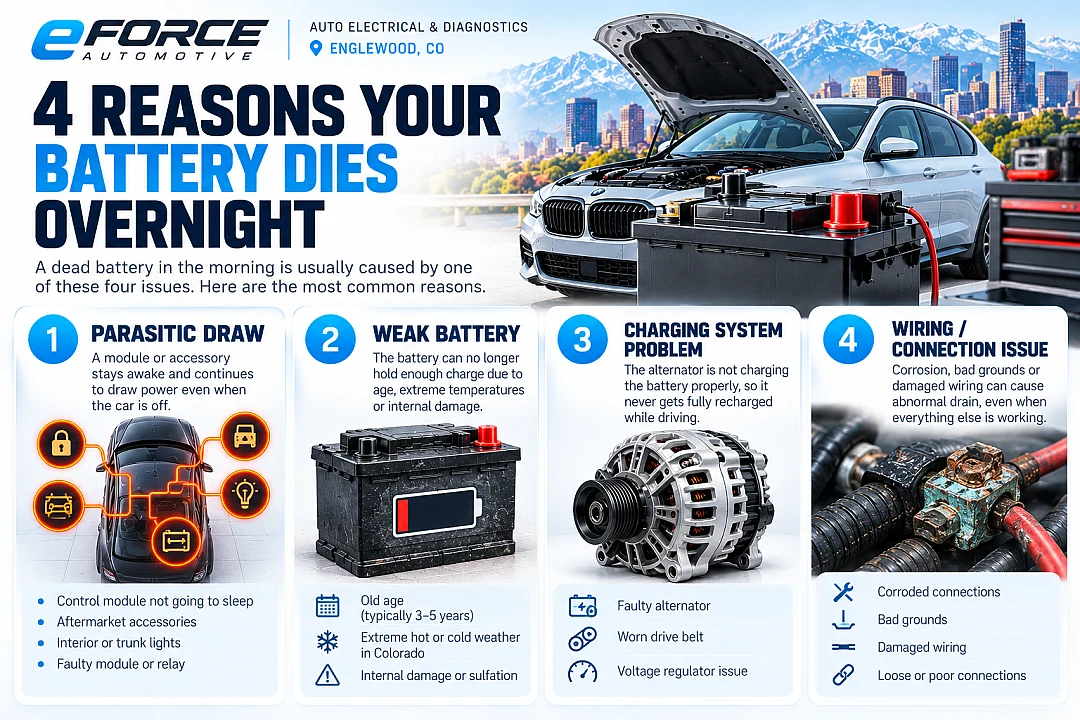
Four common reasons a car battery dies overnight
Most overnight no-start complaints fall into four broad categories. The symptom may look the same from the driver's seat, but the repair can be completely different.
1. Parasitic electrical draw
A parasitic draw happens when something continues using electricity after the ignition is off and the vehicle should be asleep. Modern vehicles contain dozens of control modules, and many remain awake for a short time after shutdown. The problem starts when a module, relay, light, or accessory never goes to sleep.
Common sources include aftermarket alarms, remote starters, dash cameras, audio equipment, glovebox or trunk lights, stuck relays, and control modules that remain active because of a fault.
2. Weak or aging battery
A battery can still show normal voltage and yet have very little usable capacity left. Age, repeated deep discharges, extreme temperatures, sulfation, or internal damage can leave the battery unable to hold enough energy overnight.
This is why a proper battery test should come before deeper electrical troubleshooting. If the battery itself cannot pass a load or conductance test, parasitic-draw measurements may be misleading.
3. Charging-system problem
The alternator is responsible for recharging the battery while the engine is running. If charging output is low because of a failing alternator, voltage regulator, drive belt, cable, or connection, the vehicle may finish the day with a partially discharged battery and fail to start the next morning.
A charging problem can look like an overnight drain even when no excessive draw exists after shutdown.
4. Wiring or connection problem
Corroded battery terminals, damaged grounds, loose connections, rodent-damaged wiring, or a shorted circuit can all create abnormal electrical behavior. Some faults cause a constant drain; others appear only intermittently, which makes them harder to diagnose without measuring the system over time.
When does the battery die?
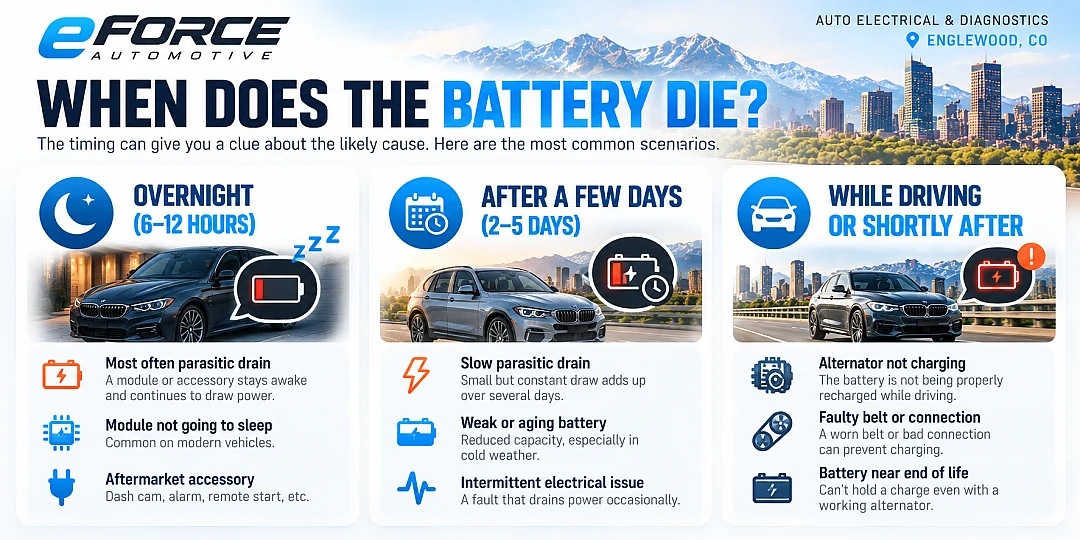
The timing of the failure is one of the best clues. It does not prove the cause, but it helps narrow the diagnostic path.
Dead after one night
If the battery is healthy and the vehicle is consistently dead after roughly 6 to 12 hours, an excessive parasitic draw becomes a strong possibility. A control module that stays awake, an aftermarket accessory, or a light that remains on can consume enough energy to prevent the engine from starting the next morning.
Dead after two to five days
A slower drain, an aging battery with reduced reserve capacity, or an intermittent electrical fault is more likely when the car can sit overnight but fails after several days. Vehicles that are driven only on short trips may also never fully recover the energy used during starting.
Battery warning while driving or the car dies shortly after
If the battery light comes on while driving, headlights dim, electrical systems begin shutting down, or the engine stalls after the vehicle has already started, the charging system deserves immediate attention. A failing alternator, belt, cable, or connection can leave the vehicle running only on the remaining battery charge.
How we diagnose a parasitic battery drain
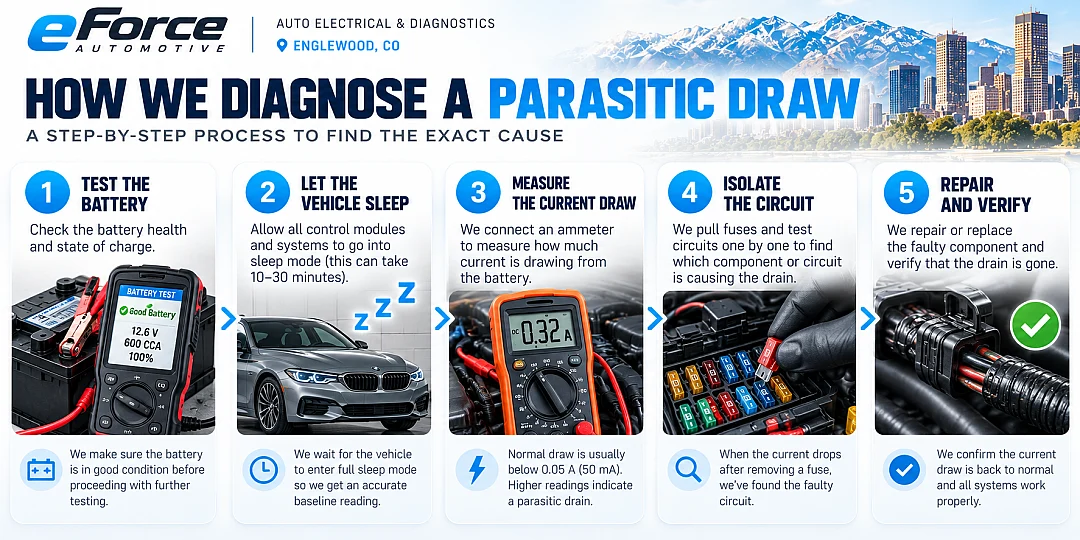
A real parasitic-draw diagnosis is more than pulling fuses at random. The vehicle has to be tested in a controlled sequence so normal module activity is not mistaken for a fault.
Step 1: Test the battery
We first check battery condition and state of charge. A weak battery can create symptoms that look like an electrical drain, so the battery needs to be known-good before the rest of the test is meaningful.
Step 2: Let the vehicle enter sleep mode
After shutdown, modern vehicles can take time to power down their networks and control modules. Doors, latches, keys, and scan equipment may need to be managed carefully so the technician does not accidentally keep the vehicle awake during testing.
Step 3: Measure key-off current draw
Once the vehicle is asleep, current leaving the battery is measured. The acceptable value depends on the vehicle and its equipment, so the result has to be interpreted in context rather than compared with one universal number.
Step 4: Isolate the circuit
If draw is excessive, the next step is to identify which circuit is responsible. That may involve fuse-drop testing, current measurements, wiring diagrams, scan data, and checking which module refuses to sleep. The goal is to narrow the problem to a specific circuit or component without disturbing the system enough to hide the fault.
Step 5: Repair and verify
After the failed component, module, relay, accessory, connection, or wiring issue is repaired, the current draw is measured again. The repair is not complete until the vehicle enters sleep mode normally and the excessive draw is gone.
Why replacing the battery may not fix the problem
A new battery can temporarily hide a parasitic draw because it has more reserve capacity than the old one. The car may seem fixed for a few days or weeks, then the same no-start returns. Repeated deep discharges can also damage the new battery, turning one electrical problem into two.
If you have already replaced the battery and it keeps going dead, the next step should usually be diagnosis rather than another battery.
Common clues you can check before scheduling service
- Does the car go dead overnight, or only after sitting for several days?
- Does it start normally after a jump and then run fine?
- Does the battery warning light appear while driving?
- Were any accessories recently installed, such as a dash cam, stereo, alarm, remote starter, or tracker?
- Do interior, trunk, or glovebox lights stay on unexpectedly?
- Did the problem begin after body work, water intrusion, rodent damage, or another electrical repair?
- Has the battery already been replaced without solving the issue?
These details can save diagnostic time because intermittent electrical faults are often tied to a specific condition.
Do not disconnect the battery every night as a permanent fix
Disconnecting a battery may prevent it from going dead, but it does not repair the fault and can create new inconveniences. Modern vehicles may lose learned settings, clock and radio data, window initialization, or other adaptations. Some vehicles also require battery registration or additional procedures after battery replacement.
If you need to disconnect the battery for an emergency, follow the vehicle manufacturer's instructions. For a recurring overnight drain, find the cause instead.
When to bring the car in for electrical diagnosis
Schedule professional diagnosis if the battery repeatedly dies, the problem returns after battery replacement, you see a battery or charging warning while driving, fuses keep blowing, or the vehicle has intermittent electrical symptoms that are difficult to reproduce.
eForce Automotive Service specializes in auto electrical repair and electrical diagnosis in Englewood for drivers throughout the Denver metro. We test the battery and charging system, trace parasitic drains, diagnose wiring and ground faults, and work with modern vehicle control modules instead of replacing parts based on guesses.
If warning lights or drivability symptoms are involved as well, see our car diagnostics and check-engine-light diagnosis service.
FAQ
Can a bad alternator drain a battery overnight?
Yes. A failing alternator can create two different problems: it may not recharge the battery properly while driving, or a failed diode can sometimes allow current to flow when the vehicle is off. Testing the charging system helps distinguish these from other types of parasitic draw.
How do I know if I have a parasitic drain?
A common clue is a battery that tests healthy and charges normally but repeatedly loses charge while the vehicle is parked. Confirmation requires measuring key-off current after the vehicle has entered sleep mode and then isolating the circuit responsible for excessive draw.
Why does my new battery keep dying?
If a recently installed battery repeatedly goes dead, there may be an unresolved charging problem or parasitic electrical draw. A new battery does not prevent a module, light, relay, accessory, or damaged circuit from continuing to consume power.
How long does parasitic-draw diagnosis take?
It depends on the vehicle and whether the fault is constant or intermittent. Modern vehicles may need time to enter sleep mode, and an intermittent drain may require repeated testing. The goal is to identify the actual circuit and cause before replacing parts.
Can cold Colorado weather cause a battery to die?
Cold weather reduces the available output of a battery while the engine needs more power to crank. Cold temperatures often expose a battery that is already weak or a vehicle that already has a small electrical drain, rather than creating the electrical fault by themselves.