
Dashboard Warning Lights: What Red, Amber and Traction Control Lights Mean
A dashboard full of symbols is easy to ignore until one of them lights up. Then the questions come fast: Is this serious? Can I keep driving? Why did the traction control light come on when nothing feels wrong? The answers depend on two things: the color of the light and how it behaves, steady or flashing.
This guide explains the dashboard lights meaning behind the most common car warning lights: what red and amber lights usually mean, what the traction control light is telling you, why several lights can come on at once, and why a quick car scan is not the same as finding the cause. It is general information, not a diagnosis of your vehicle.
Quick answers
- Red light: stop driving as soon as it is safe. Do not try to finish the trip.
- Amber (yellow) light: a fault has been detected or a system needs attention. Plan a diagnostic soon.
- Flashing light: more urgent than the same light when steady.
- Traction control or ESC light on, car drives normally: the stability system may be switched off or may have a fault. Drive carefully and get it checked.
- Traction control light flashing on a wet, icy or snowy road: usually the system doing its job. Slow down.
- Several car warning lights at once: often a voltage, ground or communication problem rather than several separate failures.
- Appointments: we work by appointment only.
Dashboard lights meaning: how to read the colors
Most vehicles use the same color logic as a traffic light, and the color is the first thing to read. The exact symbols vary by make and model, so your owner's manual is the final word on what each icon means in your car.
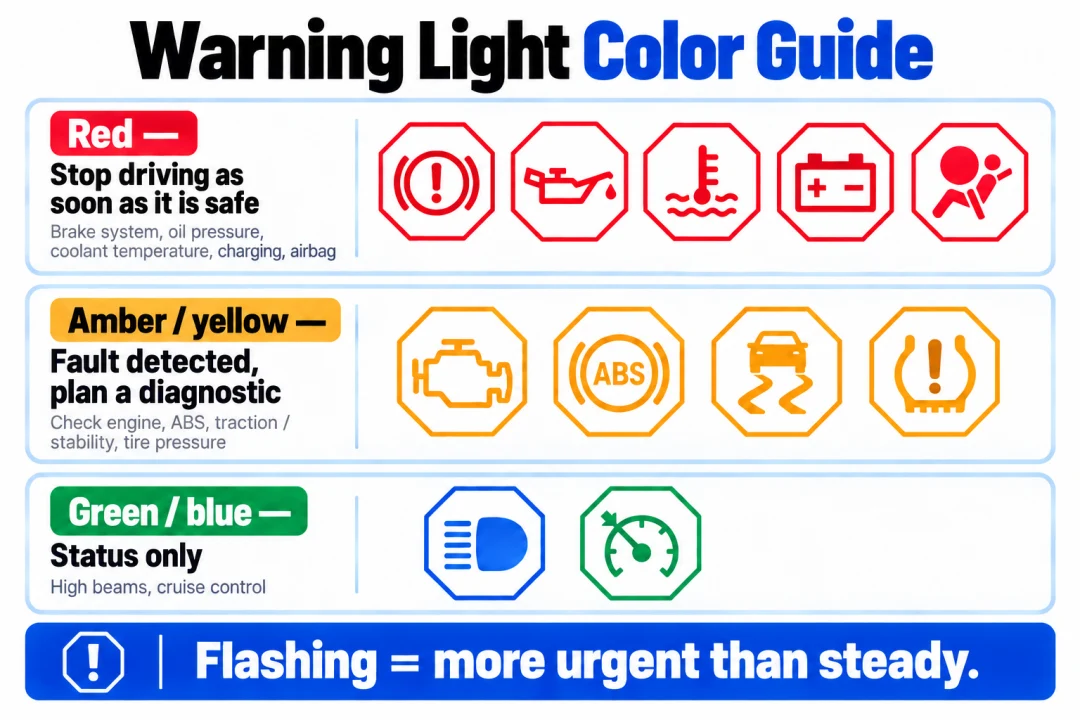
Red lights: stop driving as soon as it is safe
A red warning light means the vehicle has detected something that can cause damage or a safety risk if you keep going. Common red lights include:
- Brake system. It may mean a problem in the brake system. On some cars it also appears when the parking brake is still applied.
- Oil pressure. The engine may not be getting the lubrication it needs.
- Coolant temperature. The engine is overheating or the cooling system has a problem.
- Charging system or battery. The battery is not being charged properly, and the car may stop running when the battery runs down. See our guide to what the battery light means.
- Airbag or SRS. The restraint system has a fault and may not work as designed in a crash. On many vehicles this light is red; on others it is amber. See our airbag and SRS light repair page.
If a red light comes on while you are driving, turn on your hazard lights if needed, pull over somewhere safe and stop. Please do not keep driving to find out what it is. Arrange a safe way to get the vehicle checked; for charging, battery or airbag lights, that can be us.
Amber and yellow lights: a fault is stored, plan a diagnostic
Amber lights are the "get this checked" category. Typical examples:
- Check engine light. The engine computer has stored a fault. We cover this one in detail in our guide to what the check engine light means and what to do.
- ABS light. The anti-lock brake system has detected a problem.
- Traction control or stability control (ESC) light. Covered in the next section.
- Tire pressure light. One or more tires may be low, or the tire pressure sensing system has a fault.
An amber light does not usually mean "stop right now," but it also does not mean "ignore it." A flashing amber light is more urgent than a steady one. The longer a stored fault stays unchecked, the more likely it is to be joined by others.
Green and blue lights: status only
Green and blue lights normally tell you that something is switched on, such as high beams, cruise control or turn signals. They are not warnings. If one stays on when it should not, mention it when you book.
Dashboard symbols: how to recognize the common ones
Dashboard symbols follow similar conventions from one manufacturer to another, but the drawings are not identical. Reading a symbol is easier if you combine three clues: the color, the shape and what the car is doing. Some of the most common dashboard symbols look like this:
- An engine outline: the check engine light.
- An oil can: the oil pressure warning.
- A thermometer sitting in wavy lines: coolant temperature.
- A battery shape: the charging system or battery warning.
- A circle with an exclamation mark, often with brackets around it: the brake system warning on many vehicles.
- A car with curved or wavy lines behind it: traction control or stability control.
If a symbol is not familiar, look up its page in your owner's manual before you decide what to do. If you cannot find it, treat an unknown red symbol as a reason to stop driving as soon as it is safe, and an unknown amber symbol as a reason to schedule a diagnostic.
Traction control light: what it means
The traction control system compares the speed of each wheel. If one wheel spins faster than the others, as it can on ice, snow, wet pavement or loose gravel, the system can reduce engine power or apply a brake to that wheel to regain grip. On most modern vehicles it works together with the stability control system and the ABS, and they share the same wheel-speed sensors and the same control module.
Steady light vs flashing light
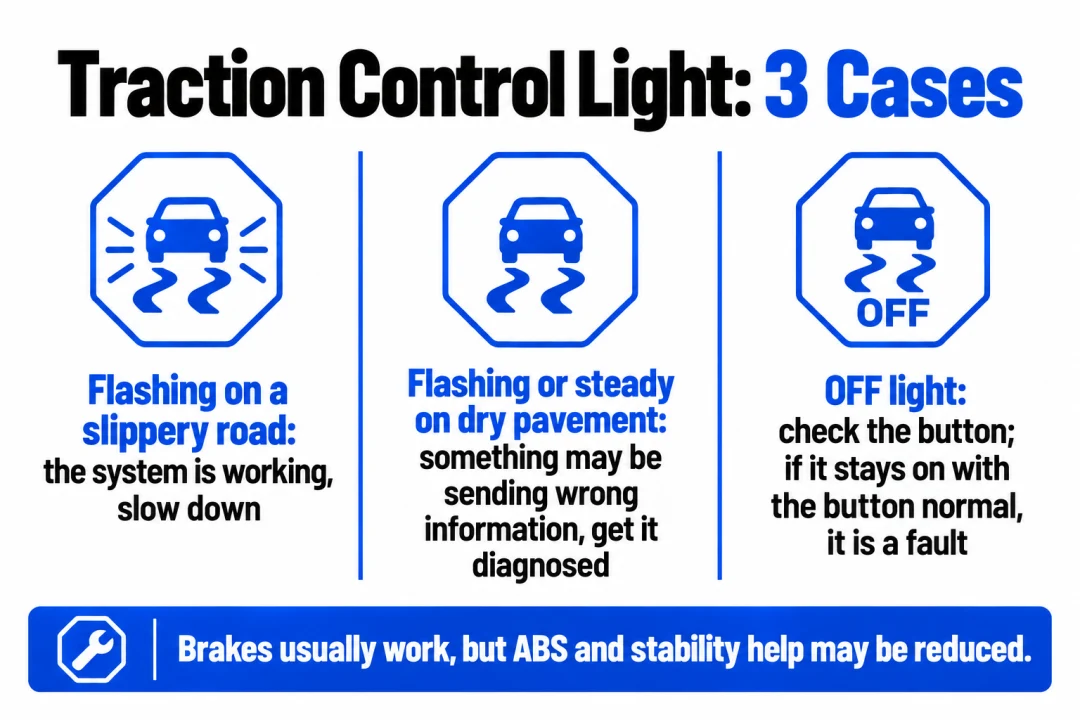
- Flashing while you drive on a slippery surface: the system is actively working. This is normal. Ease off the throttle and increase your following distance.
- Flashing or steady on dry pavement with no wheel slip: this deserves attention. Something may be feeding the system wrong information.
- Steady light that stays on after you start the car: the system has detected a fault, or it has been switched off. If you have not pressed the button, treat it as a fault.
ESC light and traction control light: are they the same?
On many vehicles the same symbol, a car with wavy lines, covers both systems, and the car simply shows it as the traction control light or the ESC light. ESC stands for electronic stability control. Depending on the manufacturer it may also be called ESP, VSC or DSC. Traction control helps the wheels grip when you accelerate. The ESC system goes a step further and helps keep the car pointed where you steer, for example in a slide.
The rule is the same as for traction control: flashing on a slippery road means the system is working, and a light that stays on without slip means a fault or that the system was switched off.
Traction control "OFF" light vs a fault light
Many vehicles have a button that turns traction control off, and the dashboard then shows an "OFF" light or a symbol with the word OFF. If you or a passenger bumped the button, press it again and see whether the light clears. If the light stays on even though the button is in its normal position, the system has stored a fault that needs to be diagnosed.
Why it often comes on together with the ABS light
The two systems share wheel-speed sensors, wiring and the ABS control module, so one fault can turn on both lights. Typical sources include:
- a wheel-speed sensor that is damaged, dirty or sending a weak signal;
- damaged wiring or a corroded connector near a wheel;
- a problem inside the ABS module, which may need replacement and ABS module programming;
- low or unstable voltage.
Which one it is cannot be told from the dashboard. It takes testing.
Can I keep driving with the traction control light on?
In most cases the normal brakes still work, but anti-lock braking and stability assistance may be reduced or switched off. That matters most on snow, ice, wet roads and in emergency stops. Until the car has been checked:
- drive more cautiously and leave extra distance;
- avoid highway speeds and winter driving if you can;
- stop driving and arrange a safe way to bring the vehicle in if the brake pedal feels different, the brake warning light is red, or other warning lights come on with it.
Why several car warning lights come on at once
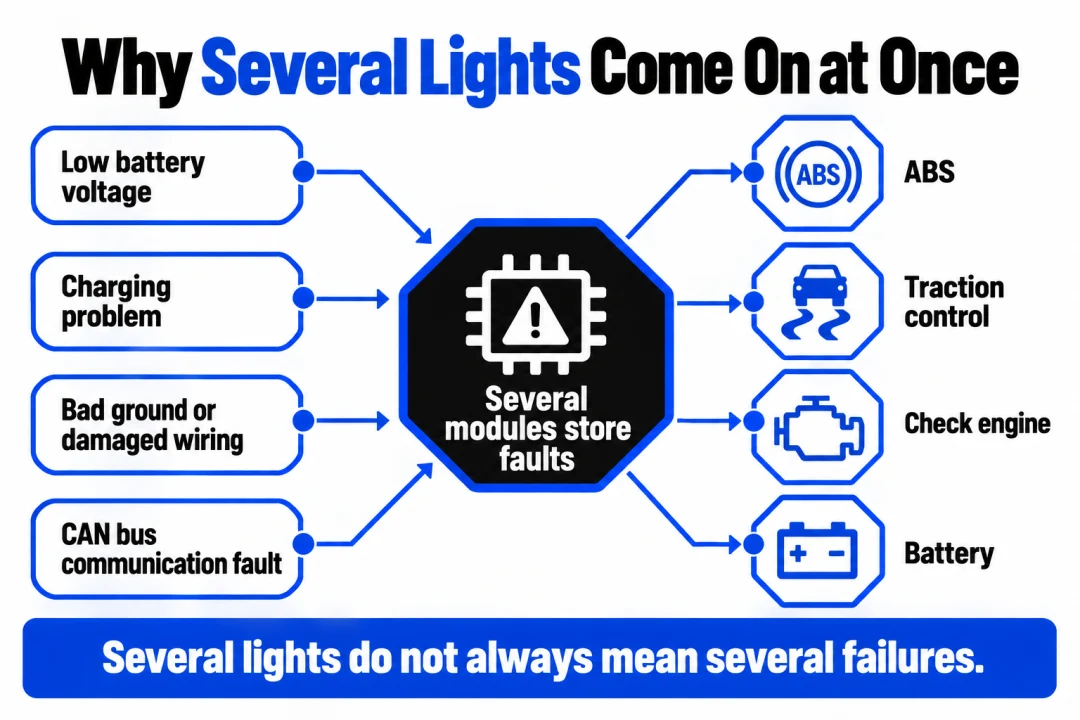
When the ABS, traction control, check engine and battery lights all appear together, it is tempting to assume that several systems failed at once. That is rarely the case. Modern vehicles are built around control modules that depend on stable power, clean grounds and constant communication with each other. When that foundation slips, several modules can set faults at once:
- Low battery voltage. A weak or discharged battery can make modules misbehave and store faults that have nothing to do with the systems they name. If something keeps draining it, see how a battery drain is found.
- A charging problem. If the alternator is not keeping up, system voltage drops while you drive and warning lights can appear in groups.
- A bad ground or damaged wiring. A poor ground connection can disturb many circuits at once.
- Communication faults. Modules talk to each other over a network called the CAN bus. When that communication is interrupted, lights can come on across the dashboard.
If your battery keeps going flat, our article on why a car battery keeps dying overnight explains the common causes.
Why a code read is not a diagnosis
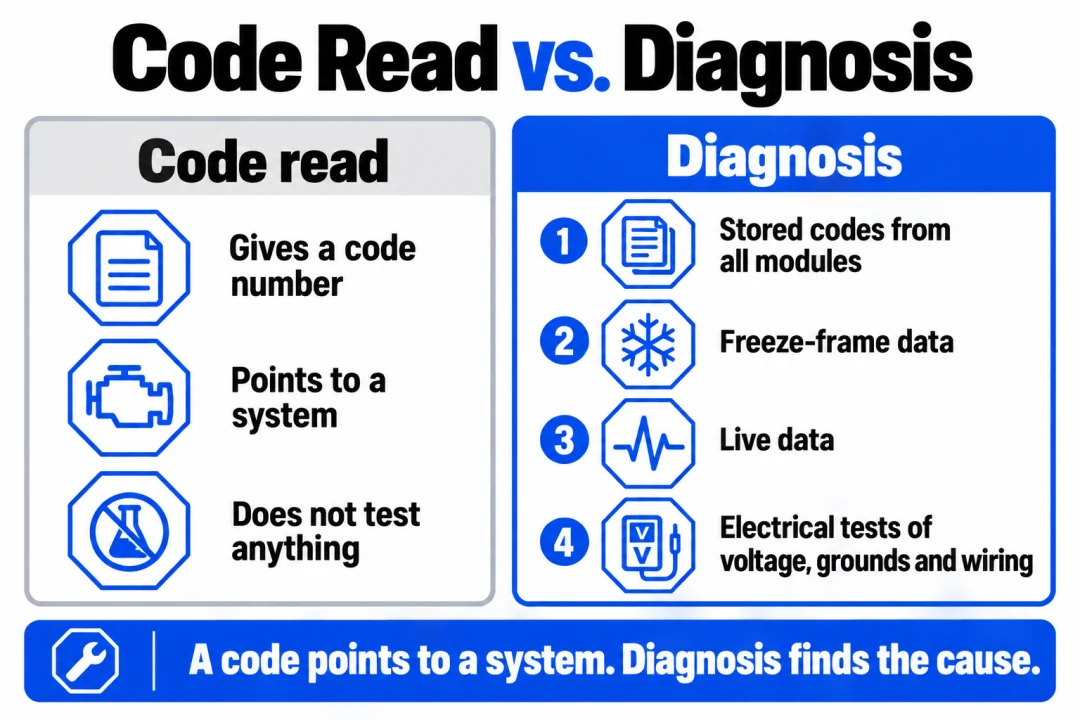
Many parts stores and apps will do a quick car scan for free. It is a handy way to see a code number, but the code only tells you which system noticed a problem. It does not tell you why. A wheel-speed code, for example, can come from the sensor itself, from the wiring that carries its signal, from the ABS module, or from low voltage. Replacing the part named in a code is how people spend money and still see the light come back.
A proper diagnosis follows the evidence:
- Stored codes from all modules, not only the engine computer.
- Freeze-frame data, which records the conditions when the fault was stored.
- Live data, to see what the sensors and modules are reporting right now.
- Electrical tests of voltage, grounds and wiring.
If the first diagnostic shows that a specific system or control module needs more in-depth testing, we discuss it with you before we go further. Complex electrical faults can require significant diagnostic time, and you decide whether to continue.
What we check at our Englewood shop
Our shop in Englewood, Colorado, focuses on automotive electrical systems and diagnostics. When a warning light brings a car to us, the work typically includes:
- Wheel-speed sensor signals and wiring, when ABS or traction control lights are on.
- Battery and charging voltage, grounds and power supplies, including voltage drops across connections.
- Module communication and wiring, including CAN bus faults, damaged wiring, open circuits and short circuits.
The result is an explanation of which system is at fault and what your options are. Learn more about our car diagnostics in Englewood, or see how we trace wiring, voltage and communication faults on the auto electrical repair page.
What to tell us when you book
We work by appointment only. A few details help the technician prepare before your car arrives:
- which lights are on and their colors;
- whether each light is steady or flashing;
- when they appear: at startup, in the rain, on cold mornings, at highway speed or after a bump;
- any recent battery, tire or brake work, or other repairs;
- the year, make, model and VIN of the vehicle (we work with all makes).
Dashboard warning lights FAQ
What do red and amber dashboard warning lights mean?
Red lights signal a problem that can cause damage or a safety risk, such as the brake system, oil pressure, coolant temperature, charging system or airbag. Stop driving as soon as it is safe. Amber or yellow lights mean a fault has been detected or a system needs attention, such as the check engine, ABS, traction control or tire pressure light. Plan a diagnostic soon, and treat a flashing light as more urgent than a steady one.
Is it safe to drive with the traction control light on?
Usually the normal brakes still work, but traction control, stability control and anti-lock braking may be reduced or switched off. Drive cautiously, leave extra distance and avoid highway and winter driving until the car has been checked. If the brake pedal feels different or a red warning light is also on, stop driving and arrange a safe way to bring the vehicle in.
Why is my traction control light flashing?
If it flashes while you are driving on ice, snow or wet pavement, the system is working to keep the wheels from slipping, and that is normal. If it flashes on dry pavement with no wheel slip, something may be sending the system wrong information, and it should be diagnosed.
Why are the ABS and traction control lights on together?
The two systems share wheel-speed sensors, wiring and the ABS control module, so one fault can turn on both lights. Common causes include a faulty wheel-speed sensor, damaged wiring or connectors, a problem in the ABS module or low voltage. Testing is needed to tell which one it is.
Can a weak battery or charging problem turn on several warning lights?
Yes. Control modules rely on stable voltage, clean grounds and communication with each other. A weak battery, a charging problem, a bad ground or a communication fault can make several modules store faults at once, even though the systems themselves may be fine.
Will resetting or clearing the light fix the problem?
No. Clearing a code only turns the light off and erases useful stored data. If the fault is still there, the light usually comes back. Have the vehicle diagnosed before clearing anything.
Can you diagnose any make?
Yes, we work with all makes. Please send the year, make, model and VIN when you book so the technician can prepare.
Do I need an appointment?
Yes. We work by appointment only. Contact us to schedule a time, and tell us which lights are on and when they appear.
Next steps
Warning lights are easiest to understand when you know what the car is actually reporting. If a light is red, stop driving as soon as it is safe. If it is amber, plan a diagnostic. Our team in Englewood works by appointment only and serves the Denver area, including Sheridan, Littleton, Centennial, Greenwood Village, Cherry Hills Village, south Denver and Aurora.
See how our car diagnostics work, learn about auto electrical repair, or browse all our services.
eForce Automotive Service · 1713 W Baltic Pl, Englewood, CO 80110
Hours: Mon–Fri 9 AM–6 PM, Sat 10 AM–4 PM, Sun closed · By appointment only
This article is general information, not a diagnosis of your vehicle.