
Battery Light On: What It Means and What to Do Next
A car battery light on the dash is one of the easiest warnings to misread. The symbol looks like a battery, so most drivers assume the battery is the problem. Often it is not. The battery light is a warning about the charging system: the parts that keep the battery charged and supply power to the car while the engine runs.
This guide explains what the battery light monitors, what it means when it comes on while driving, at startup or flickers, the common causes and how the fault is found. It is general information, not a diagnosis of your vehicle. Our shop is in Englewood, Colorado, and we handle auto electrical diagnosis by appointment.
Quick answers
- What it means: the car has detected a problem with charging voltage. The battery may not be getting charged.
- Can you keep driving? The car usually runs on battery power for a while, then electrical systems weaken and the engine can stall. Plan to stop driving it until it is checked.
- Is it the battery? Sometimes. It can also be a connection, a ground, wiring or the charging output.
- What we do: test the battery and charging system, then the power and ground circuits, to find the actual cause.
What the battery light actually monitors
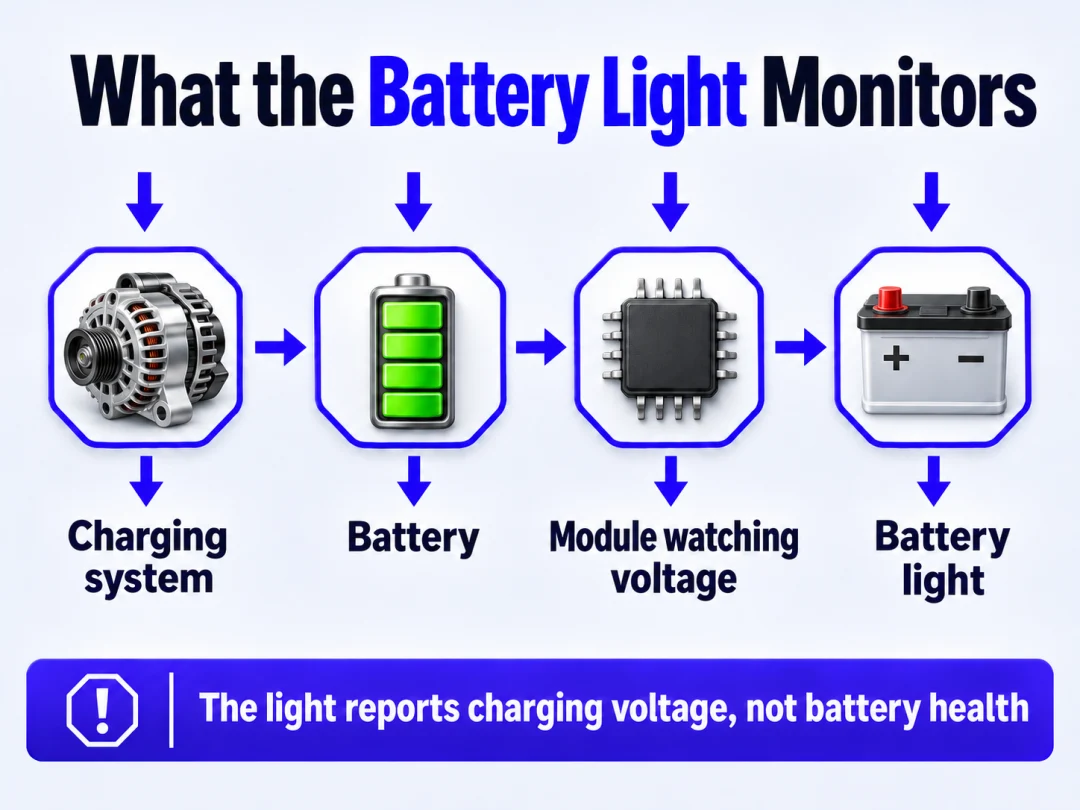
With the engine running, the car's electrical system is supposed to run on power from the charging system, and the battery is recharged at the same time. The battery mainly starts the engine and backs things up when demand is high.
The battery light comes on when the car decides that charging voltage is out of the expected range, usually too low, on some vehicles also too high. Depending on the car, that decision is made by the charging system itself or by an engine or body computer that watches system voltage. Either way, the light is reporting a voltage problem, not reading the battery's health.
That is why the light normally comes on briefly with the ignition on, before the engine starts, and goes out once the engine is running. Your owner's manual shows the exact symbol and behavior for your car.
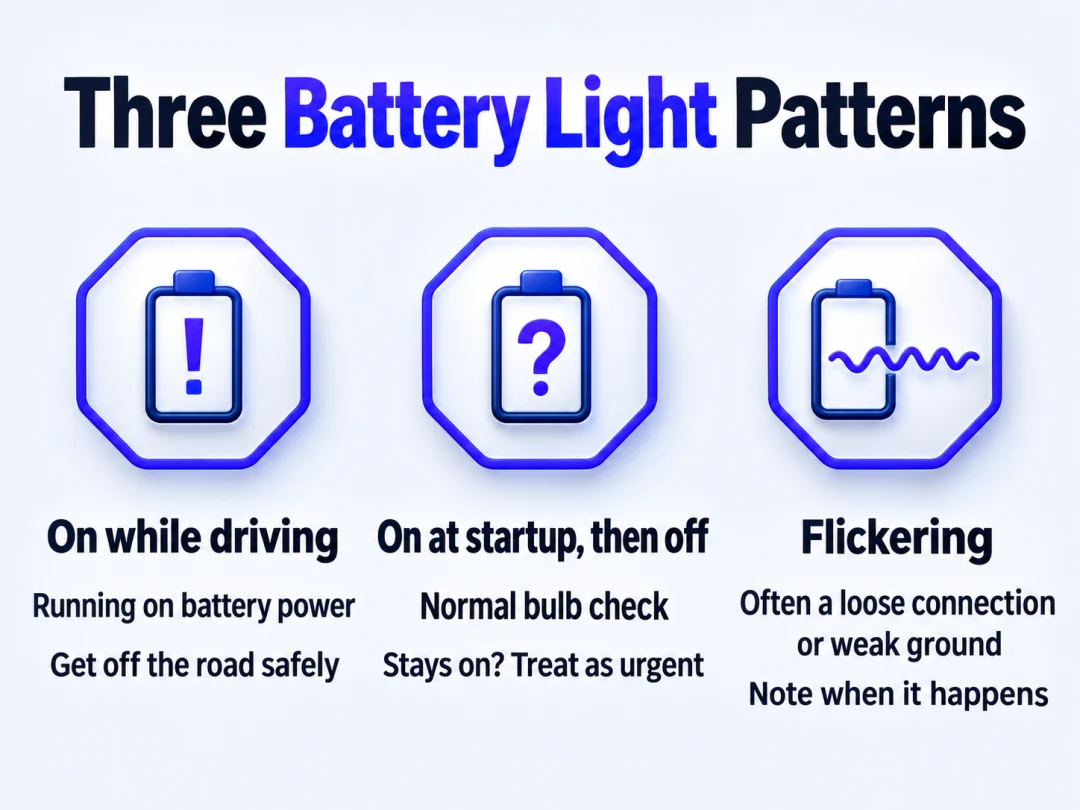
Battery light on while driving vs at startup vs flickering
On while driving
A light that comes on and stays on while you drive is the most urgent version. The car is probably running on stored battery power. As the battery runs down, you may see dim lights, gauges that act up and other warnings, and eventually the engine can stall. Turn off accessories you do not need, and get the car off the road somewhere safe rather than hoping it lasts.
On at startup, then off
A light that comes on with the ignition and goes out after the engine starts is the normal bulb check. If it stays on after the engine is running, treat it the same as a light that comes on while driving.
Flickering on and off
A flickering battery light, especially with dashboard lights flickering or headlights that pulse with engine speed, often points to an intermittent connection: a loose terminal, a corroded connector or a weak ground. It can also be an early sign of a charging output problem. Intermittent faults can be hard to find later, so note when it happens (cold start, bumps, using the A/C, at idle).
Common causes
The light only says "voltage is wrong". These are the usual reasons; tests show which one applies to your car:
- A weak or failing battery that cannot hold or accept a charge properly.
- Loose or corroded battery connections at the terminals or cable ends.
- Bad grounds: the return path for current between the engine, body and battery.
- Damaged wiring in the charging circuit, including connectors and fusible links.
- Charging output problems, including the alternator or its drive belt.
We list the alternator as a possible cause because it is one. Our job is to find out whether it is the cause before anything is replaced.
Other signs that come with it
A charging problem often shows up in more than one place:
- dim headlights or interior lights, or lights that brighten when you rev the engine;
- dashboard lights flickering;
- several warning lights at once, because control modules react to low voltage; see our guide to dashboard warning lights;
- communication codes such as U0100, because modules can drop off the network when voltage is low; see our guide to U0100 lost communication codes;
- slow power windows, a weak blower or a radio that resets;
- slow cranking the next time you start the car.
Low voltage in a car can make unrelated systems look faulty, which is one reason a full scan helps before anything is replaced.
Why replacing the battery does not always fix it
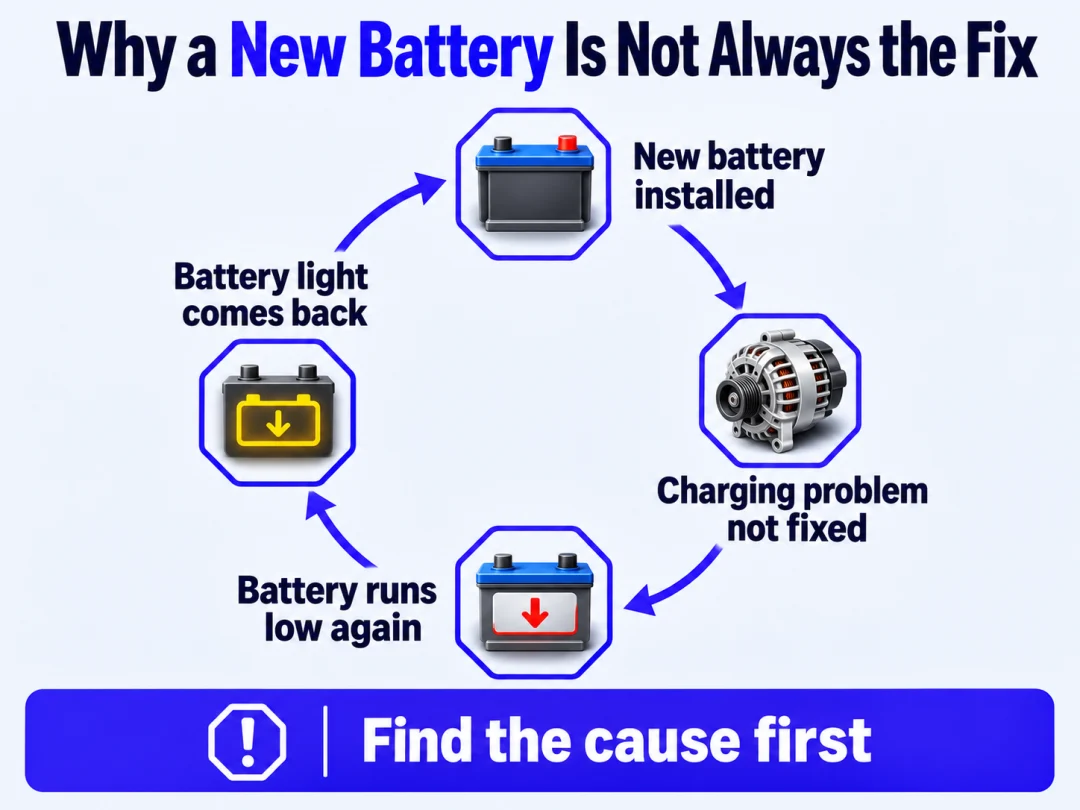
A new battery is a common first move, and sometimes it is the right one. But if the battery went flat because the charging system was not charging it, a new battery only buys time. It starts the car, the light comes back, and soon the new battery is low too.
The same is true for a battery that was damaged by repeated deep discharges caused by a bad connection or ground. Replace the battery without fixing the connection and the problem returns. A battery that dies while the car is parked overnight is a different symptom; our guides on why a car battery keeps dying overnight and the parasitic draw test cover that one.
On some vehicles, a new battery also has to be registered with the car so it charges correctly, and some learned values may need a relearn after the battery is disconnected. Our guide to relearn and calibration after a battery replacement explains when that applies.
How we diagnose a battery light
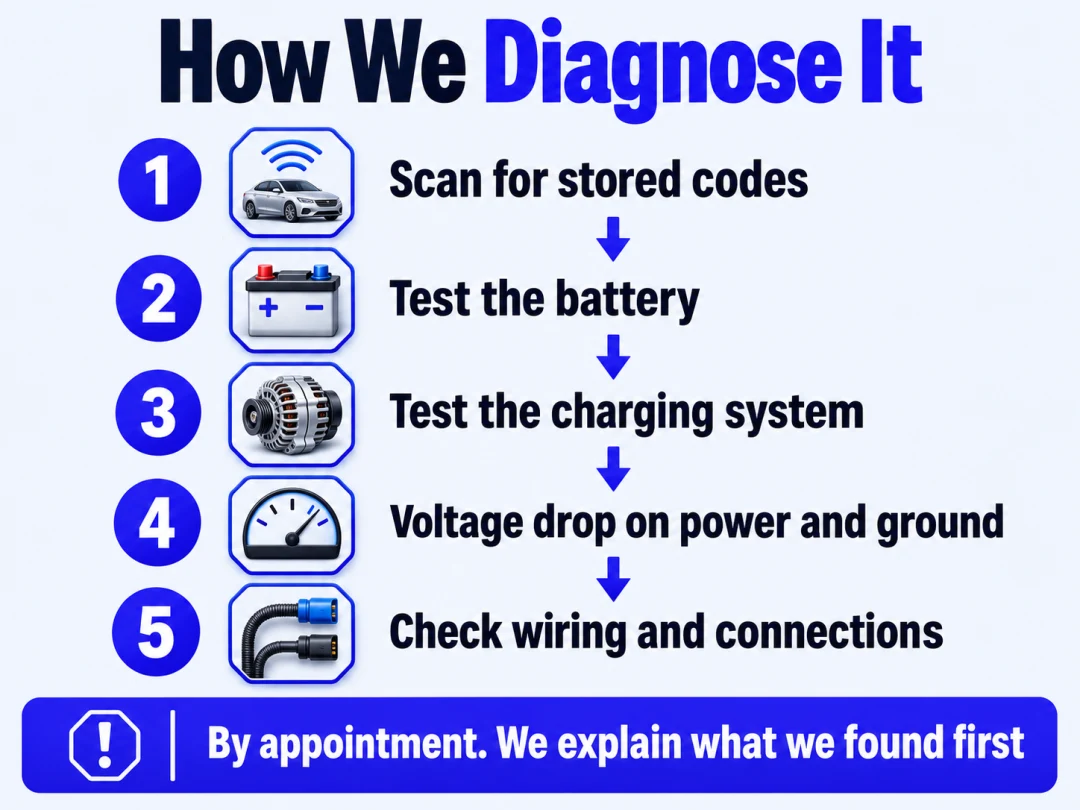
At our Englewood shop the diagnosis follows the circuit, not a guess:
- Scan the vehicle for stored codes in the engine and other modules, since many cars log charging and voltage codes. See our car diagnostics page.
- Test the battery to see whether it can hold and deliver a charge.
- Test the charging system with the engine running, at idle and under electrical load.
- Run voltage drop tests on the power and ground circuits. A connection can look fine and still lose voltage under load; a voltage drop test finds that resistance.
- Check wiring and connections in the charging circuit, including connectors and grounds.
You get an explanation of what was found and what it means before any further work. Complex electrical faults can take longer to trace, and the technician will discuss that with you first.
When to bring the car in
Bring it in soon if the battery light stays on with the engine running, flickers, or comes with dim lights or other warning lights. If the car no longer starts at all, our guide on why a car won't start explains what to check.
Book an appointment at our Englewood shop. We work in-shop only, by appointment. Have the year, make, model and a short description of when the light comes on ready.
Battery light FAQ
Can I drive with the battery light on?
The car may keep running for a while on battery power, but the battery is likely not being charged. As voltage drops, lights and electronics weaken and the engine can stall. Stop driving it as soon as you safely can and have it checked.
Does the battery light mean I need a new battery?
Not necessarily. The light warns about charging voltage. A weak battery is one possible cause, but so are loose or corroded connections, bad grounds, wiring and charging output. Testing shows which one it is.
Why did the battery light come on after a new battery?
The battery may not have been the cause. A charging problem, a loose or corroded connection or a bad ground will keep the light on with a new battery. A poor connection made during the installation can also do it.
Why does the battery light flicker on and off?
A flickering light often points to an intermittent connection, such as a loose terminal, a corroded connector or a weak ground, or to charging output that is dropping in and out. Note when it happens; that helps the diagnosis.
Can a bad ground turn on the battery light?
Yes. A ground with high resistance can make charging voltage look low to the car, even when the battery and the charging parts are fine. A voltage drop test on the ground circuit shows it. See our guide to bad ground symptoms and the voltage drop test.
Next steps
Battery light on? Book an appointment at our Englewood shop for an electrical diagnosis. Our auto electrical repair page explains what else we diagnose.
This article is general information, not a diagnosis of your vehicle. Your owner's manual describes the warning lights on your car. If the battery light comes on while driving, get off the road somewhere safe; the engine can stall when the battery runs down.