
Check Engine Light On: What It Means and What to Do
The check engine light is one of the most common and most ignored warnings in any car. Some drivers panic at the first glow; others put tape over it and keep driving. Neither helps. The light is a message from your vehicle's computer: it has found something outside normal limits and stored a record of it. What matters is how the light behaves, what else the car is doing, and how quickly you get the cause properly diagnosed.
This guide explains the difference between a steady and a flashing check engine light, when it is reasonable to keep driving, why a free code read at a parts store is not the same as a diagnosis, and when to schedule a visit to our shop in Englewood, Colorado.
Quick answers
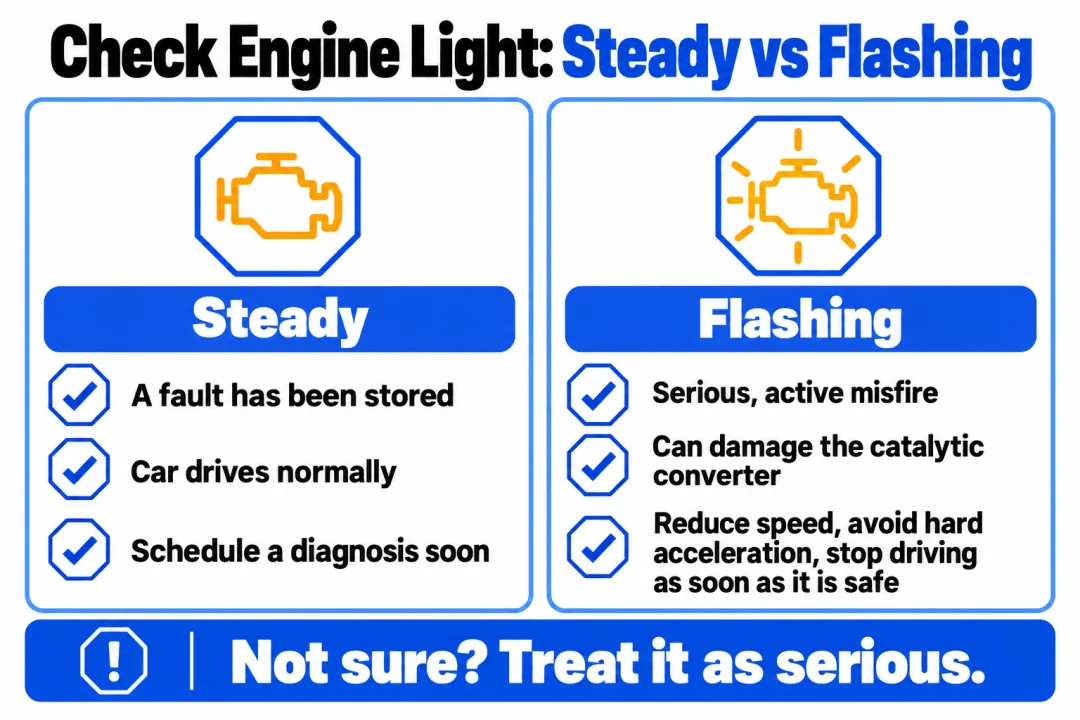
- Steady light, car drives normally: a fault has been stored. No need to panic, but do not ignore it. Plan to have it diagnosed soon.
- Check engine light flashing: treat it as urgent. Reduce speed, avoid hard acceleration and stop driving as soon as it is safe.
- Light plus overheating, smoke, a burning smell, a severe loss of power or a red warning light: pull over safely and stop driving.
- Parts-store code read: it gives you a code, which points to a system, not to the cause. It does not test anything.
- A real diagnosis: combines the stored codes, freeze-frame data, live data, system tests and electrical checks to confirm what actually failed.
- Appointments: we work by appointment only, so contact us to schedule your diagnostic.
What the check engine light actually means
Every modern vehicle monitors its engine, emissions, transmission and many related systems through an onboard diagnostic system (OBD-II). Sensors constantly report to the engine computer. When a reading falls outside its expected range, or when two readings do not make sense together, the computer stores a diagnostic trouble code, often called a DTC, and turns on the check engine light.
Two points are worth understanding right away:
- The light means "a fault was detected," not "the engine is about to fail." Many faults are minor. Others are early warnings of something that gets more expensive the longer it runs.
- The light does not say what is wrong. The code behind it describes where the computer noticed a problem, which is not always where the problem started.
Steady check engine light
A steady light means the computer has stored a fault, and the fault is not currently severe enough to be an emergency. The vehicle often runs and drives normally, which is exactly why it is so easy to put off. If the car feels the same as always, you generally have time to schedule a diagnosis, but "soon" is better than "someday." Small faults can turn into bigger ones, and a stored code can also hide other problems that appear later.
Check engine light flashing: what it means
A flashing check engine light is a different signal. It usually means the engine is misfiring badly enough that unburned fuel may be reaching the exhaust, which can overheat and damage the catalytic converter. Drivers often, though not always, notice shaking, hesitation or a loss of power at the same time.
If the light is flashing, reduce speed, avoid hard acceleration and stop driving as soon as you can do so safely. A flashing light is not something to drive across town with, and it is not a reason to wait for the weekend.
Can I keep driving with the check engine light on?
The honest answer depends on what the light is doing and what the car is doing.
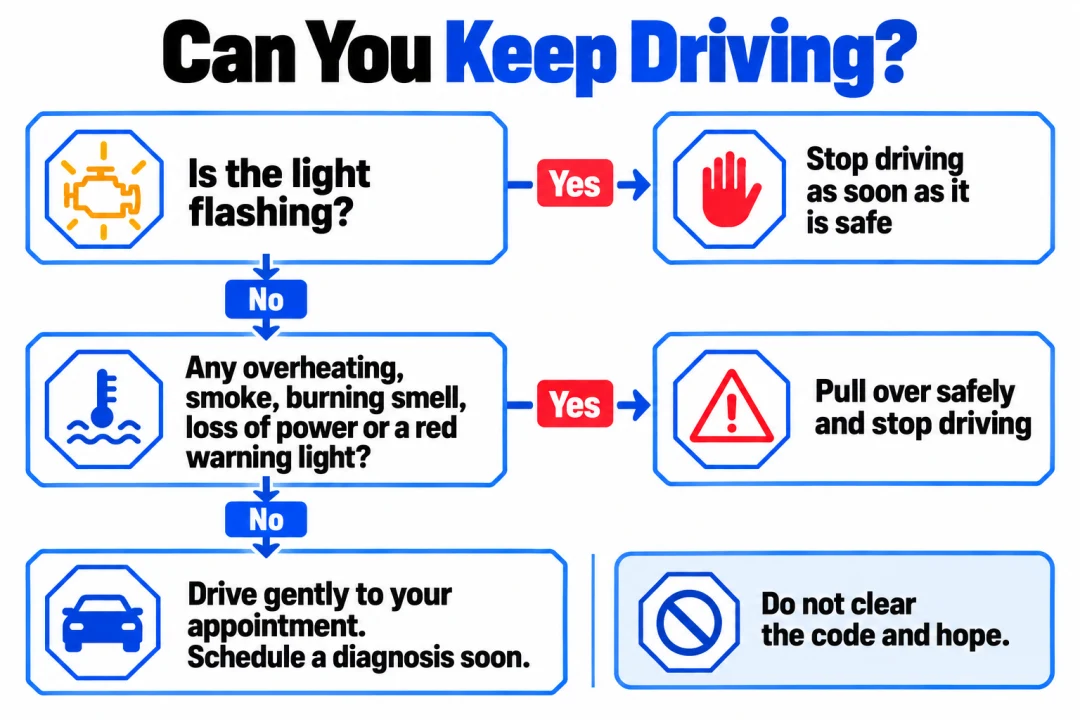
Generally reasonable to drive to your appointment:
- The light is steady, and
- the car starts, idles and accelerates normally, and
- there is no overheating, smoke, unusual smell or new noise.
Drive gently, avoid heavy loads and long trips, and get it scheduled.
Stop driving as soon as it is safe:
- The light is flashing, or
- the car shakes, stumbles, hesitates or loses power, or
- the temperature gauge climbs or you see steam or smoke, or
- you smell burning, fuel or something sweet and syrupy, or
- another warning light, especially a red one, comes on at the same time.
If you are in doubt, treat the problem as serious. Arrange a safe way to get the vehicle to a shop rather than risking more damage to the engine or the exhaust system.
What to do right now
- Note exactly when the light came on. Was it after fueling, after a cold start, on the highway or after hitting a pothole? This is useful information for the technician.
- Check the gas cap. If you recently refueled, make sure the cap is tight. A loose cap is a well-known cause of some emissions-related codes, though it is far from the only cause.
- Pay attention to how the car behaves. Rough idle, poor acceleration, hard starting, stalling, unusual smells or changes in fuel economy all help narrow things down.
- Do not clear the code and hope. Clearing the code erases useful stored data, and if the fault is real, the light usually comes back.
- Schedule a diagnosis. The sooner the cause is found, the more options you generally have.
Why a parts-store code read does not tell you the cause
Many auto parts stores will read your codes for free. It is a convenient first step and a good way to learn the code number. But it is not a diagnosis, and treating it like one is how people end up replacing parts that were never broken.
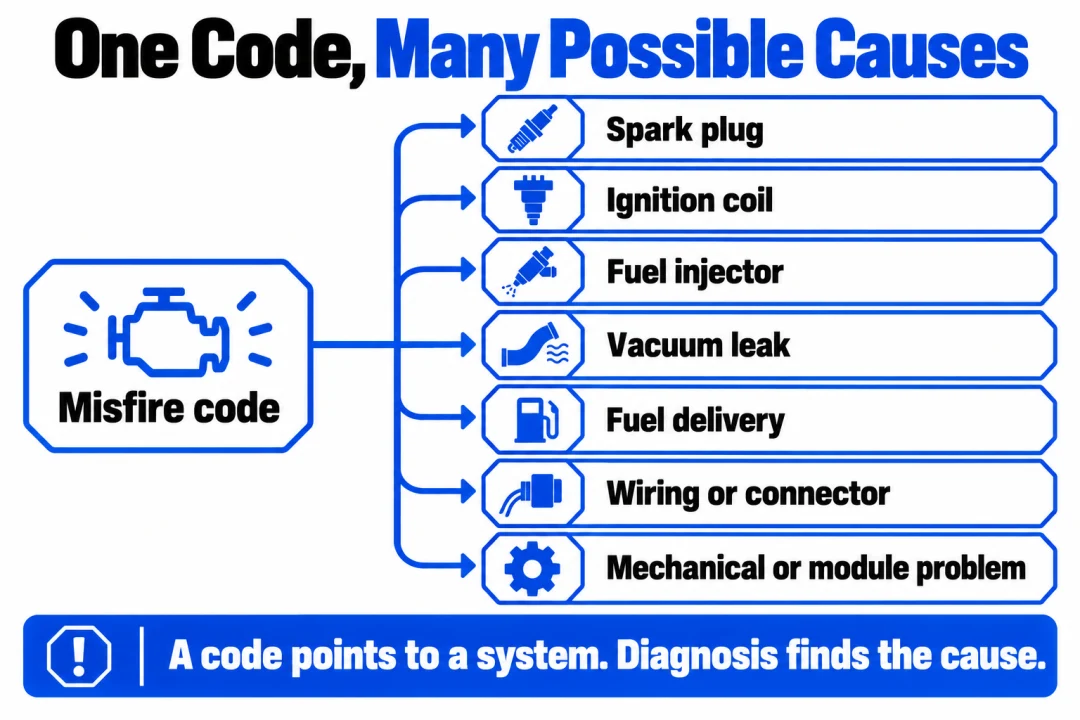
A code points to a system, not to the cause
A handheld reader gives you a code number and a generic description. It does not test the vehicle. Take a very common example: a code that indicates a misfire. That code tells you that one or more cylinders is not burning fuel properly. It does not tell you why. The cause might be a worn spark plug, a failing ignition coil, a leaking or clogged fuel injector, a vacuum leak, a fuel delivery issue, a wiring or connector fault, a mechanical problem or even a control module issue. Each of these needs a different repair.
The same applies to codes about oxygen sensors, fuel trim and catalytic converter efficiency. A sensor that reports a problem may be perfectly fine and simply doing its job. Swapping the part named in a code description often means paying for a part that was never the problem. For a common example, see our guide to the P0420 catalyst efficiency code.
What a proper diagnostic includes
A real diagnosis reads the codes from every module, looks at the freeze-frame data stored when the fault happened, checks live data and runs the system and electrical tests the vehicle supports. If the first diagnostic shows that a specific system needs more in-depth testing, we discuss it with you before proceeding. You can read more on our car diagnostics page.
Why electrical problems often hide behind a check engine light
The check engine light is often thought of as an engine problem. In practice, a surprising number of check engine lights trace back to the electrical side of the vehicle:
- Low system voltage. A weak battery or a charging problem can cause sensors and modules to misbehave and store codes that have nothing to do with the parts they name. If your battery keeps going flat, see our guide on why a car battery keeps dying overnight, and read how a battery drain is found.
- Poor grounds, corroded connectors and damaged wiring. A good sensor signal that passes through a damaged connector or chewed wire can look like a failed sensor, and these faults often create codes that come and go.
- Module communication problems. Modern vehicles rely on communication networks between control modules. When modules cannot talk to each other reliably, multiple warning lights can appear at once. If a module itself has failed, it may need module programming and coding.
These problems are hard to solve with a code reader alone. They need circuit testing and electrical knowledge, which is a core part of our work. See our auto electrical repair page for the kinds of faults we diagnose, including parasitic battery drains, CAN bus communication faults, open and short circuits, voltage drops, and power and ground issues.
When to schedule a diagnostic
Make an appointment soon if:
- the check engine light is on, even if the car seems fine;
- the light comes and goes, which usually means an intermittent fault rather than a fixed problem;
- you notice rough idle, hesitation, stalling, hard starting (see a car that will not start) or poor fuel economy;
- the light came on along with other dashboard warning lights, such as ABS, traction control, battery or airbag;
- you have already read the code at a parts store and want to find the actual cause before buying parts.
Act right away, and do not drive the vehicle, if the light is flashing or the car is overheating, smoking or losing power. If the dash shows reduced engine power or limp mode, see our reduced engine power / limp mode guide.
How to prepare for your visit
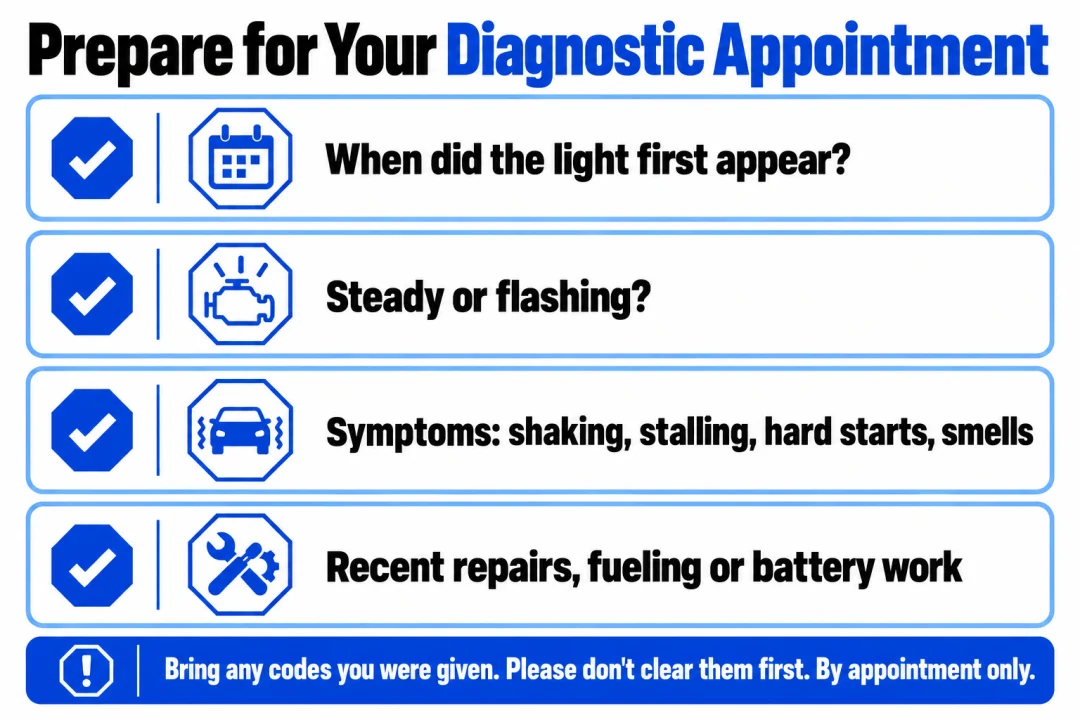
We work by appointment only, so contact us to schedule a time. To help the technician, be ready to share:
- when the light first appeared and whether it is steady or flashing;
- any symptoms you have noticed, such as shaking, stalling, hard starts or unusual smells;
- recent repairs, fueling or battery work;
- any codes you were given elsewhere, though please do not clear them first.
Check engine light FAQ
Will the check engine light turn off by itself?
Sometimes the light goes out if the computer no longer detects the fault, but the stored code and the underlying cause usually remain. A light that goes out and returns is a sign of an intermittent problem that is worth diagnosing.
Can a loose gas cap cause a check engine light?
It can cause certain emissions-related codes, which is why checking the cap is a reasonable first step. Many other faults cause the same light, so if it stays on after tightening the cap, have the vehicle diagnosed. For one common example, see our guide to the P0455 EVAP large leak code.
Do you work on my make of vehicle?
We work with a wide range of makes, and German cars are our specialty: BMW, Mercedes-Benz, Audi, Volkswagen and Porsche. Our technicians are OEM manufacturer-certified.
Do you come to me?
No. Please bring your car to our shop in Englewood, by appointment.
Why is my check engine light flashing?
A flashing light usually means the engine is misfiring badly enough that unburned fuel can reach the exhaust and damage the catalytic converter. Reduce speed, avoid hard acceleration and stop driving as soon as it is safe.
Can I drive with the check engine light on?
If the light is steady and the car drives normally, it is generally reasonable to drive gently to your appointment. If the light is flashing, the car shakes or loses power, or you see overheating or smoke, stop driving as soon as it is safe.
Next steps
If your check engine light is on, the most useful step is to find out what is actually behind it. Read about our car diagnostics service, or learn how we trace wiring, voltage and module faults on our auto electrical repair page.
eForce Automotive Service · 1713 W Baltic Pl, Englewood, CO 80110
Hours: Mon–Fri 9 AM–6 PM, Sat 10 AM–4 PM, Sun closed · By appointment only
We serve the Denver area, including Sheridan, Littleton, Centennial, Greenwood Village, Cherry Hills Village, south Denver and Aurora.
This article is general information, not a diagnosis of your vehicle.