
Replacing an ECU or Control Module: Why Programming Comes First
Control modules are expensive, and when one fails, many drivers look for a replacement online, sometimes a used one from a salvage yard. Before you buy, it helps to know that most replacement modules do not simply plug in and work. An ECU, PCM, TCM, BCM or ABS module usually needs programming, configuration or initialization for your specific car. Our module programming page describes that work; this guide explains the decision before the purchase.
It covers why a replacement rarely works plug-and-play, what changes between new and used modules, how to tell whether the module really failed, what programming can involve and why we check the VIN first. It is general information, not a diagnosis of your vehicle. Our shop is in Englewood, Colorado, serving the Denver and south Denver metro area.
Quick answers
- Does a new module need programming? Usually, yes: software, configuration and often immobilizer or VIN data.
- Can a used module work? Often it can be prepared and adapted, depending on the vehicle and module. Some cannot.
- Is the module really bad? Rule out power, ground and wiring first. Many "dead" modules are not.
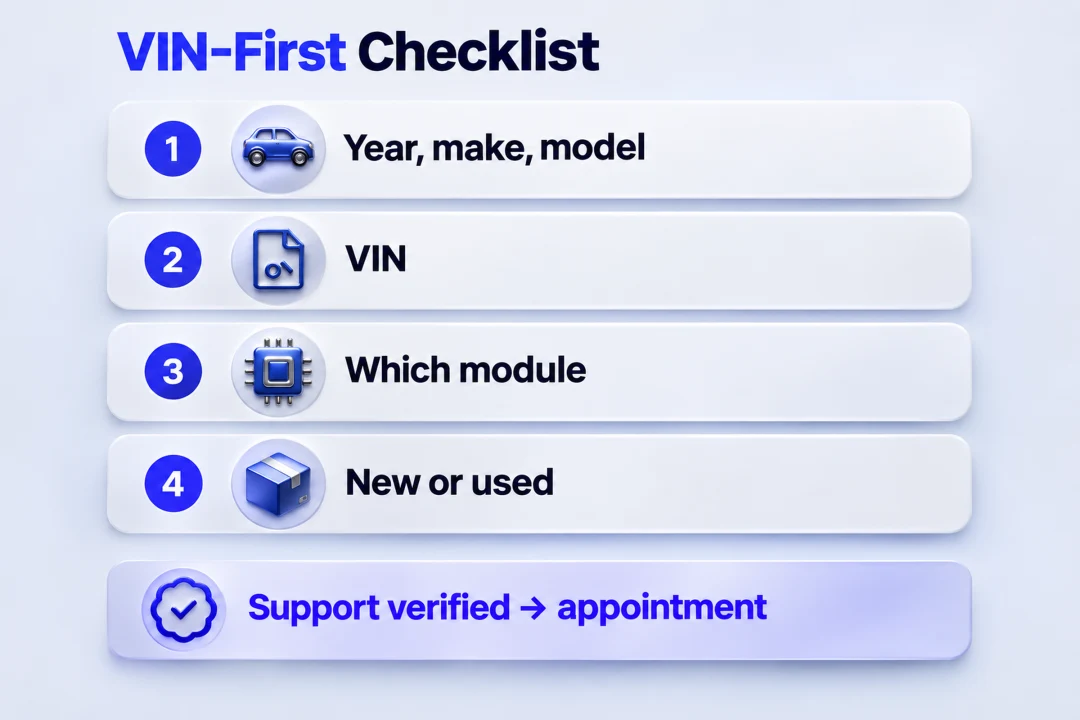
- First step: have the year, make, model, VIN and the module ready so support can be verified before the appointment.
Why a replacement module rarely works plug-and-play
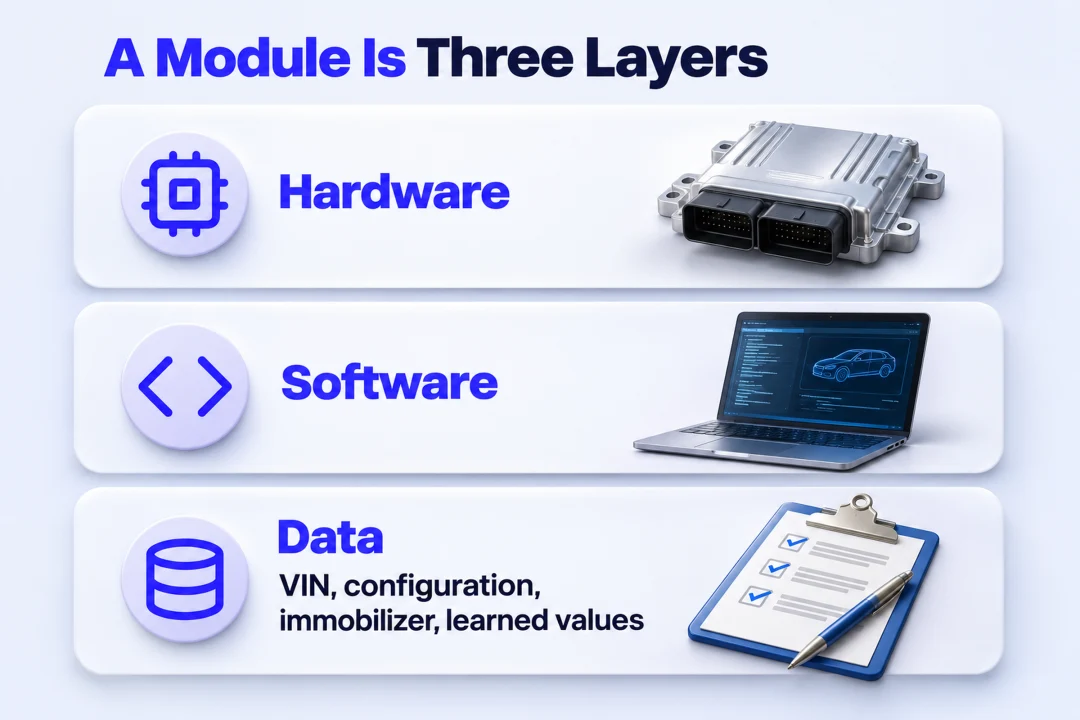
A control module is hardware plus software plus data. The hardware may be identical across many cars, but the software version, the configuration for your car's options and the data that ties the module to your car are not.
Depending on the module, that data can include the VIN, the vehicle's equipment and coding, learned values, and on many cars immobilizer information shared with the key and other modules. A module that does not match can cause a no-start, warning lights, communication codes or systems that do not work. That is why "same part number" does not always mean "will work in my car".
New vs used modules: what changes
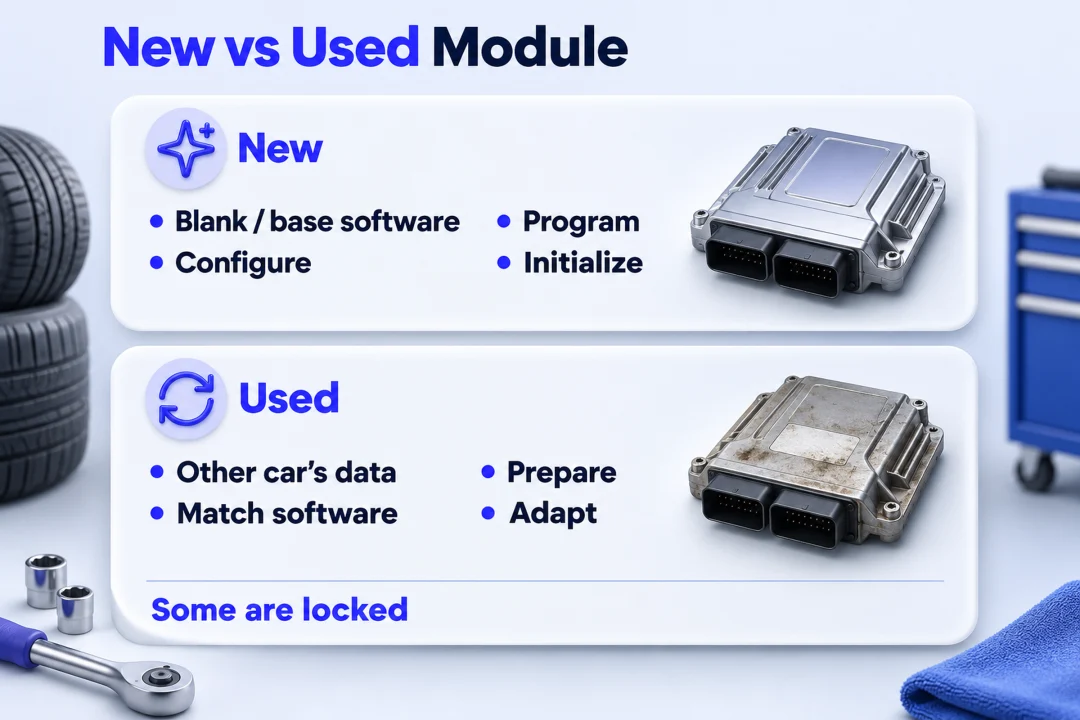
A new module typically arrives blank or with base software. It has to be programmed with the correct software for your car, configured for its equipment and initialized so the other modules accept it.
A used module comes from another car and carries that car's data. Before it works in yours, it may need to be prepared: the old data cleared or replaced, the software matched and the module adapted. On some vehicles the data from the original module can be transferred to the replacement. Whether a used module can be prepared at all depends on the vehicle, the module and the security it uses; some are locked to the car they came from.
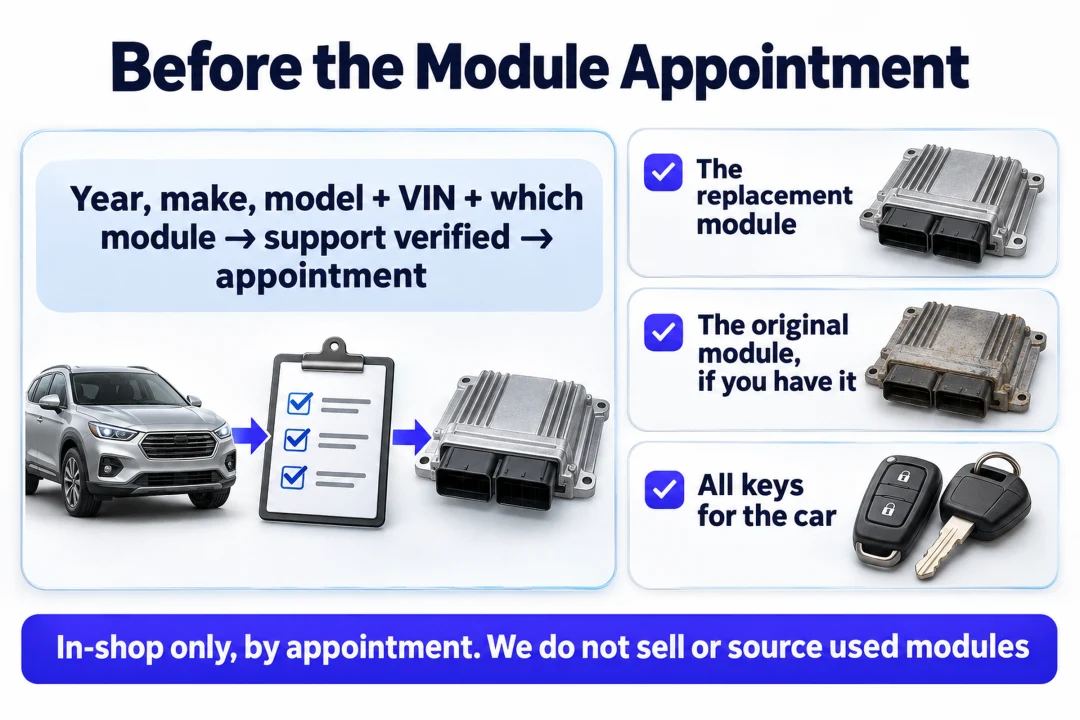
Practical advice: before buying a used module, check that the part matches your vehicle exactly and ask us to verify by VIN whether that module can be prepared for your car. We do not sell or source used modules.
Signs a module may really be failing, and what to rule out first
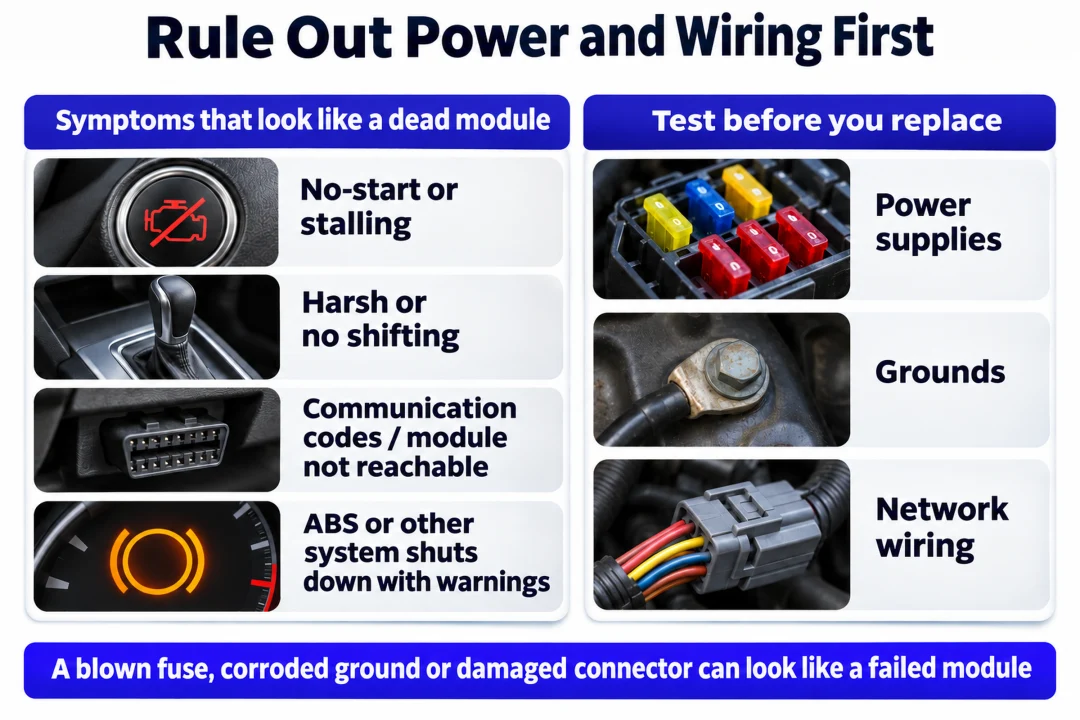
Bad ECU symptoms and other module faults can include a no-start, stalling, harsh or no shifting, communication codes, a module the scan tool cannot reach, or a system such as ABS that shuts down with warning lights. Codes such as U0100 "lost communication" with the ECM often point to power, ground or network wiring rather than a failed module itself.
The same symptoms come from power, ground and wiring faults. A module with a blown fuse, a corroded ground or a damaged connector looks dead even when it is fine. Before a module is replaced, its power supplies, grounds and network wiring should be tested; our auto electrical repair page covers that work. A thorough car diagnostics scan of all modules is the place to start.
What programming may involve
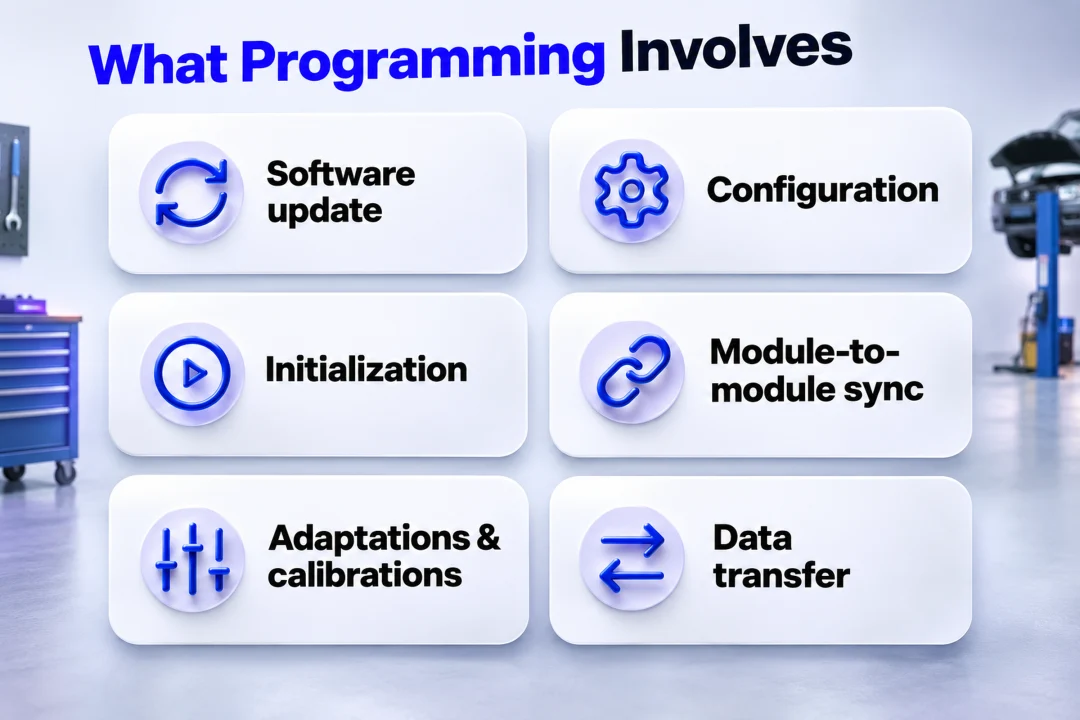
Depending on the vehicle and the module, the work can include:
- Software updates or flashing the correct software version;
- Configuration for the vehicle's equipment and options;
- Initialization so the module is accepted by the rest of the car;
- Module-to-module synchronization, for example with the immobilizer;
- Adaptations and sensor calibrations the module needs to work correctly;
- Data transfer from the original module to a replacement, where the module allows it.
If an engine computer is replaced, the keys may also need to be matched to the car again; see our key fob programming page.
We do not repair circuit boards at the component level. Our work on modules is programming, configuration, data transfer, cloning where applicable, and calibration. We do not transfer mileage or odometer data.
Why the VIN and the module are checked before an appointment
Programming support depends on the vehicle year, model, the module and the procedure needed. Some newer vehicles use additional security and manufacturer authorization that can limit certain programming.
We have access to OEM manufacturer software for supported GM, Ford, Mazda and Nissan vehicles, which covers many factory-level procedures such as module programming and replacement, initialization and configuration, software updates and module-to-module synchronization. For newer European vehicles, particularly certain Audi, Mercedes-Benz and BMW platforms, capabilities can be more limited and are verified for the specific vehicle and service.
So the first step is simple: have the year, make, model, VIN and which module is being replaced ready when you book, and we verify support before scheduling.
For repair shops
If you are a repair shop, technician or dealer, we provide module programming, cloning and calibration for shops. Depending on the module and application, that can include ECU/PCM/TCM cloning, bench and boot mode programming, flash and EEPROM data transfer, original-to-replacement data transfer, used module preparation, module backup and software recovery, and chip or memory transfer between compatible modules when appropriate. Many services can be performed with the module removed from the vehicle, so the complete vehicle is not always required. Support depends on the module and application; contact us with the details before sending anything. We do not do general circuit-board or component-level module repair.
When to bring the car in
Book an appointment at our Englewood shop once support for your vehicle and module has been verified. We work in-shop only, by appointment. Bring the replacement module and, if you have it, the original one, plus all keys for the car.
Replacement module FAQ
Do I need to program a new ECU?
In most cases, yes. A new ECU usually needs the correct software, configuration for your car and initialization, and on many vehicles it must be matched to the immobilizer and keys.
Can I use a used ECU from another car?
Sometimes. A used ECU carries the other car's data and usually has to be prepared and adapted for yours. Whether that is possible depends on the vehicle, the module and its security, so verify by VIN before you buy.
Can a module be programmed without the car?
For repair shops and dealers, many modules can be programmed with the module removed from the vehicle, depending on the module and application — including cloning and bench or boot procedures where supported. For private customers, we program modules with the vehicle at our shop.
Why won't my car start after a module replacement?
Common reasons are a module that has not been programmed or initialized, an immobilizer or key mismatch, the wrong software or part, or an underlying power, ground or wiring fault that was never fixed.
Which makes can you program?
We work with a wide range of makes and modules, including ECU/PCM, TCM, BCM, ABS and SRS. We have OEM manufacturer software for supported GM, Ford, Mazda and Nissan vehicles. For certain newer Audi, Mercedes-Benz and BMW platforms, capabilities are more limited. Support is verified by VIN for each vehicle and module.
Next steps
Replacing a module? Have the year, make, model, VIN and the module ready when you book an appointment at our Englewood shop. Our module programming page lists the modules and procedures we work with.
eForce Automotive Service · 1713 W Baltic Pl, Englewood, CO 80110
Hours: Mon–Fri 9 AM–6 PM, Sat 10 AM–4 PM, Sun closed · By appointment only · In-shop only
This article is general information, not a diagnosis of your vehicle. Programming support depends on the vehicle, the module and the procedure and is verified by VIN before an appointment.