
Car Electrical Problems: Symptoms Before Something Fails
Car electrical problems rarely announce themselves with one clean failure. More often they start as intermittent car electrical issues: a flicker here, a fuse that pops twice, a warning light that comes and goes, a battery that “tested fine” last week while the car still acts strange.
This guide covers early symptoms, why a fuse that keeps blowing is a clue (not a reason to install a bigger fuse), random module glitches, batteries that pass a basic test, and how electrical diagnosis differs from a parts swap. It is general information, not a diagnosis of your vehicle. Our shop is in Englewood, Colorado, serving the Denver and south Denver metro area. Start with our auto electrical repair page. We work in-shop only, by appointment.
Quick answer: early electrical symptoms are often intermittent
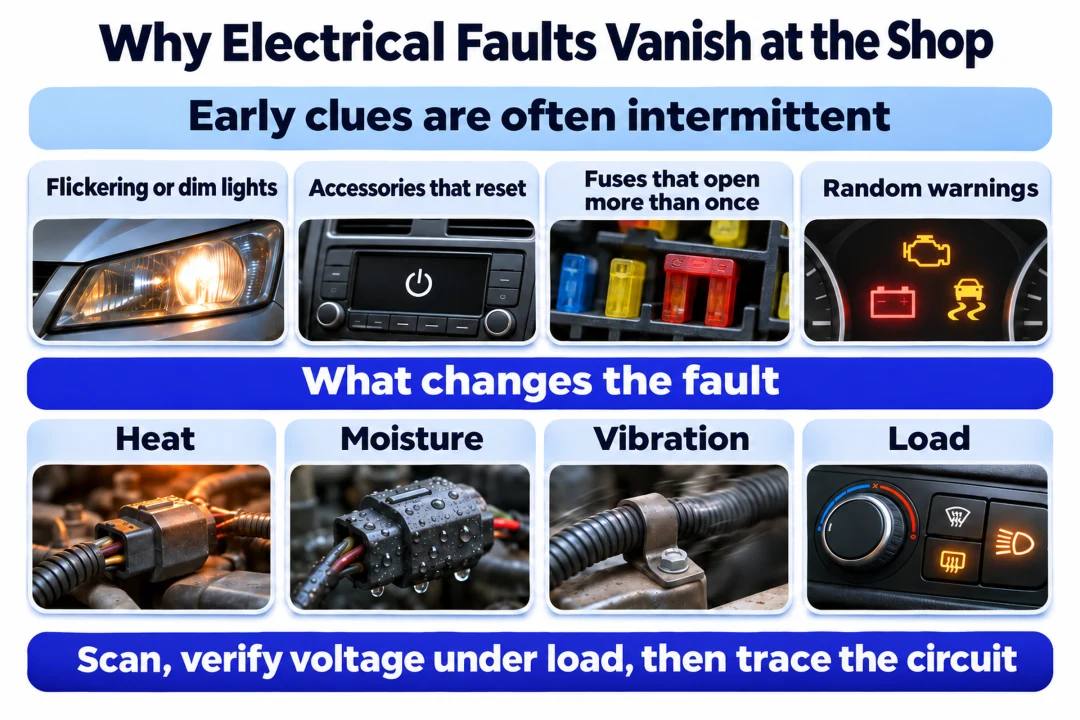
- Early clues: flickering or dim lights, accessories that reset, fuses that open more than once, random warnings.
- Why they vanish at the shop: heat, moisture, vibration, and load change the fault.
- Wrong fix: replacing the battery or a module because a code named it, without proving power and ground.
- Right path: scan, verify voltage under load, then trace the circuit — see also voltage drop testing.
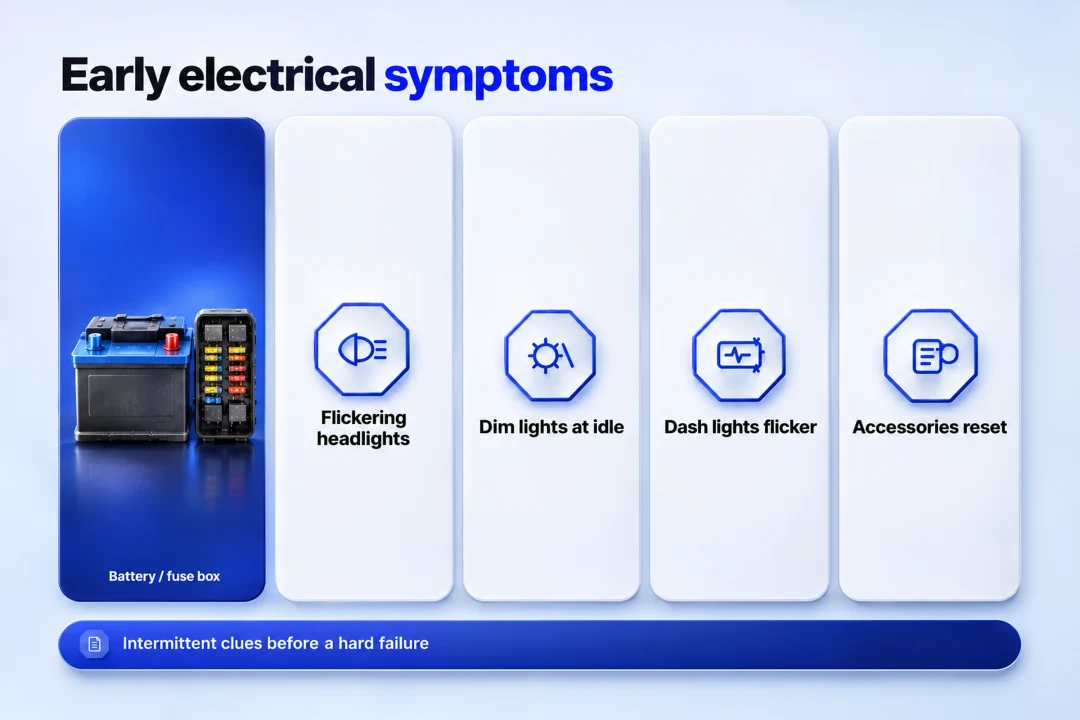
Flickering lights, dim headlights, weak accessories
Headlights flickering, dim headlights, dashboard lights flickering, or interior lights that pulse with engine speed often point to:
- loose or corroded battery connections;
- a bad ground;
- charging output problems (including the alternator);
- a failing switch, dimmer, or module command.
Car flickering lights that change with RPM are a classic charging or connection clue. If the battery light is on at the same time, read our battery light guide. We diagnose the charging system and perform alternator diagnosis and repair when tests show the alternator is the cause — not by guessing from the flicker alone.
Weak power windows, a blower that slows at idle, or a radio that reboots are the same family: the circuit is not getting stable voltage under load.
Fuses that keep blowing
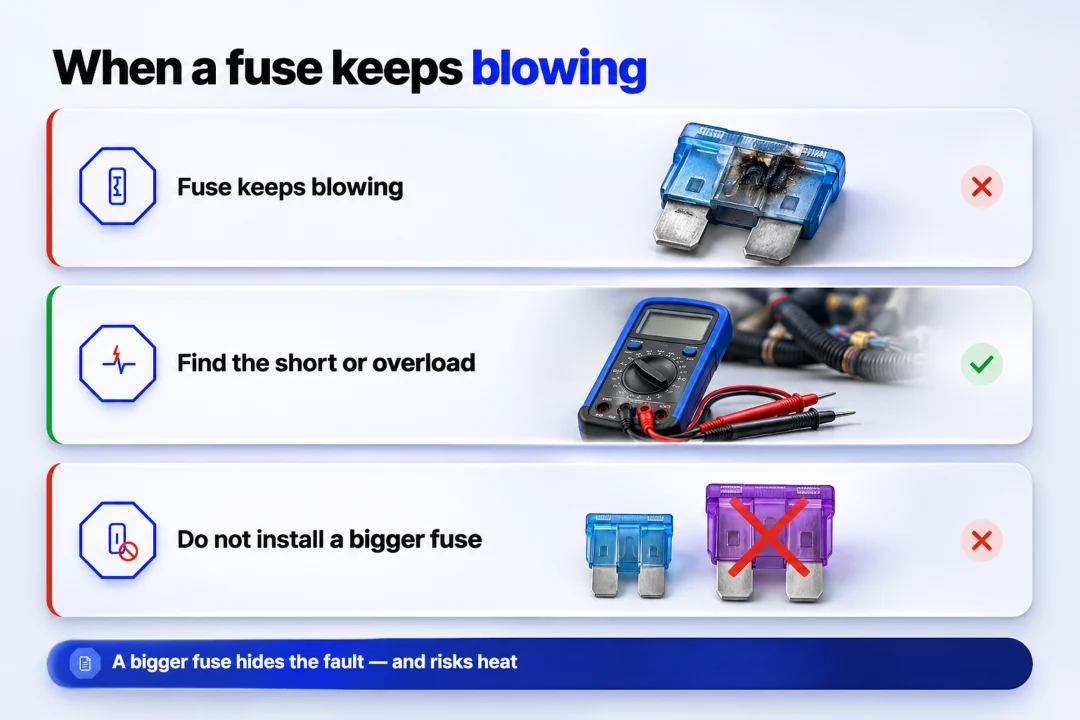
A fuse keeps blowing (or a car fuse keeps blowing) for a reason: the circuit is drawing more current than the fuse rating allows. Common causes:
- a short to ground in the harness or a component;
- a failing motor or module that stalls and over-current;
- water intrusion;
- a previous “fix” that installed the wrong load on that circuit.
Do not upsize the fuse. A larger fuse will not fix a short circuit in car wiring; it can overheat the harness and start a fire. “Fuse box repair” internet tips that only swap blades miss the overload cause.
Diagnosis finds whether the short is in a component or in the harness. When the fault is in the wiring or grounds, eForce repairs those circuits in-house.
Random warning lights and module glitches
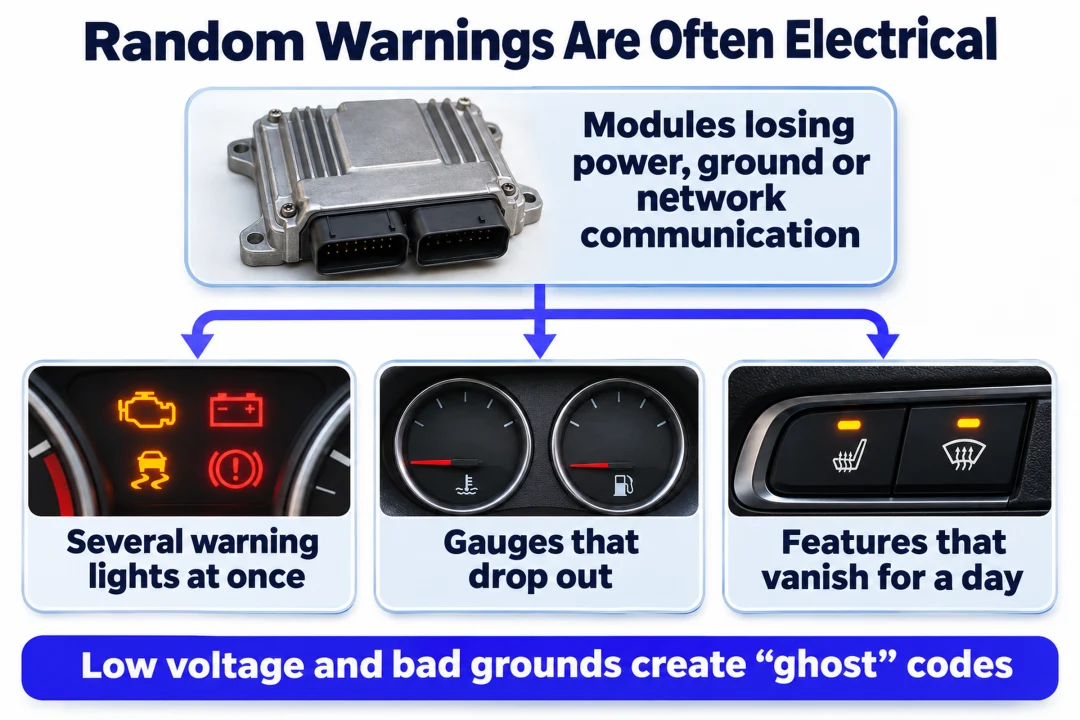
Several warning lights at once, gauges that drop out, or features that vanish for a day often mean modules are losing power, ground, or network communication — not that every named system failed.
Useful deeper reads:
- dashboard warning lights;
- U0100 lost communication with ECM / CAN;
- bad ground symptoms and voltage drop tests.
Low voltage and bad grounds create “ghost” codes that send people into unnecessary parts purchases.
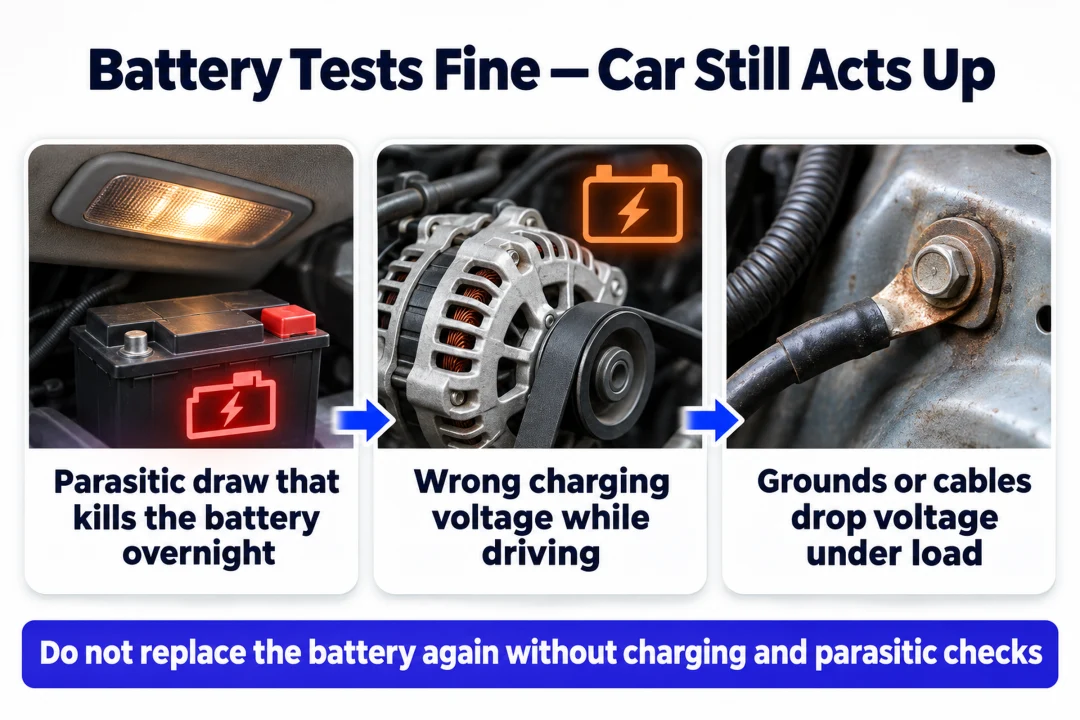
Battery that “tests fine” but the car still acts up
A battery can pass a handheld tester and still leave you with electrical weirdness because:
- the fault is a parasitic draw that kills the battery overnight — see parasitic draw test and why a car battery keeps dying overnight;
- charging voltage is wrong while driving (alternator or wiring);
- grounds or cables drop voltage under load even though static voltage looks normal.
“Replace the battery again” without charging and parasitic checks is how the same complaint returns.
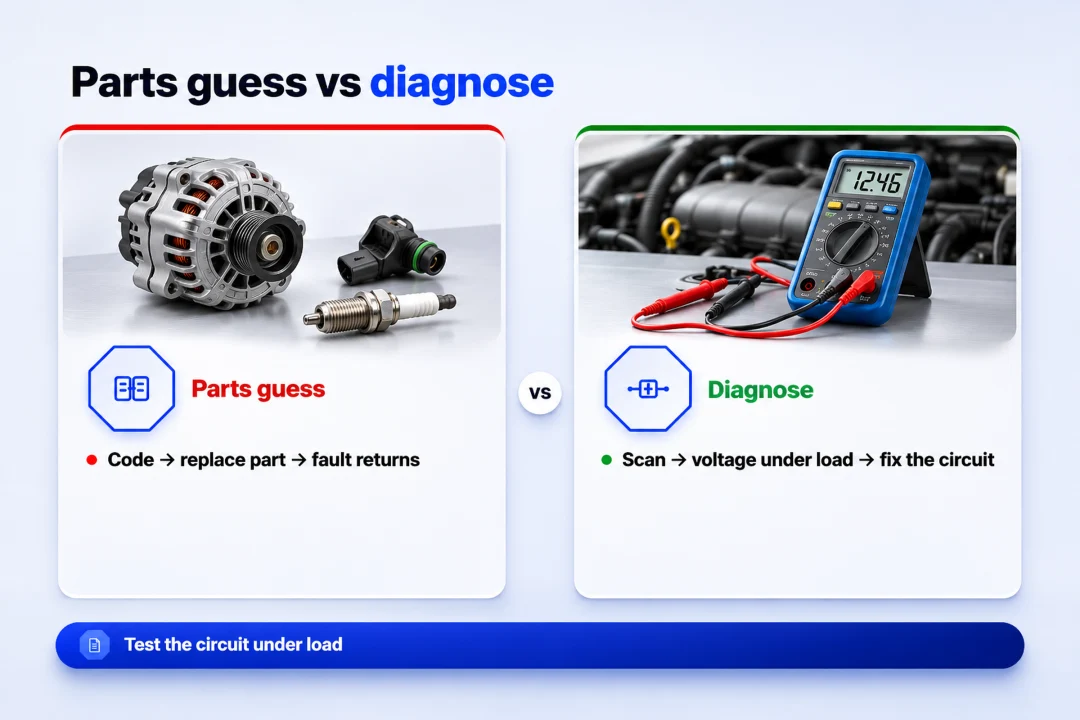
How electrical diagnosis differs from a parts swap
| Parts-swap approach | Diagnostic approach |
|---|---|
| Replace the part named in a code | Prove power, ground, and signal to that part |
| Upsize a fuse that keeps opening | Measure current and find the short or overload |
| New battery because lights flicker | Test charging, grounds, and connections under load |
| New module because of U-codes | Verify network voltage, grounds, and communication |
At eForce, electrical diagnosis is structured: full scan when needed (car diagnostics), battery and charging verification (including alternator testing and repair when indicated), voltage drop on power and ground sides, then inspection of the wiring and connections the measurements point to. When the fault is wiring or a bad ground, we repair it. You get an explanation before further work. We work in-shop only, by appointment, on all makes. We do not cover EV/hybrid high-voltage systems in this article’s scope.
Booking notes
Helpful details:
- year, make, model, VIN;
- which symptoms and when (cold, hot, rain, bumps, at idle);
- which fuse, if a fuse keeps blowing, and which circuit it protects;
- whether the battery or alternator was already replaced;
- any recent stereo, trailer wiring, or aftermarket accessory installs.
Car electrical problems FAQ
Why do my headlights flicker only at idle?
Often charging output is low at idle, or a connection/ground is marginal under that load. Alternator and connection tests separate those causes.
Is a fuse that blows twice a coincidence?
Rarely. Treat a repeated open fuse as a short or overload until proven otherwise.
Can a short circuit drain the battery overnight?
Some shorts and stuck modules cause parasitic draws. Others blow fuses immediately. Both need circuit diagnosis — see our parasitic draw guide for the overnight case.
Do you repair wiring harnesses?
Yes. We diagnose opens, shorts, and ground faults, and we repair the wiring and grounds when that is what the tests show.
Do you repair alternators?
Yes. We diagnose charging faults and repair the alternator when that is the cause.
Next steps
Seeing early car electrical problems — flickering lights, repeat fuses, or random warnings? Book an electrical diagnostic appointment at our Englewood shop. We work in-shop only, by appointment. Start with auto electrical repair.
This article is general information, not a diagnosis of your vehicle. Do not bypass fuses or probe high-current cables unless you know how to do it safely.