
U0100 and "Lost Communication" Codes: What They Mean
If a scan tool showed you U0100, U0101 or another code that starts with "U", the car is telling you that its computers stopped hearing from each other. The code names a module, so it is tempting to buy that module. Often that is the wrong move: the module may be fine, and the real problem is the power, ground or wiring that connects it to the rest of the car.
This guide explains what U-codes are, what the common lost-communication codes mean, why the module is often not the problem and how communication faults are diagnosed. It is general information, not a diagnosis of your vehicle. Our shop is in Englewood, Colorado, and we diagnose CAN bus and electrical faults by appointment.
Quick answers
- U0100 (generic meaning): lost communication with the engine control module (ECM/PCM).
- U0101 (generic meaning): lost communication with the transmission control module (TCM).
- Is the module bad? Not necessarily. Power, ground, connectors, network wiring and low voltage cause many of these codes.
- Can you clear it? You can, but if the cause is still there, the code returns, and the car may not run or shift normally in the meantime.
- What we do: test the CAN bus circuits, power supplies, grounds and connections before any module is replaced.
What a U-code is
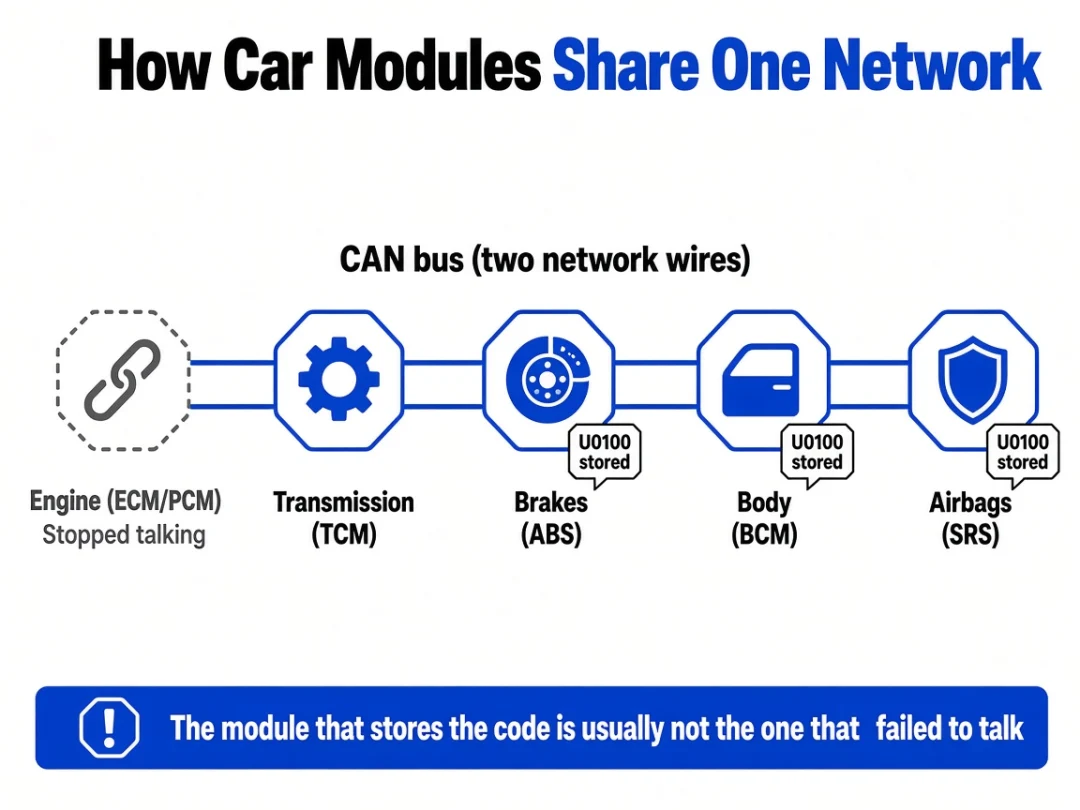
Modern cars have many control modules: engine, transmission, brakes (ABS), body, airbags and more. They share information over a network, most often a CAN bus (Controller Area Network): a pair of wires that every module on that network talks over.
Diagnostic trouble codes are grouped by letter. P-codes are powertrain faults, the ones behind most check engine lights; our check engine light guide covers them. U-codes are network, or communication, codes. A U-code does not say that a sensor read wrong. It says that one module expected messages from another module and stopped receiving them.
The module that stores the code is usually not the module that failed to talk. U0100 stored in the transmission or ABS module means those modules could not hear the engine module.
Common lost-communication codes
These are the generic (SAE) code definitions. Exact wording and detail vary by make and model, and some use letters such as "A" or "B" when a vehicle has more than one module of a type.
| Code | Generic meaning |
|---|---|
| U0100 | Lost communication with ECM/PCM "A" (engine) |
| U0101 | Lost communication with TCM (transmission) |
| U0121 | Lost communication with the anti-lock brake system (ABS) control module |
| U0140 | Lost communication with the body control module (BCM) |
Seeing several of these at once is a clue: when many modules report each other missing, the cause is often shared, such as a network wiring fault, a common ground or low voltage.
Why the module is often not the problem
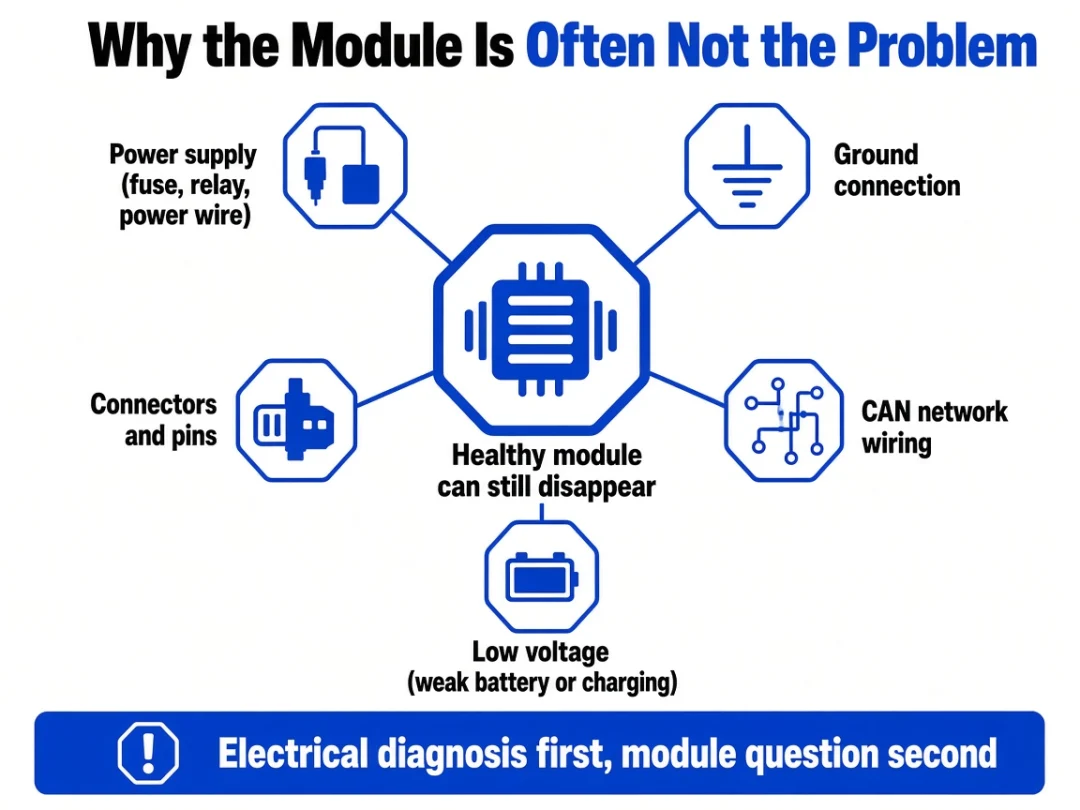
A module can only talk on the network if it has power, a good ground and an intact connection to the network wires. Lose any of these and the module "disappears", even if it is perfectly healthy:
- Power supply: a blown fuse, a failed relay or a damaged power wire to the module.
- Ground: a loose, corroded or broken ground connection.
- Connectors: corrosion, water intrusion, bent or pushed-back pins.
- CAN wiring: a chafed, shorted or broken network wire, or a fault in one module that can disrupt the whole network.
- Low voltage: a weak battery or a charging problem can make modules drop off or log communication codes during cranking. If the battery keeps going flat, a parasitic draw test finds what is draining it.
That is why a lost-communication code is an electrical diagnosis first and a module question second.
Symptoms that can come with it
What you notice depends on which module dropped off the network:
- a no-start or a crank with no start, when the engine module cannot be reached; see our guide on why a car won't start;
- the engine shutting off while driving, or shifting problems when the transmission module is involved;
- several warning lights at once, such as ABS, traction control, airbag and check engine; see dashboard warning lights and, for the SRS light, airbag light on;
- gauges that drop to zero or act up;
- a scan tool that cannot connect to one module, or to any of them.
Some cars show a U-code with no symptom at all, because the fault happened once and was stored. Stored history still matters: intermittent connection problems often come back.
Why replacing the module first is a gamble
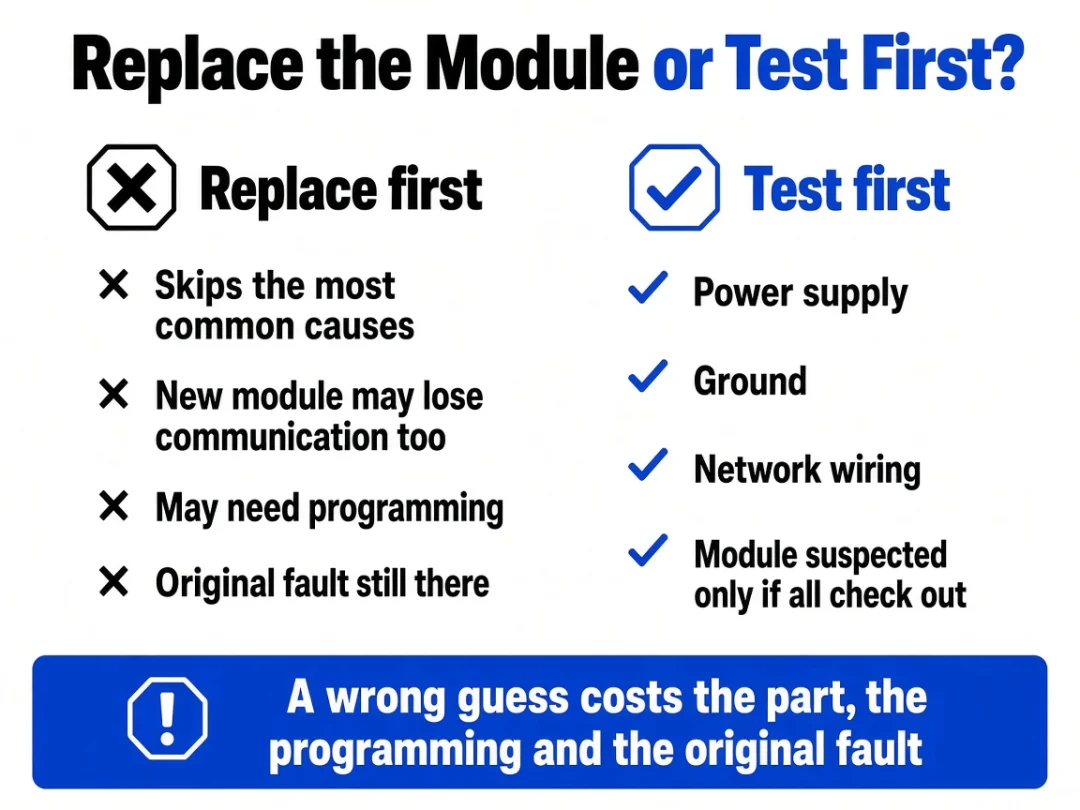
Replacing a module because its name is in the code skips the most common causes. If the real fault is a ground or a connector, the new module will lose communication the same way. And many replacement modules, new or used, need programming before they work in your car, so a wrong guess means the part, the programming and the original fault all at once.
Sometimes the module really has failed: it has power, ground and good network wiring, and it still does not respond. Then replacement and programming are the right fix. Our module programming page explains that work, and support depends on the year, model and module, verified by VIN.
How we diagnose communication faults
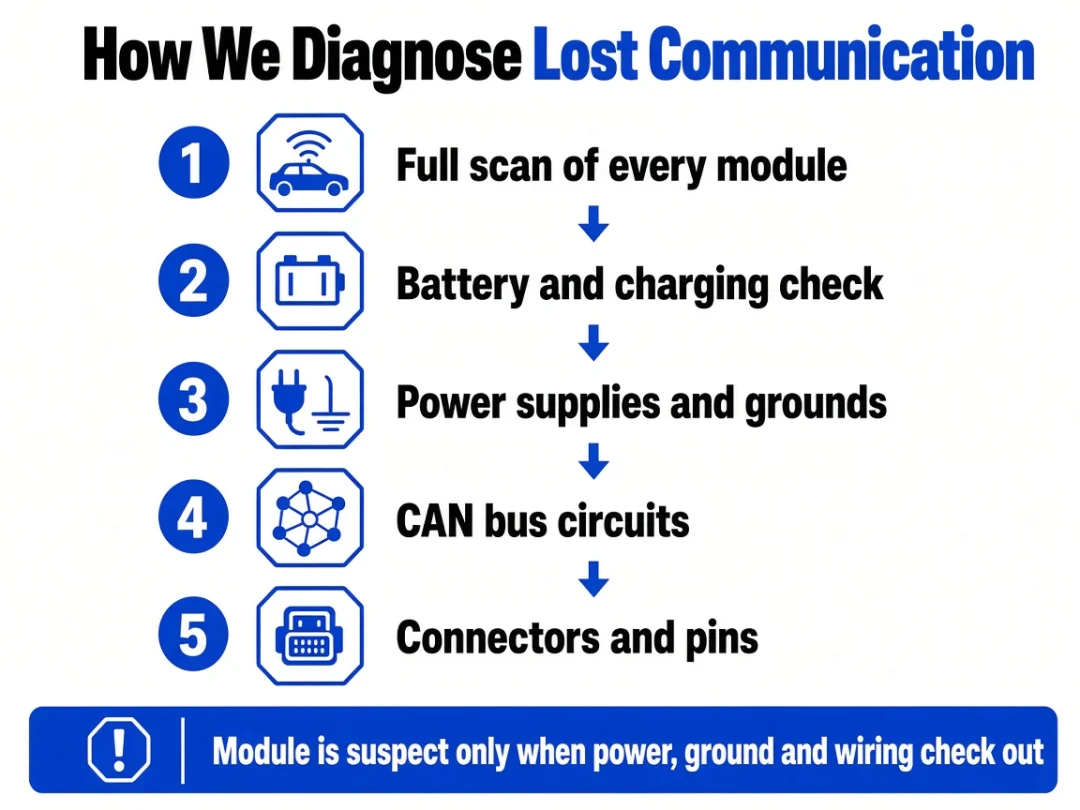
At our Englewood shop we work through the network the same way every time:
- Full scan of every module, to see which ones respond, which codes are stored and which are current. See our car diagnostics page.
- Battery and charging check, since low voltage can cause communication codes on its own.
- Power supplies and grounds at the module that is not responding, tested under load.
- CAN bus circuits: the network wiring and its connections between modules.
- Connectors for corrosion, water and damaged pins.
Only when power, ground and wiring check out do we treat the module itself as the suspect. Network faults can take time to trace, and the technician will discuss further diagnostic work with you before going ahead.
When to bring the car in
Bring it in if a U-code keeps returning, the car does not start, it stalls or shifts badly, or several warning lights came on together. Book an appointment at our Englewood shop. We work in-shop only, by appointment. If you already have the code list from a scan, bring it.
U0100 and U-code FAQ
Can a weak battery cause U0100?
Yes, it can. Low voltage, especially during cranking, can make modules drop off the network and log communication codes. That is why the battery and charging system are checked first.
Does U0100 mean my ECM is bad?
Not necessarily. U0100 means other modules lost contact with the engine module. A blown fuse, a bad ground, a corroded connector or damaged network wiring can cause it. The module is suspected only after power, ground and wiring check out.
Can I clear a U0100 code and keep driving?
Clearing removes the stored code, not the cause. If the fault is still there, the code returns, and depending on the module the car may stall, not start or shift poorly. Have it diagnosed rather than relying on a cleared code.
Why do I have several U-codes at once?
Several modules reporting each other missing usually points to a shared cause: a network wiring fault, a common ground, a power supply or low voltage. One module with a fault can also disrupt the whole network.
Will a new module need programming?
Often, yes. Many replacement modules, new or used, need programming, configuration or initialization before they work in the car. Support depends on the year, model and module, and we verify it by VIN before the appointment.
Next steps
Lost-communication code? Book an appointment at our Englewood shop for an electrical diagnosis. Our auto electrical repair page explains what else we diagnose.
This article is general information, not a diagnosis of your vehicle. Code definitions here are the generic ones; your vehicle's manufacturer may add detail. Do not clear codes and assume the problem is gone.