
Car Stalling or Shutting Off While Driving: Causes and What to Do
A car that shuts off while you are driving is frightening for a good reason: the engine stops, and the power assist for your steering and brakes goes with it. Some cars stall once and never again. Others cut out at a stop light, over a bump or only on hot days, then restart as if nothing happened. That makes car stalling while driving easy to dismiss and hard to find. This is general information, not a diagnosis of your vehicle. Our shop is in Englewood, Colorado, serving the Denver and south Denver metro area.
Quick answers
- Right now: turn on the hazard lights, steer to a safe place and stop. Without engine power, steering and brakes may feel much heavier or be partly lost.
- Do not keep restarting in a traffic lane. A car that stalled once can stall again without warning.
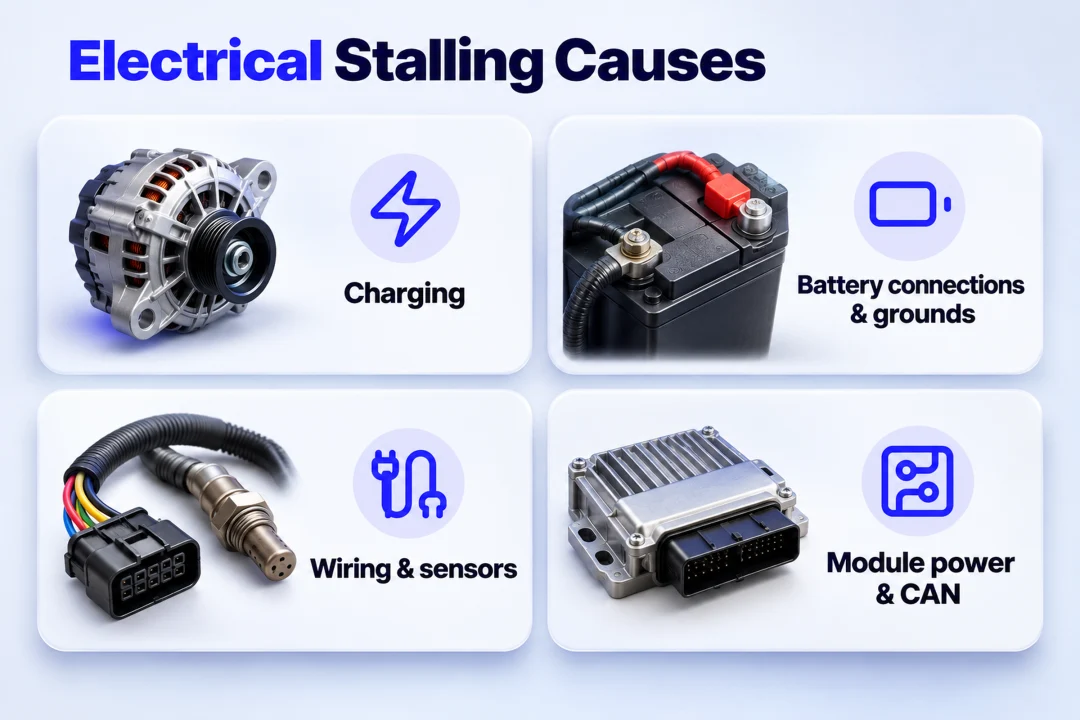
- Common electrical causes: a charging system fault, loose or corroded battery connections, bad grounds, wiring and connector faults, a lost sensor signal, or a module power or communication problem.
- What we do: we test the battery, charging system, grounds, wiring and module communication to find the cause. See our auto electrical diagnostics in Englewood.
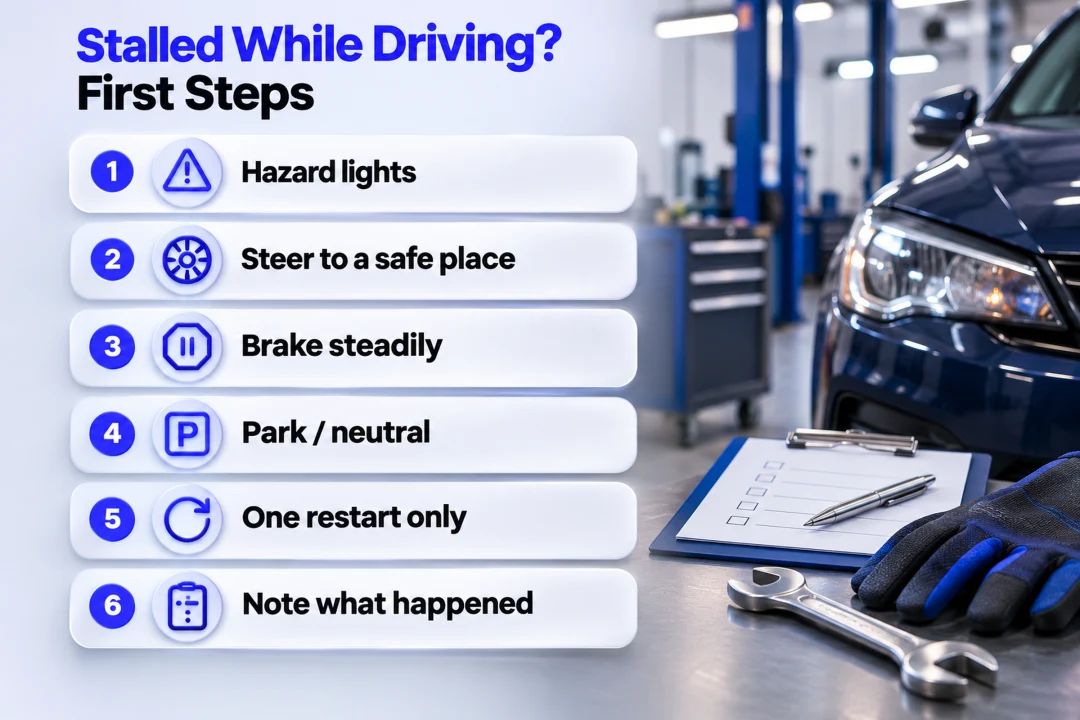
What to do right now if your car shuts off while driving
- Turn on the hazard lights immediately. Other drivers need to know you are losing speed.
- Hold the wheel with both hands and steer smoothly to a safe place: a shoulder, a side street or a parking lot. Power assist may be reduced or gone, so expect a heavier wheel and a harder brake pedal.
- Brake firmly and steadily. Do not pump the pedal: the brake booster has only a limited reserve once the engine stops.
- Once stopped, put the car in Park (or in neutral with the parking brake set on a manual transmission). If you cannot leave a traffic lane, stay buckled in with the hazard lights on.
- Try one restart, in a safe place, following your owner's manual. Push-button vehicles may need your foot on the brake. Repeated cranking drains the battery and does not help find the cause.
- Write down what happened: speed, lights that came on, noises or smells, and whether and when the engine restarted. These notes help the diagnosis.
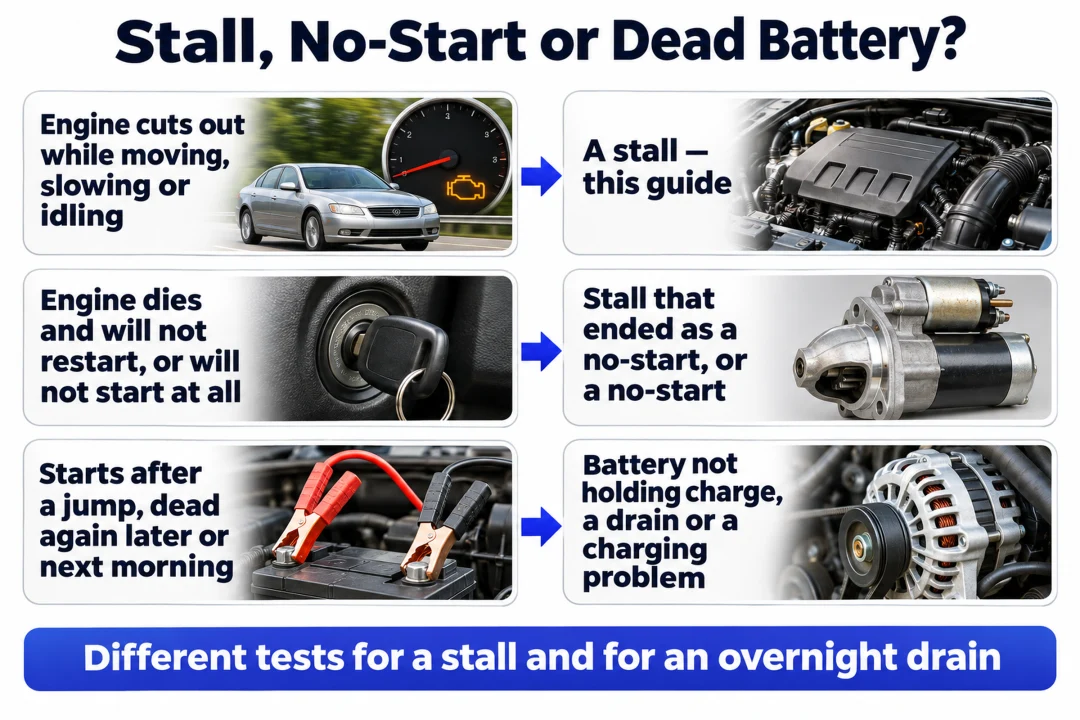
Stalling, no-start or dead battery: which is it?
| What happens | What it usually is | Where to read more |
|---|---|---|
| The engine cuts out while the car is moving, slowing down or idling | A stall: this guide | You are here |
| The engine dies and then will not restart, or it will not start at all | A stall that ended as a no-start, or a no-start | Car won't start: battery, starter, alternator or immobilizer |
| The car starts after a jump but is dead again later or the next morning | A battery that is not holding charge, a drain or a charging problem | Why a car battery keeps dying overnight |
If a car that sits for a day or two needs a jump, the cause may be a drain, which is a different test from a stall diagnosis: see our guide to the parasitic draw test.
Clues from when it stalls
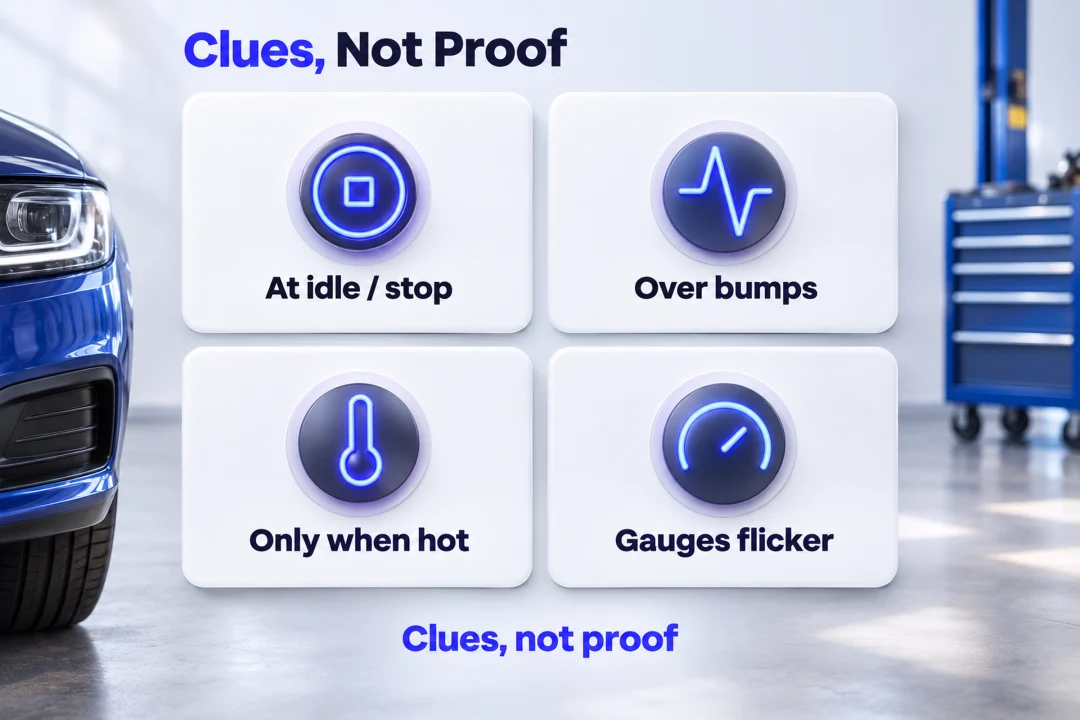
The moment the engine stalls or cuts out says a lot about where to look. These are clues, not proof: different faults can look alike, and one symptom can have several causes.
| When it stalls | What it can point to |
|---|---|
| At idle, at a stop light or when slowing down | Idle and air intake problems, a vacuum leak, charging output too low at low engine speed, or a transmission problem |
| Over bumps or when the wiring or battery cables are moved | A loose or corroded battery terminal, a weak ground, a connector or damaged wiring |
| Only when the engine is hot | A heat-sensitive sensor, ignition or fuel component, or an electronic module |
| Gauges flicker or lights dim just before it dies | Low or unstable system voltage: charging, battery connections or grounds |
Common causes: electrical and electronic
Modern engines need steady electrical power: the ignition, the fuel pump, the injectors and the engine computer all need clean voltage, good grounds and correct signals every moment the engine runs. When any of these is interrupted, even for a fraction of a second, the engine can shut off.
Charging system problems
The alternator is driven by the engine and supplies the car's electrical needs while it runs, as well as recharging the battery. If charging output drops because of the alternator, its voltage control, a slipping drive belt or a poor cable or connection, the car starts living off the battery. When system voltage falls too low, the ignition, fuel pump and engine computer stop working correctly and the engine dies. It may not restart because the battery is drained.
Typical signs are a battery or charging warning light, dimming headlights at idle, flickering gauges and a car that needs a jump afterwards. Charging system testing checks battery condition, charging voltage with the electrical loads switched on and the cable and ground paths that carry the current. When diagnosis points to the alternator, we diagnose and repair it in-shop. Our battery light / charging system guide and battery drain guide explain how charging, battery and drain problems differ.
Loose or corroded battery terminals, damaged cables and bad grounds
A battery terminal that looks tight can still make poor contact under vibration. A corroded clamp, a damaged cable or a weak engine-to-chassis ground can interrupt power for a moment, enough to stall a running engine and flicker the dashboard. Road salt and winter moisture make corrosion more likely. A voltage drop test measures how much voltage is lost across a cable, terminal or ground while current flows, which shows a poor connection that a plain voltage reading can miss.
Wiring, sensor signals and module power
The circuits that feed ignition, the fuel pump and the engine computer run through fuses, relays, connectors and long wiring harnesses. A chafed wire, a corroded connector, a worn relay or an open or short circuit can cut power without warning. These faults are often intermittent and worse with vibration, heat or moisture, and add-on accessories such as alarms and remote starters can introduce a faulty connection too.
The engine computer also uses crankshaft and camshaft position signals to time spark and fuel. If a sensor, its wiring or its connector drops the signal, the engine can shut off instantly with no sputtering. The computer (ECM or PCM) and other modules need steady power, a good ground and working communication over the vehicle's data network, such as the CAN bus. A lost power or ground, a CAN bus fault or a failing module can shut the engine off or set several warning lights at once. We diagnose power and ground issues, CAN bus communication faults and module communication problems. If a module itself is found faulty, replacement and programming may be needed on some vehicles, where the module and vehicle allow it; see our module programming page.
Key and immobilizer faults
On some vehicles the anti-theft system can interrupt fuel or ignition when it does not recognize the key signal, but this usually shows up at startup and is rare while driving.
Causes outside the electrical system
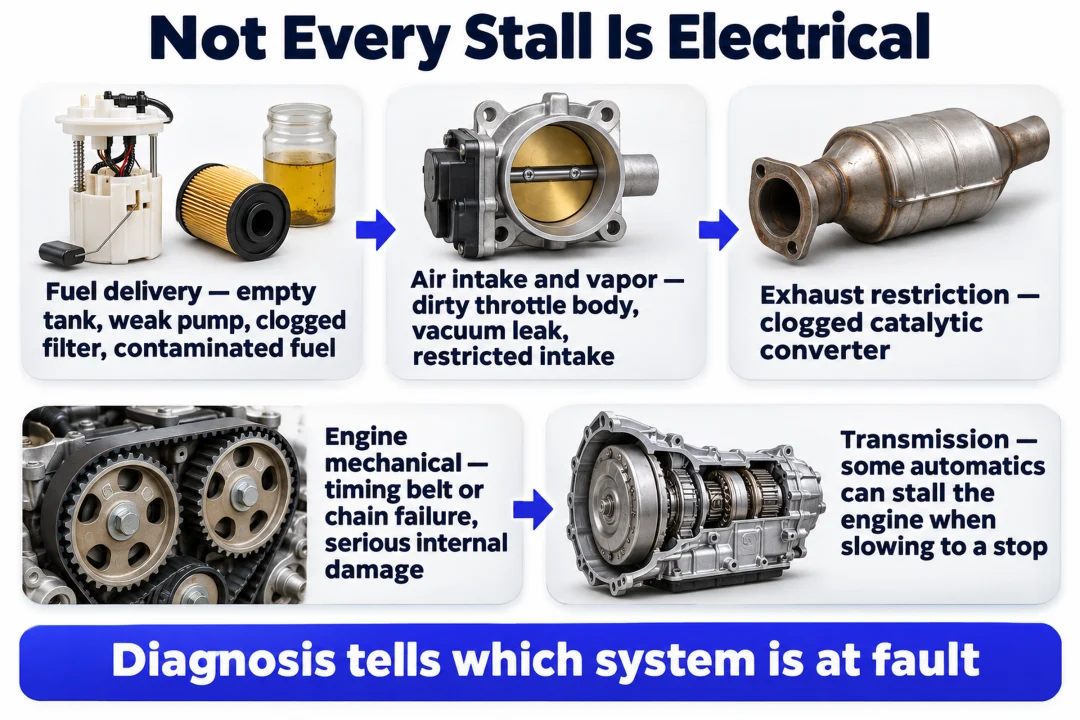
Not every stall is electrical. A running engine also needs fuel, air and sound mechanical condition:
- Fuel delivery: empty tank, faulty gauge, weak pump, clogged filter or contaminated fuel.
- Air intake and vapor systems: dirty throttle body, vacuum leak or restricted intake.
- Exhaust restriction: a clogged catalytic converter can choke the engine until it stalls.
- Engine mechanical problems: timing belt or chain failure or serious internal damage.
- Transmission: some automatics can stall the engine when slowing to a stop if a part fails.
This guide concentrates on the electrical causes because that is what an electrical diagnostic covers. Diagnosis tells which system is at fault; for non-electrical causes we tell you what we found, so you are not left guessing.
Warning lights before it dies
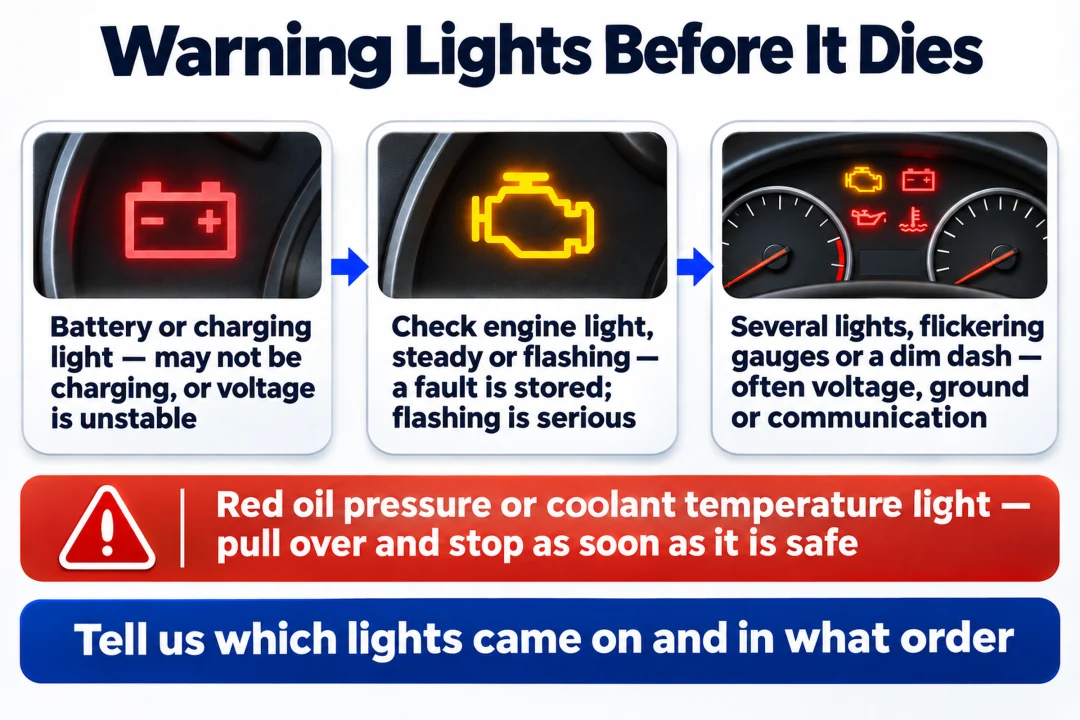
Some stalls come with no warning at all. Others give hints:
- Battery or charging light: the system may not be charging, or voltage is unstable. Closely linked to stalling. See our battery light guide.
- Check engine light, steady or flashing: a fault is stored, and a flashing light means a serious problem. A stall does not always set the light or leave a code. Read more about a check engine light on.
- Several lights at once, flickering gauges or a dim dashboard: often a voltage or ground problem, or a module communication fault. Traction control, stability control and ABS lights can also come on with low voltage or a communication problem. Our guide to dashboard warning lights and the traction control light covers what those colors mean.
A red oil pressure or coolant temperature light is different: pull over and stop as soon as it is safe. Some engines shut down on their own to protect themselves.
Tell us which lights came on and in what order. The order often shows where the problem started.
How we diagnose an intermittent stall
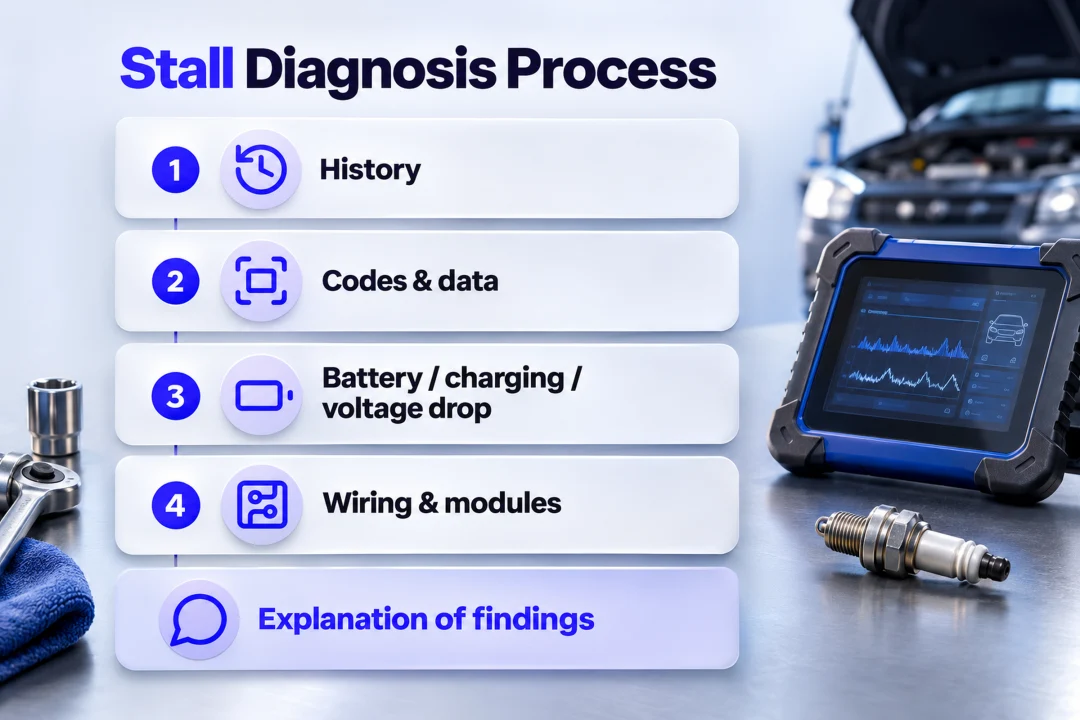
- History and conditions: when it stalls, how often, hot or cold, at idle or under load, and what changed recently.
- Codes and data: we read stored codes from the engine computer and the other modules and check the recorded data.
- Battery, charging and voltage drop tests: battery condition and charging voltage with the electrical loads switched on, then cables, terminals and grounds under current.
- Wiring and module checks: the circuits that feed ignition, fuel pump, sensors and modules, including shorts and open circuits, plus power, ground and network communication of the modules involved.
At the end you get an explanation of what was found. A fault that does not appear on the day of the visit, or that needs further tracing of wiring or circuits, can take additional diagnostic time, and the technician discusses that with you before proceeding.
What to tell us when you book
- When it stalls: at idle, at a stop, accelerating, turning, hot, cold, in rain, on bumps.
- Whether it restarts, and how soon.
- Which warning lights came on, and any recent battery, alternator, wiring or other repair.
- Any aftermarket alarm, remote starter, dash camera or audio equipment.
- Year, make, model and VIN.
Car stalling FAQ
Why does my car shut off while driving?
The engine needs power, fuel, air and correct sensor signals at every moment. Electrical faults, or fuel, air or mechanical problems, can interrupt them. Diagnosis shows which system is at fault.
Is it dangerous if the car stalls while driving?
It can be. Without the engine, power assist for steering and brakes may be reduced or lost. Turn on the hazard lights, steer to a safe place and stop, then have the cause found.
Can a bad alternator make the car stall while driving?
Yes. If charging stops supplying enough power, the car runs on the battery until voltage gets too low and the engine shuts off. Charging system testing shows whether charging is the cause.
Can a weak battery or loose battery cable cause stalling?
A weak battery alone rarely stops a running engine while charging works. A loose or corroded terminal, a damaged cable or a weak ground can interrupt power for a moment and stall it.
Why does my car stall when I stop or at idle?
At low engine speed the engine and charging system have the least margin. Causes include idle or air intake problems, a vacuum leak, low charging output, a lost sensor signal or a transmission problem.
The car restarts right away. Can I ignore it?
No. A restart does not mean the cause is gone. Intermittent faults such as a loose connection or a heat-sensitive sensor can return without warning. Have the car checked.
Does a check engine light have to come on when a car stalls?
No. A sudden loss of power or of a sensor signal does not always store a code or turn the light on. A stall without a light still needs a diagnosis.
Can wiring or a bad ground cause intermittent stalling?
Yes. A damaged wire, corroded connector, weak ground or worn relay can cut power for an instant, often over bumps, in heat or in moisture. Voltage drop tests and a wiring inspection find these faults.
Do you come to me?
No. We work in our shop in Englewood, by appointment only. If the car should not be driven, please arrange a safe way to bring it in.
Next steps
Car stalls or cuts out? Bring the car to our shop in Englewood for an electrical diagnostic, by appointment only. We test to find the cause instead of guessing. Read more about our electrical diagnostic service, our car diagnostics and the full services overview.
eForce Automotive Service · 1713 W Baltic Pl, Englewood, CO 80110
Hours: Mon–Fri 9 AM–6 PM, Sat 10 AM–4 PM, Sun closed · By appointment only · In-shop only
This article is general information, not a diagnosis of your vehicle. A car that shuts off while driving can lose power assist for steering and brakes. Turn on the hazard lights, move to a safe place and do not keep driving a car that stalls repeatedly. Do not open the hood near moving parts, work on the battery or touch wiring while the engine is running.