
Relearns and Calibration After a Repair or Battery Change
You replaced the battery, cleaned or replaced the throttle body, or had a part swapped, and now the car idles high, shifts oddly or shows a warning light that was not there before. The repair itself may be fine. What is often missing is the step after it: a relearn, calibration or initialization that tells the car's computers about the change.
This guide explains why modern cars need relearns, common examples, symptoms of a missed relearn, where software updates come in and why the procedure depends on your exact vehicle. It is general information, not a diagnosis of your vehicle. Our shop is in Englewood, Colorado, and we handle module adaptation and initialization by appointment.
Quick answers
- Why relearns exist: modules store learned values, and some repairs or a battery change erase or invalidate them.
- Common examples: throttle body and idle relearn, steering angle sensor calibration, transmission adaptations, crankshaft position relearn, battery registration on some vehicles.
- Signs one was missed: rough or high idle, harsh shifts, stability or steering warning lights, codes that come back.
- ADAS and TPMS: driver-assistance cameras and radar may need ADAS calibration after related work, and new tire pressure sensors usually need TPMS programming.
- Is it the same for every car? No. Procedures depend on the make, model and year, so the VIN is checked first.
Why modern cars need a relearn after some repairs
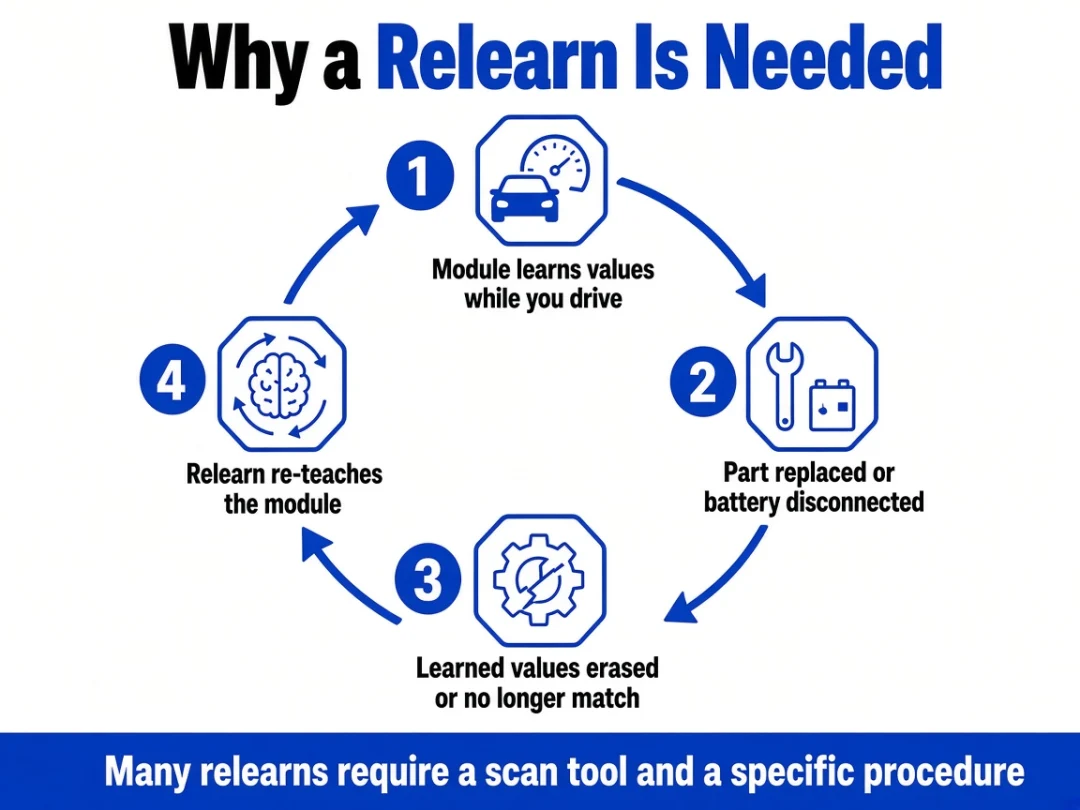
Control modules do not just follow fixed settings. Over time they learn: how much air the engine needs at idle, how the transmission's clutches respond, where the steering is centered, how a sensor signal lines up with engine position. These learned values are stored in the module and used every time you drive.
When a part is replaced, cleaned or disconnected, those values may no longer match reality. Some are erased when the battery is disconnected; others stay stored and are now wrong. A relearn, calibration or initialization procedure resets or re-teaches them so the module and the part work together again. Some relearns happen on their own with driving; many require a scan tool and a specific procedure.
Common examples
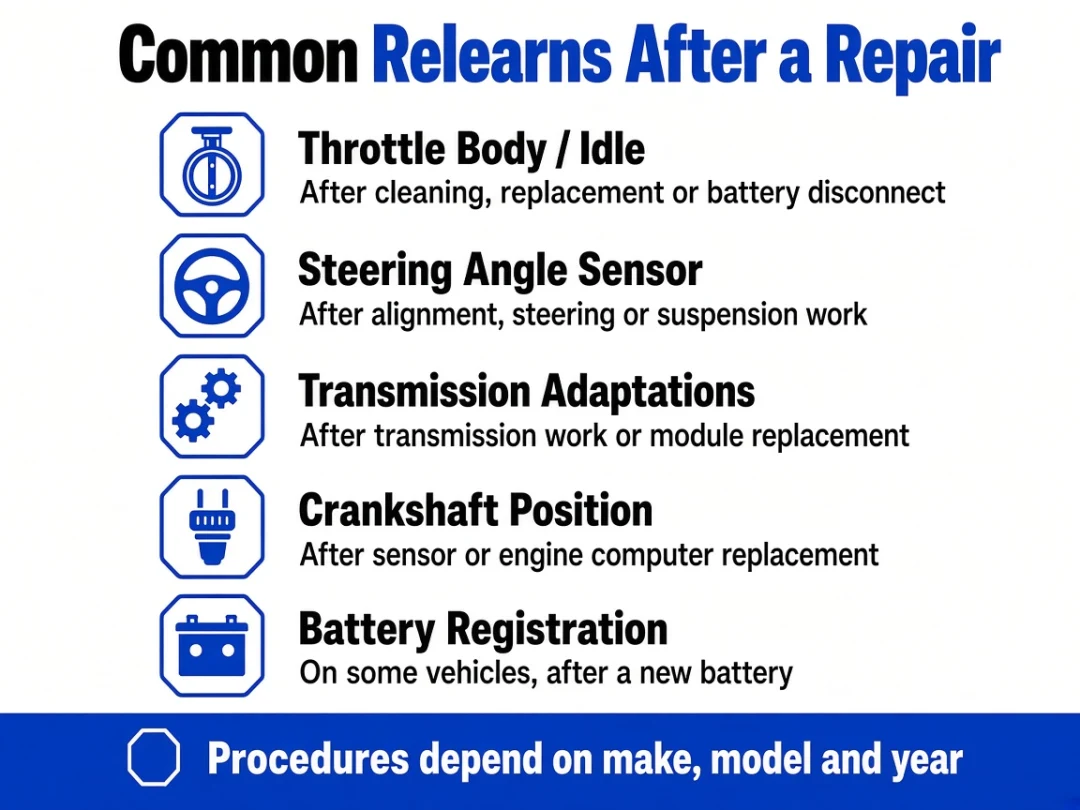
- Throttle body / idle relearn. After a throttle body is cleaned or replaced, or after a battery disconnect, the engine module may need to relearn the throttle's closed position and idle airflow.
- Steering angle sensor calibration. The stability control system uses the steering angle sensor to know where the wheels point. After alignment, steering or suspension work, the sensor may need calibration or a reset.
- Transmission adaptations. Automatic transmissions learn shift timing and clutch pressures. After transmission work or a module replacement, adaptations may need resetting and relearning.
- Crankshaft position relearn. Some vehicles need the engine module to relearn sensor variation after the crankshaft position sensor, the engine computer or related parts are replaced.
- Battery registration. On some vehicles, the car must be told that a new battery was installed, so it charges the battery correctly.
Tire pressure sensors and driver-assistance cameras and radar also have their own procedures on many vehicles; they are covered in their own sections below.
Symptoms of a missed relearn
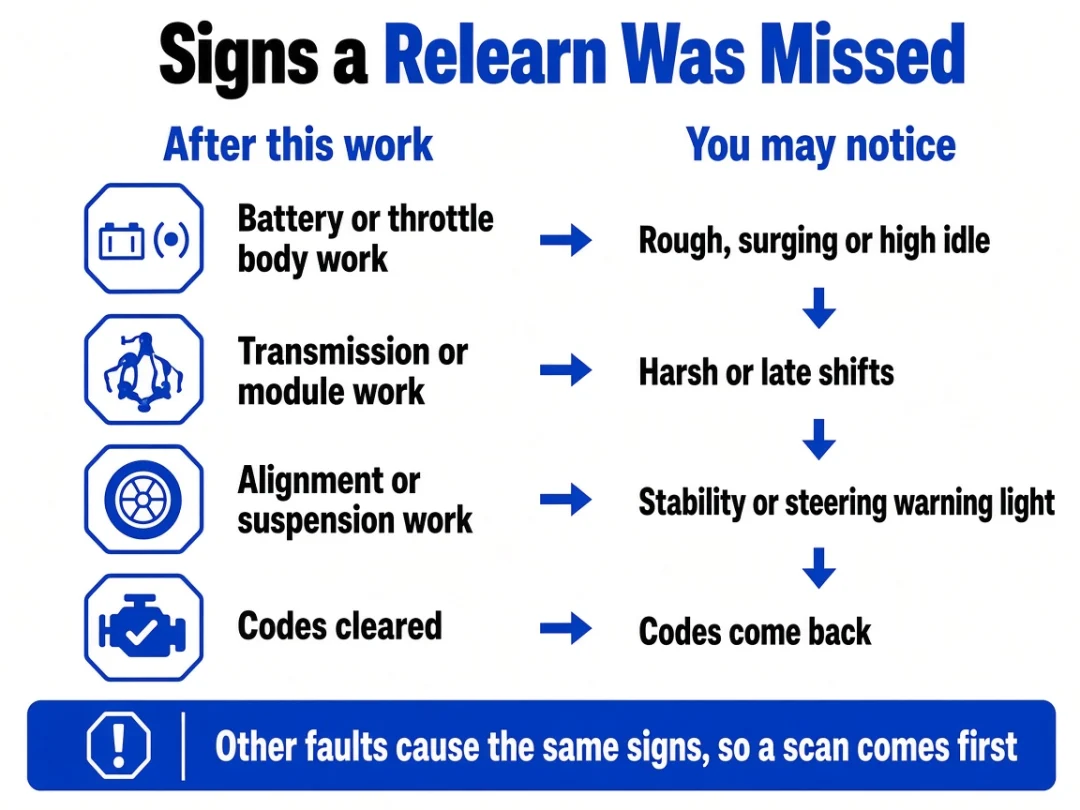
- rough, surging or high idle, or stalling at stops, after throttle body or battery work;
- harsh, late or slipping-feeling shifts after transmission or module work;
- stability control, traction control or steering warning lights after alignment or suspension work; see our guide to dashboard warning lights;
- check engine light and codes that come back after being cleared; see our check engine light guide;
- a car that seems to "act weird" after a battery change.
These symptoms can also have other causes, including a faulty part or the original problem not being fixed, so a scan comes first. Our car diagnostics page explains that step. If the car will not start at all after battery work, our car won't start guide walks through the usual causes, and if a scan shows "lost communication" codes after module work, see our U0100 guide.
Software updates: when a module needs one
Manufacturers release software updates for control modules to correct known issues, improve how a system behaves or support a replacement part. A module may need an update when a replacement part requires newer software, when the manufacturer has released a fix for a known concern, or when a new module is installed.
An update is not a cure-all, and it is not something to try at random. It is applied when the vehicle, the module and the reason match the manufacturer's information. The updates discussed here are factory software, not performance changes.
Why procedures depend on the make, model and year
There is no universal relearn. Two cars with the same symptom can need completely different procedures, tools and conditions, and some need factory-level software. A procedure for one make, or even another model year, can fail or cause new problems on another.
That is why we check the year, make, model and VIN first. We have access to OEM manufacturer software for supported GM, Ford, Mazda and Nissan vehicles. For certain newer Audi, Mercedes-Benz and BMW platforms, capabilities can be more limited and are verified for the specific vehicle and procedure.
ADAS calibration after windshield, camera, radar or alignment work
Advanced driver-assistance systems (ADAS) rely on cameras and radar sensors that must be aimed precisely. Lane-keeping uses a front camera, usually mounted behind the windshield. Adaptive cruise control often uses a radar sensor in the front bumper or grille, and blind-spot monitoring uses sensors at the rear corners.
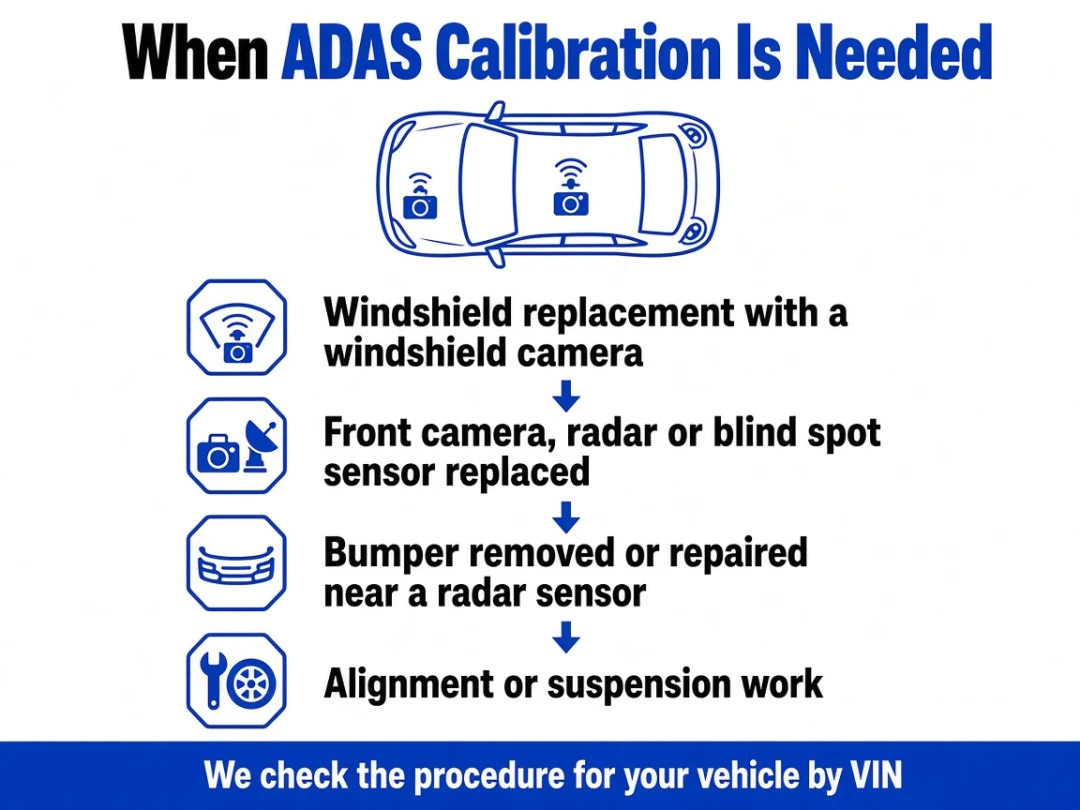
If one of those sensors moves even slightly, the system may read the road wrong, show a warning or switch itself off. Work that commonly calls for ADAS calibration includes:
- a windshield replacement on a car with a windshield-mounted camera;
- replacing or removing a front camera, radar sensor or blind spot sensor;
- bumper removal or repair near a radar sensor;
- a wheel alignment or suspension work that changes the vehicle's thrust angle.
Whether a calibration is needed, and which type, depends on the make, model, year and equipment. We do the ADAS calibration itself; the windshield, bumper or alignment work is done elsewhere. We check the procedure for your vehicle by VIN before the appointment.
TPMS programming: when the tire pressure light stays on
The tire pressure monitoring system (TPMS) uses sensors in each wheel that report to a module. When new sensors are installed, or wheels with different sensors go on the car, the module has to learn their IDs. Until it does, the TPMS light can stay on or flash even when the tires are correctly inflated.
A TPMS reset and TPMS programming are not the same thing. A reset tells the system that the current pressures are correct, and on some vehicles it can be done from a button or menu. Programming writes or relearns sensor IDs so the module recognizes new sensors, which often requires a scan tool. If you have new sensors or wheels and the light will not go off, a reset alone may not be enough.
Procedures differ by vehicle, so they are verified for your vehicle first. We do the programming; we do not sell tires or sensors.
How we handle it
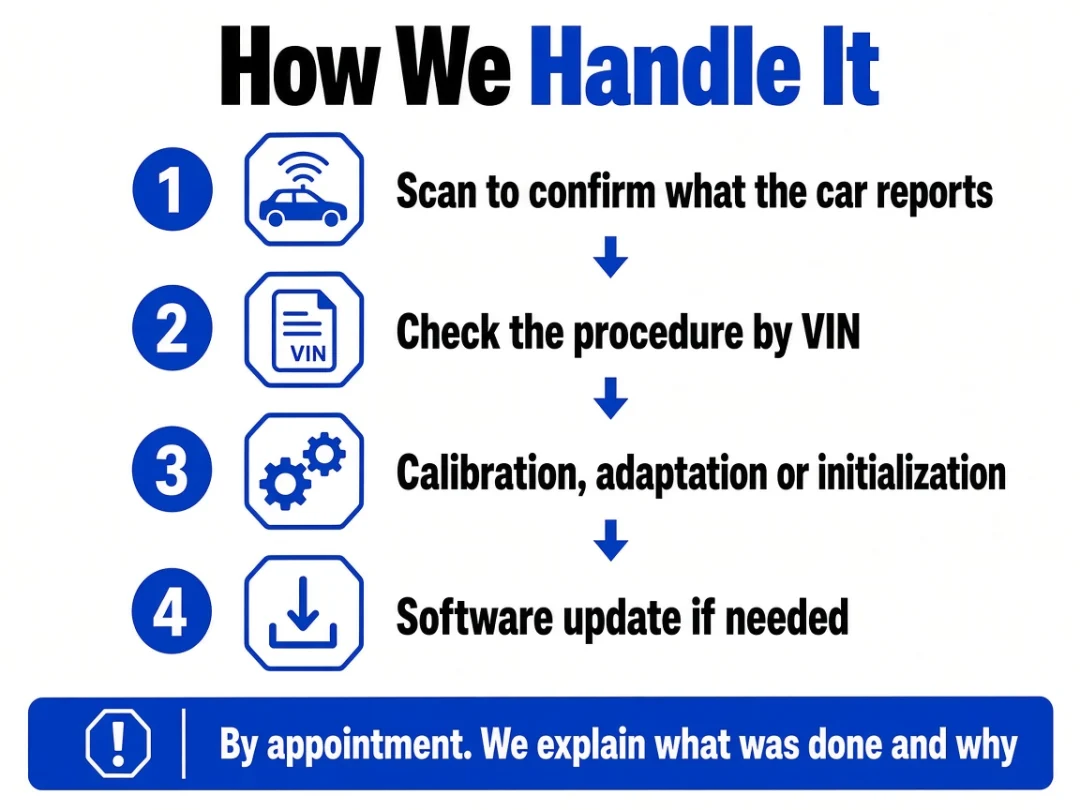
At our Englewood shop we start with a scan to confirm what the car is reporting, then perform the procedures the vehicle needs: sensor calibration, ADAS calibration, TPMS programming, module adaptation, initialization and software updates, depending on the vehicle and module. You get an explanation of what was done and why.
Book an appointment at our Englewood shop. We work in-shop only, by appointment. Tell us what was repaired or replaced and when the symptom started.
Relearn and calibration FAQ
Does my car need a relearn after a new battery?
Some cars do. Disconnecting the battery can erase learned values such as idle settings, and some vehicles also need battery registration. Others relearn on their own with driving. It depends on the vehicle.
What is a throttle body relearn?
It is a procedure that teaches the engine module the throttle's closed position and idle airflow, usually after the throttle body is cleaned or replaced or the battery is disconnected. Without it, the idle can be rough, high or unstable.
Why is my traction control light on after an alignment?
A common reason is a steering angle sensor that needs calibration after alignment or steering work, so the stability system knows where the wheels point. Other faults can turn on the same light, so a scan confirms the cause.
Can a relearn be done without a scan tool?
Some simple relearns can be done with a driving or key-cycle procedure described by the manufacturer. Many others require a scan tool or factory software. It depends on the make, model and system.
Do all cars need battery registration?
No. Battery registration applies to some vehicles that manage battery charging closely. Your owner's manual or the manufacturer's information for your vehicle shows whether it is needed.
Does my car need ADAS calibration after a windshield replacement?
Many vehicles with a camera mounted behind the windshield do, because the camera has to be re-aimed after the glass is replaced. Whether it is required, and which procedure applies, depends on the make, model, year and equipment, so it is checked for your vehicle.
Why is my TPMS light still on after new sensors or tires?
The TPMS module may not have learned the new sensor IDs yet. New sensors or wheels often need TPMS programming or a relearn before the light goes off. A sensor fault or a low tire can also keep the light on. Our guide to a TPMS light that is flashing or on explains when a reset, a relearn or sensor programming is needed.
What is the difference between a TPMS reset and TPMS programming?
A TPMS reset tells the system the current tire pressures are correct. TPMS programming writes or relearns sensor IDs so the module recognizes new sensors. After new sensors are installed, a reset alone may not be enough.
Next steps
Car acting differently after a repair or a battery change, a driver-assistance warning after windshield or alignment work, or a TPMS light that will not go off? Book an appointment at our Englewood shop. Our module programming page lists the programming and adaptation work we do.
This article is general information, not a diagnosis of your vehicle. Relearn, ADAS calibration and TPMS procedures differ by make, model and year; follow the manufacturer's information for your vehicle.