
P0456 Code: EVAP Small Leak — What It Means and What to Check
A P0456 code means the engine computer ran a leak test on the evaporative emission (EVAP) system and found a very small leak. The EVAP system traps fuel vapor from the tank so it can be burned in the engine instead of escaping into the air. P0456 says the sealed system did not hold the way it should, even though the leak is small.
"Small" describes the size of the leak the test detected, not how much it matters. A small leak can come from a gas cap, but it can just as easily come from a hose, a seal or a valve. This guide explains what P0456 typically means, how it differs from P0455, P0442 and P0457, the common causes and how diagnosis finds the leak. It describes typical patterns, not findings from a particular customer's car.
What a P0456 code means (EVAP small leak)
Fuel vapor from the tank is stored in a charcoal canister. When conditions are right, the engine computer opens a purge valve and the engine draws that vapor in and burns it. A vent valve lets fresh air into the canister, or closes so the system can be sealed for testing.
To check for leaks, the computer seals the system and watches whether it holds pressure or vacuum over time. How it does that depends on the platform. When the change suggests a leak above the smallest size it is designed to detect, it stores P0456, usually described as a "very small leak detected."
The code does not say where the leak is. It says the system did not stay sealed during the test. There is no single cause that applies to every vehicle, and a small leak is not a reason to ignore the light: it can return, keep readiness monitors from completing and affect an emissions inspection.
P0456 vs P0455 vs P0442 (and a note on P0457)
These codes describe the size or type of leak the test detected:
- P0455 typically means a large leak, such as a missing or loose gas cap or a disconnected hose. Our P0455 large leak guide covers that code and the gas cap discussion.
- P0442 typically means a small leak, larger than the one behind P0456.
- P0456 typically means a very small leak, the smallest size the system tests for.
- P0457 typically points to a leak linked to the fuel cap, such as a cap that is loose or not installed.
The size threshold behind each code depends on the manufacturer, so there is no universal measurement that applies to every vehicle. A smaller code is not a less real fault; it only describes what the test saw. Very small leaks can be harder to locate than large ones, which is one reason they deserve proper testing.
Other EVAP codes describe different problems: incorrect purge flow, vent control faults or general EVAP malfunctions such as P0440. They are diagnosed differently from a leak code.
Typical causes of a small EVAP leak
Typical P0456 causes include:
- The gas cap or its seal. A cap that is not fully closed, a worn seal or the wrong cap is one possible branch; the P0455 article explains why a cap is not always the answer.
- EVAP hoses and lines. Rubber hoses and connectors can crack, harden or loosen with age, heat and vibration.
- Seals and connections. Small leaks often hide at joints, O-rings or quick connectors.
- The purge or vent valve. A valve that does not seal fully when closed can let the system leak during the test.
- The canister or filler neck. These are possible findings too, depending on the vehicle.
Symptoms of a small leak are often limited to the check engine light. Some drivers notice a faint fuel smell; most notice nothing at all. Our check engine light guide covers what to do when the lamp comes on.
Searches often pair P0456 with a brand, such as Jeep, Ford or Ram. The code definition is broadly the same across makes, but component layout and test methods vary.
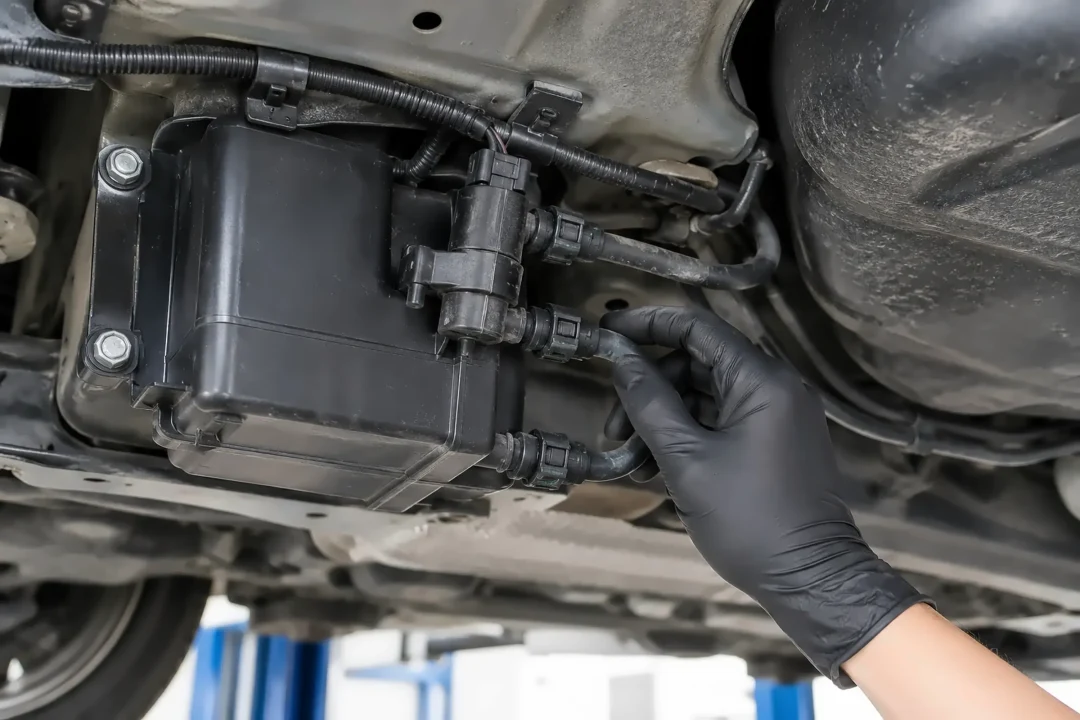
Illustrative in-shop inspection; not a customer's vehicle.
Why tightening the gas cap often fails
Checking the gas cap is a sensible first step, and sometimes it is the cause. But if the leak is in a hose, a seal or a valve, a tight cap changes nothing. The computer runs its leak test again under the right conditions, and the code comes back.
Clearing the code and hoping it stays off has the same problem. It also resets readiness monitors, which can matter if an emissions inspection is coming up. Buying a new cap without testing may simply delay finding the real leak.
Do not try to find a small leak by pressurizing the fuel system or making your own smoke test at home. Fuel vapor is flammable, and EVAP components can be damaged by too much pressure.
How we diagnose a P0456 in the shop
At eForce Automotive Service, car diagnostics for a small leak code follows the system:
- Scan and freeze frame. We read every stored EVAP code and the conditions, such as fuel level and temperature, when P0456 set.
- Visual inspection. We check the gas cap and seal, and inspect visible EVAP hoses, lines and connections for cracks, looseness or damage.
- Valve checks. Using a scan tool, we command the purge and vent valves and check that they respond and seal.
- Leak testing. We use shop equipment designed for EVAP systems to locate the leak, following the procedure for the platform.
- Circuit checks when needed. If a valve does not respond, we test its wiring and connector under auto electrical repair.
- Explain, then repair. We repair or replace EVAP valves and hoses when testing confirms them. If the leak is in another component, such as the canister or filler neck, we explain the finding and the next step.
For an example of how purge and vent valves are tested before replacement, see our EVAP valve article.
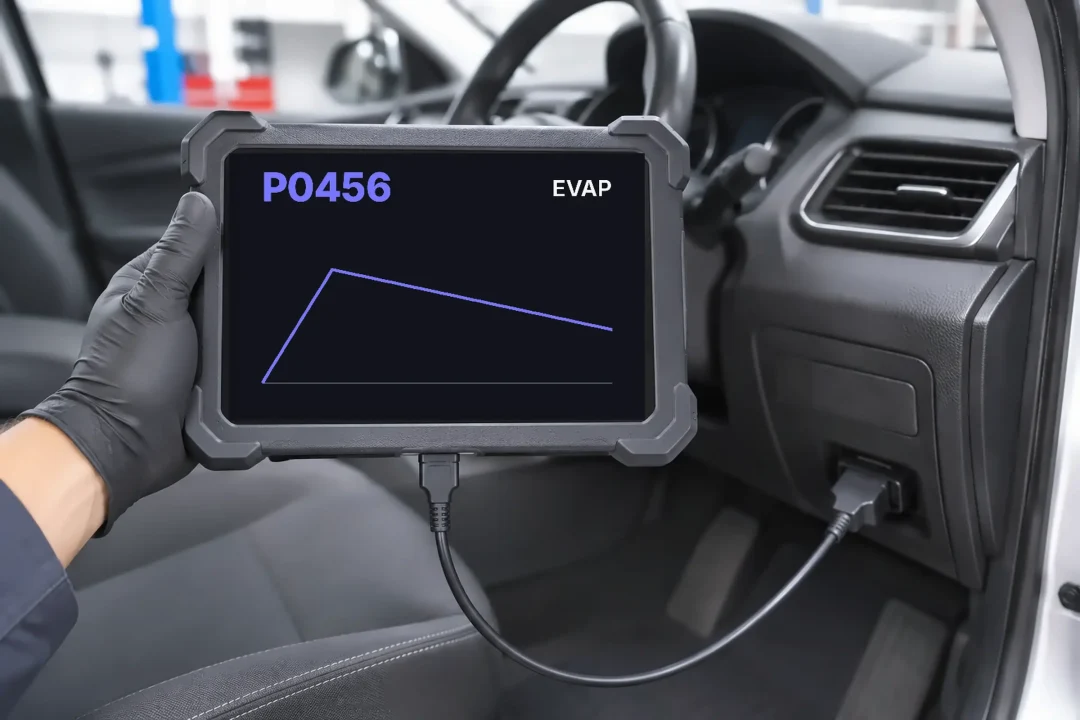
Illustrative scan tool screen; not data from a customer's vehicle.
Book through the phone number in the site header. We work in-shop only, by appointment, at 1713 W Baltic Pl, Englewood, CO 80110. See our services and service area.
FAQ
What does a P0456 code mean?
It means the EVAP system's leak test detected a very small leak. The code says the system did not stay sealed, not which part is leaking.
Is a P0456 small leak the same as a P0455 large leak?
No. P0455 typically describes a large leak, while P0456 describes a very small one. Our P0455 guide covers the large-leak code.
Can a loose gas cap cause a P0456?
Yes, a cap that is not fully closed or has a worn seal is a typical cause. It is not the only one; hoses, seals and valves can cause the same code.
What is the difference between P0456 and P0442?
Both are leak codes. P0442 typically describes a small leak, and P0456 a very small one. The exact thresholds depend on the manufacturer, and the diagnostic approach is similar.
Will replacing the gas cap always fix a P0456?
No. A new cap fixes the code only when the cap was the leak. If a hose, seal or valve is leaking, the code returns.
How do I book EVAP / P0456 diagnosis in Englewood?
Call the number in the site header to set an in-shop appointment. Mention all stored codes and whether the cap was recently changed.
General information, not a diagnosis of your vehicle. Fuel vapor is flammable; do not pressurize or smoke-test EVAP systems at home.