
Subaru WRX STI 2016: Engine Knock, AVCS Sync Faults and a Multi-Day Diagnosis
A 2016 Subaru WRX STI came in with an engine knocking sound at idle, AVCS / VVT sync faults, a failed Colorado emissions visit, and a busy dash. A one-code parts swap was never going to finish it.
This post shows how we handle that job: what the lights meant, what the P0011 code family points at on an STI, why multi-day diagnosis is normal here, and when to bring a similar car in.
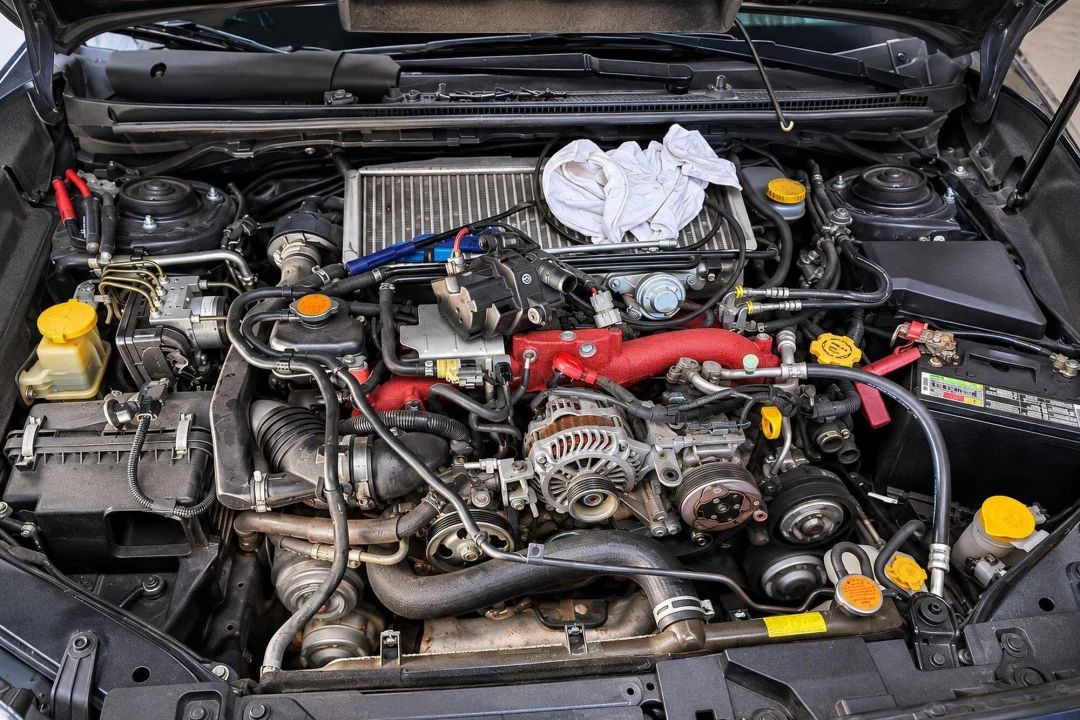
The car: 2016 Subaru WRX STI with knock, AVCS faults and a failed emissions test
The car was a 2016 WRX STI — EJ-series turbo, daily driven, about 400 horsepower as the customer runs it. That number describes the car, not a tuning service we sell.
What we walked into:
- a metallic engine knocking / ticking sound at idle;
- AVCS / VVT sync faults that would not clear with a casual code wipe;
- a failed emissions test on the active check engine light;
- CEL, battery / charging, and power steering (EPS) lights together;
- several days of structured testing before the car was ready to return.
On cars like this 2016 WRX STI, the AVCS/VVT sync faults that come with idle knock and a failed emissions test commonly land in the P0011 / P0021 family (intake cam timing not matching the ECM command on one or both banks). We treat those as a starting map — the scan on any one car can differ.
Shop work example: the symptoms come from a real car in our Englewood shop; the example codes and cause paths below are typical for this platform, not a verbatim scan log unless noted.
On EJ-series Subarus, Subaru AVCS is the variable valve timing setup. Restricted oil to the AVCS oil control valves — or a sticking variable valve timing solenoid — is what usually stores that P0011 / P0021 family. That oil path is also why ticks get blamed on “rod knock” before anyone checks the OCVs and screens.
What the dashboard was saying (CEL, charging light, power steering light)
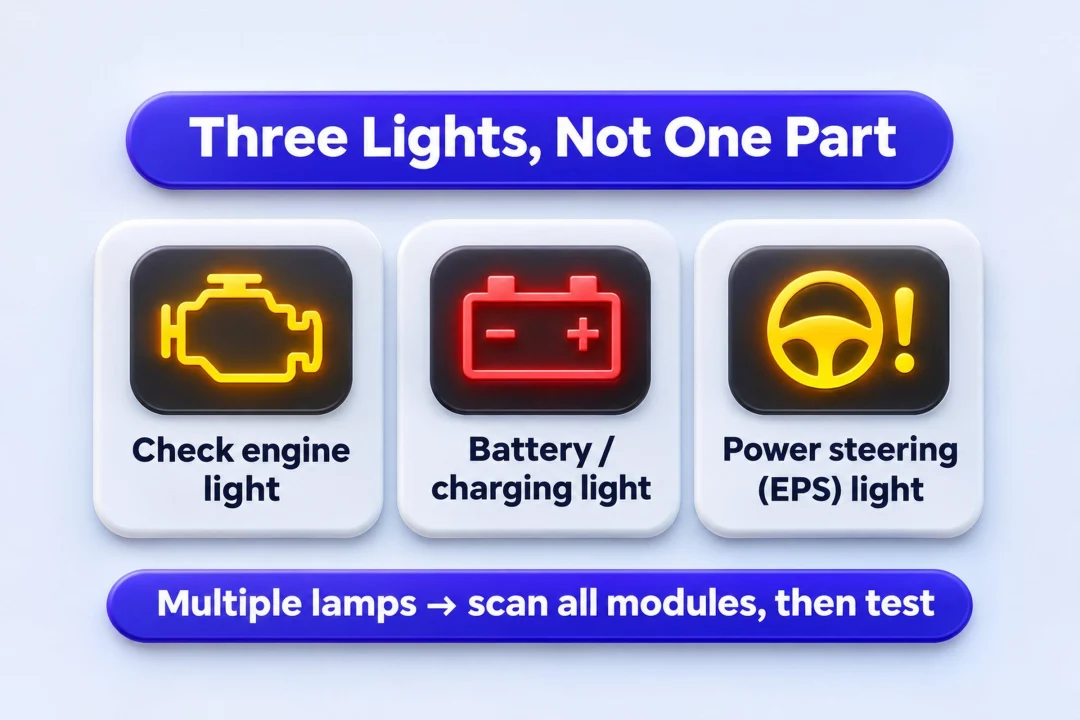
Three lamps at once are a clue, not a shopping list:
- Check engine light — AVCS performance codes will keep it on and will fail emissions.
- Battery / charging light — see our battery light guide; it is not automatically “replace the alternator.”
- Power steering warning light — EPS can complain when voltage or module data is unhappy; context in dashboard warning lights.
Live charging data in this class of job often sits in the mid-13 V range when the charging light is a secondary clue — we read voltage on the car in front of us. That keeps charging and EPS lamps as context to verify, not the first parts to throw. Follow-up: auto electrical repair, alternator repair, check engine light on.
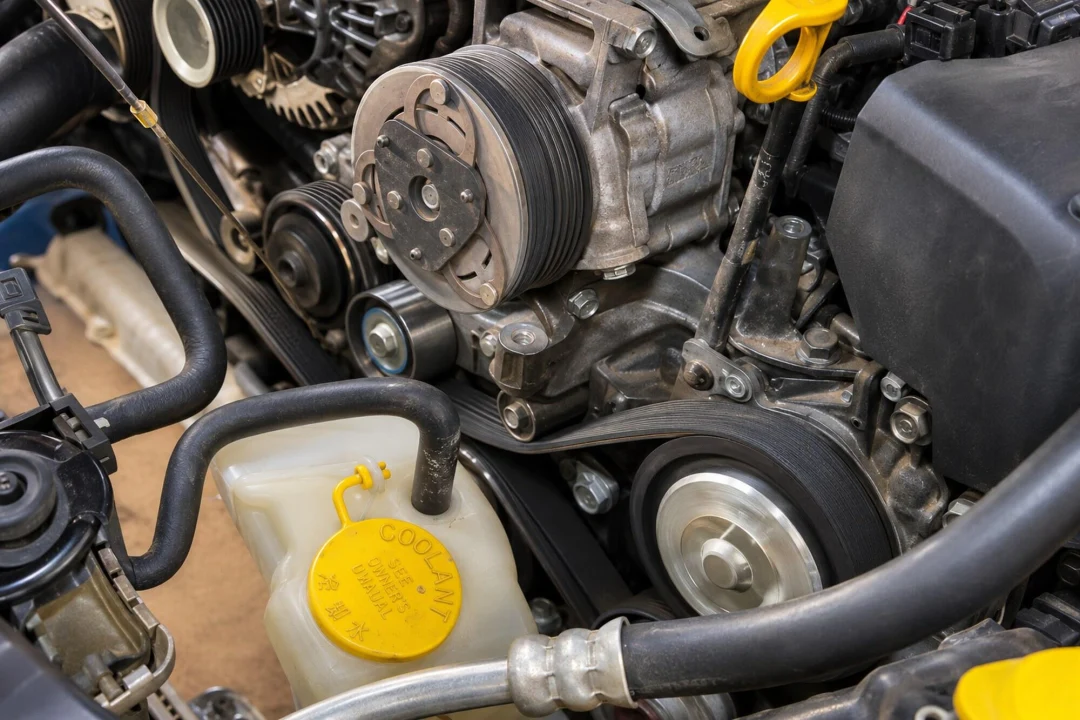
Front accessory drive: belt, pulleys and nearby hoses.
AVCS / VVT sync faults — what P0011 and P0021 point at (and what they don’t)
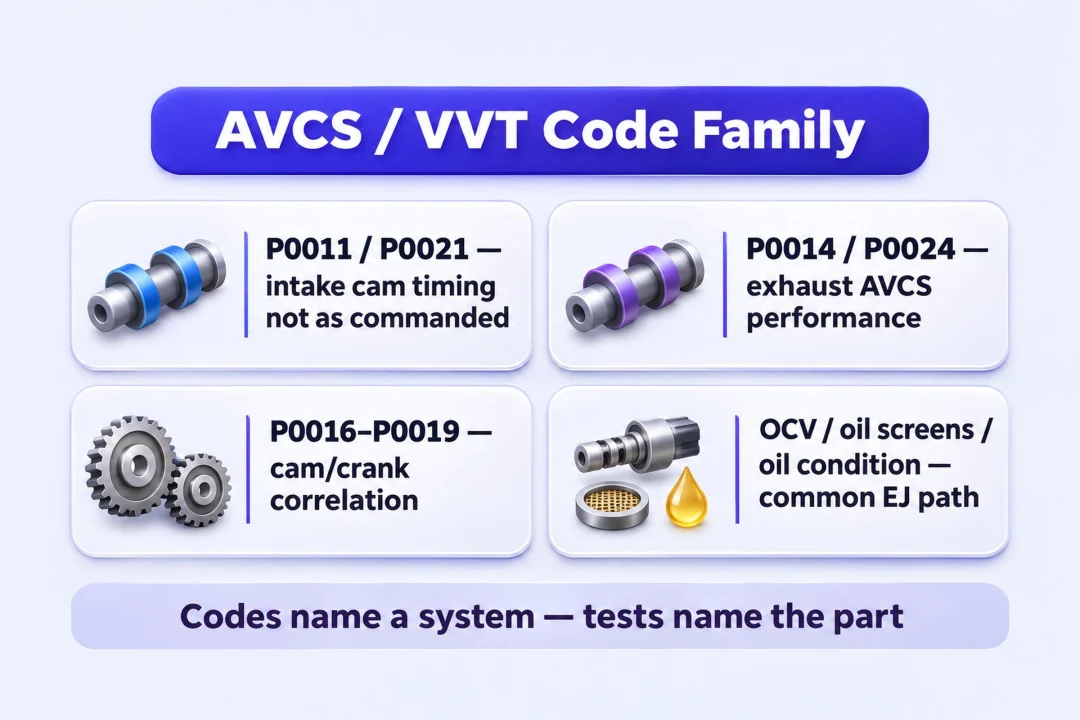
Owners search P0011 code, P0021, P0014, P0024, P0016, and camshaft position correlation. On this kind of STI job the pattern that usually matches idle knock plus AVCS sync faults is the P0011 / P0021 family — intake cam timing on one or both banks not matching what the ECM commanded.
| Code family | Plain language | Typical STI / EJ path |
|---|---|---|
| P0011 / P0021 | Intake AVCS over-advanced or performance fault | Oil control valves, clogged AVCS oil screens, dirty/wrong oil, low oil pressure |
| P0014 / P0024 | Exhaust AVCS performance | Same oil-control neighborhood on exhaust side |
| P0016–P0019 | Cam/crank correlation | Sensors, wiring, actual timing — different branch |
| Sensor / circuit | Signal the ECM cannot trust | Camshaft position sensor, harness, ground |
EJ turbo AVCS checks start the same way: oil level and condition, oil control valve / AVCS solenoid response, and the mesh screens in the AVCS oil feed that varnish and starve the system. A stuck OCV is a common path to vvt solenoid replacement after the data proves it.
Those codes do not mean “rod knock,” “ringland,” or “replace the engine.” EJ257 rod-bearing knock and ringland failure are real, but they look different (deep load knock, oil-pressure clues, misfire, blow-by). We rule them out — we do not assume them from every tick next to a P0011.
Why a code read is not a diagnosis on a case like this
A printout that says “P0011 — replace VVT solenoid” skips the work:
- Knock + AVCS codes can share an oil-control cause — or sit next to an unrelated noise.
- Failed emissions needs a real fix, not a cleared light for the station visit.
- Charging and EPS lights need voltage context before an alternator guess.
- STIs are sensitive to oil quality and AVCS oil feed; guessing solenoids twice gets expensive.
Same idea as other multi-step jobs we document, such as locked ECU bench access: prove the system, then repair what failed.
How a multi-day diagnostic looks on this kind of STI job
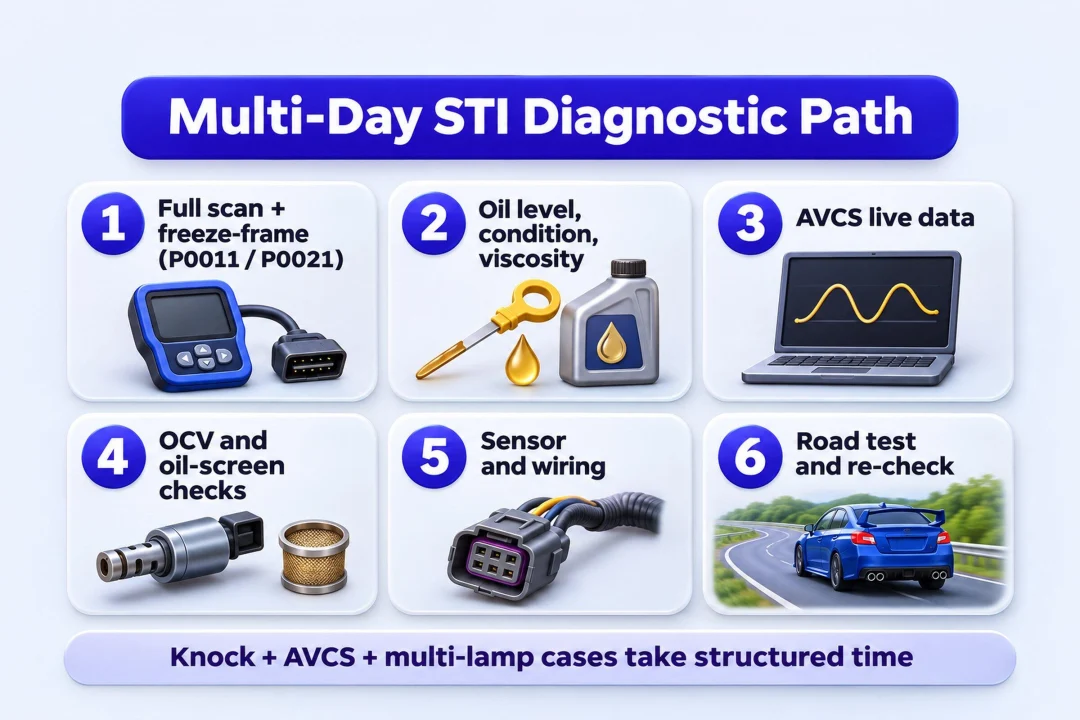
Several days is normal when AVCS needs a full drive cycle, knock must be caught cold and hot, and oil-control parts must be verified — not swapped on a hunch. On jobs like this 2016 WRX STI, here is how we work:
- Full scan and freeze-frame — every module, then the AVCS/VVT family (often P0011 / P0021) with RPM, load, and temperature.
- Oil basics — level, condition, correct viscosity before any solenoid comes off.
- AVCS live data — commanded vs actual cam angles and oil-control response.
- OCV and oil-screen path — oil control valves plus AVCS feed screens for the varnish restriction EJ turbos are known for.
- Sensor / wiring — cam/crank integrity so a camshaft position sensor or harness fault is not missed.
- Noise differential — idle tick vs deep load knock; oil-pressure context so “rod knock” is not assumed from a phone video.
- Charging / EPS context — live module voltage on that car; lamps documented, not used to skip AVCS work.
- Road test and re-check — drive cycle, confirm AVCS values, CEL stays off for emissions readiness.
That is the path we use on jobs like this STI. The car was finished and ready to return to the customer.
What was repaired on this kind of STI job
On EJ-series turbos, the path that typically clears this pattern is restoring AVCS oil control: correct oil service, clearing restricted feed screens when present, and oil control valve / VVT solenoid work on the banks the tests fail — then verifying cam response on a retest drive. When knock tracks with an AVCS oil-control fault, it typically quiets with that repair — not an automatic bottom-end teardown. We repair what the tests on that car prove; we do not invent a parts list from a forum thread.
No “every Subaru,” no same-day promises on multi-lamp cases, and no horsepower sold as a service.
When to bring a car with knock + timing codes + multiple lights in
Bring it in when:
- an engine knocking sound shows up with a CEL and AVCS / cam codes;
- the car failed emissions on an active light;
- battery and power steering lights join the CEL;
- a prior shop cleared codes or swapped one solenoid and the problem returned.
Start with car diagnostics. Also: auto electrical repair, services, service area.
In-shop, by appointment. Book through the phone number in the site header.
FAQ
What does a P0011 (or similar AVCS/VVT) code mean on a Subaru?
A P0011 code means intake cam timing on bank 1 did not match the ECM command. P0021 is the bank-2 twin. On STIs, start with oil condition, AVCS oil screens, and the oil control valve / VVT solenoid — not an automatic engine replacement.
Can engine knock and a timing sync code be related?
Yes. Restricted AVCS oil flow or a sticking solenoid can produce both a tick and P0011/P0021. Deep rod knock is different; diagnosis separates the sound and the oil-pressure picture.
Why would CEL, battery and power steering lights come on together?
Shared voltage, ground, or module issues — or separate findings. We scan everything and read live voltage before replacing parts.
Will a car with an active CEL pass Colorado emissions?
Usually no. An active check engine light, or monitors that are not ready, fails Colorado emissions. Fix the cause, confirm readiness, then retest.
How long can a complex electrical and timing diagnosis take?
From a same-visit scan to several days when AVCS needs a full drive cycle or knock must be reproduced on purpose. Jobs like this STI often take that longer path.
Do you work on Subaru WRX / STI models?
Most makes are welcome when we verify support by year, model, and VIN. We do AVCS/VVT and electrical diagnosis on Subarus that pass that check — without claiming every STI sight-unseen.
Next steps
Knock, AVCS codes, failed emissions, or a busy dash on a WRX STI? Book diagnostics at our Englewood shop — start with car diagnostics.
Shop work example — not a diagnosis of your vehicle, and not a promise that every Subaru with a tick or P0011 needs the same repair.