
Reduced Engine Power or Limp Mode: What It Means and What to Do
Reduced engine power on the dash — sometimes labeled limp mode, limp home, or a similar message — means the vehicle has limited performance on purpose. It is a protective strategy, not a diagnosis of one failed part.
This guide explains what drivers feel, common trigger families, the electrical angle (low voltage, grounds, module communication), why disconnecting the battery is a bad “fix,” and how diagnosis starts. It is general information, not a diagnosis of your vehicle. Our shop is in Englewood, Colorado, and we handle car diagnostics by appointment.
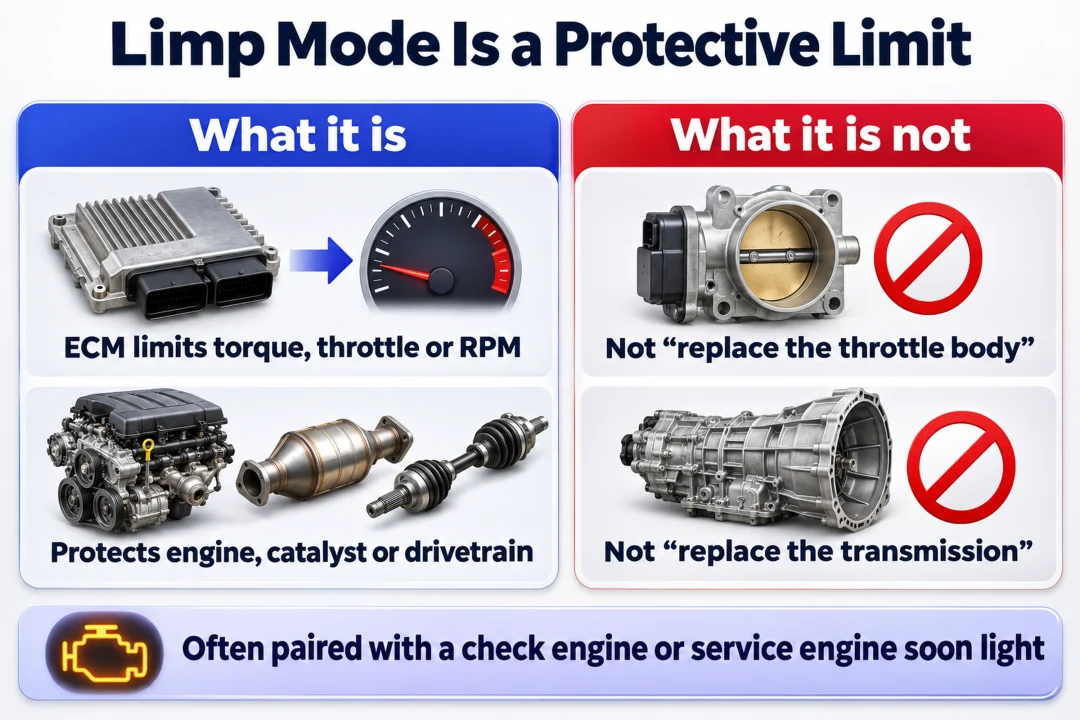
Quick answer: limp / reduced power = protective mode, not a single part
- What it is: the ECM (and sometimes the transmission control module) limits torque, throttle opening, or RPM to protect the engine, catalyst, or drivetrain.
- What it is not: a label that means “replace the throttle body” or “replace the transmission.”
- Often paired with: a check engine light or service engine soon light, stored codes, and sometimes other warnings.
- What to do now: reduce load, avoid highway passing if power is severely limited, and arrange diagnosis rather than clearing codes and hoping.
What drivers feel
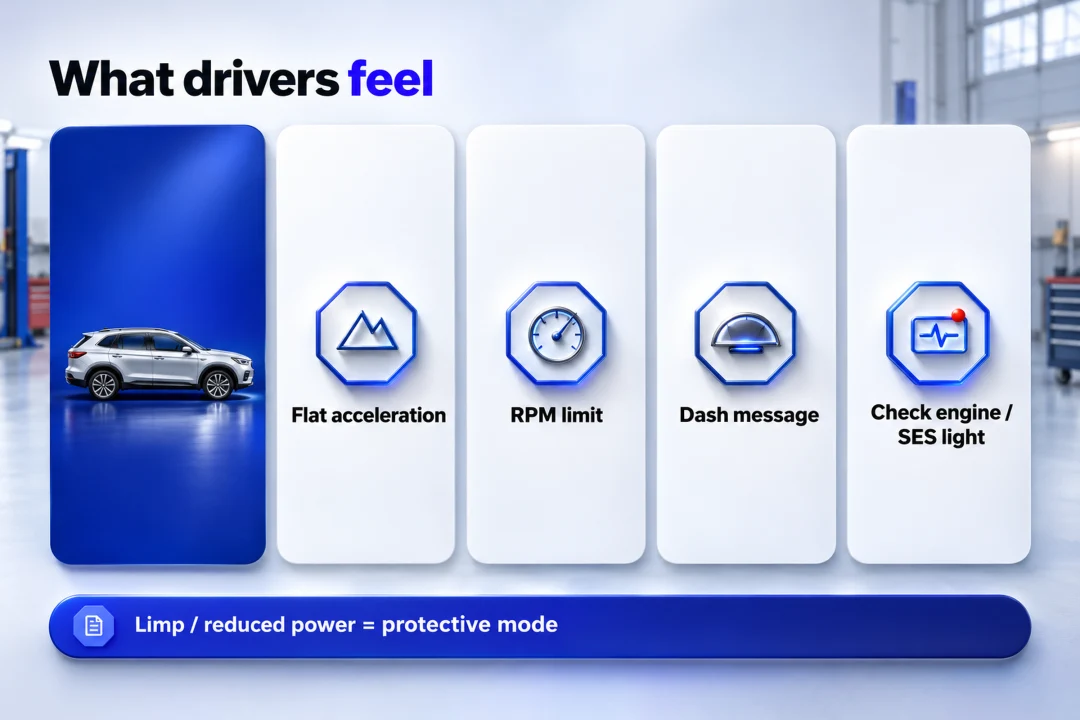
Typical limp mode car symptoms:
- acceleration feels flat; the car will not take normal throttle;
- RPM may be capped;
- a message such as “Reduced Engine Power,” “Limp Home,” or similar;
- check engine / service engine soon light on;
- sometimes multiple warnings at once — see dashboard warning lights.
Severity varies. Some cars barely crawl; others feel only mildly restricted. Either way, the computer has already decided something is wrong.
Common trigger families — identify the system, don’t guess
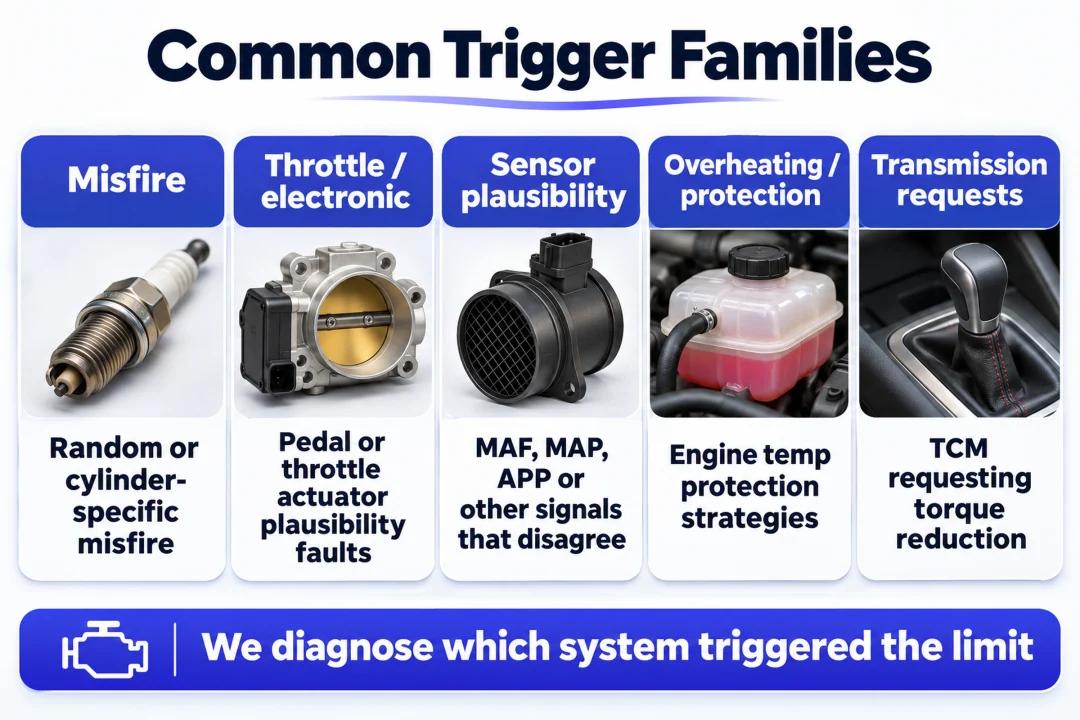
Reduced engine power is a response. Common trigger families include:
| Family | Examples | Our approach |
|---|---|---|
| Misfire | Random or cylinder-specific misfire (including P0300-type events) | Diagnose misfire cause; see P0300 random misfire; flashing CEL context in check engine light guide |
| Throttle / electronic | Pedal or throttle actuator plausibility faults | Scan + circuit/live data checks |
| Sensor plausibility | MAF, MAP, APP, coolant, or other signals that disagree | Prove the signal and circuit before parts |
| Overheating / protection | Engine temp protection strategies | Identify system; we explain mechanical findings |
| Transmission requests | TCM requesting torque reduction | Identify system; we do not promise transmission overhaul from the message alone |
eForce diagnoses which system triggered the limit. We do not advertise engine or transmission rebuilds from a limp-mode message.
Electrical angle: voltage, grounds, module communication
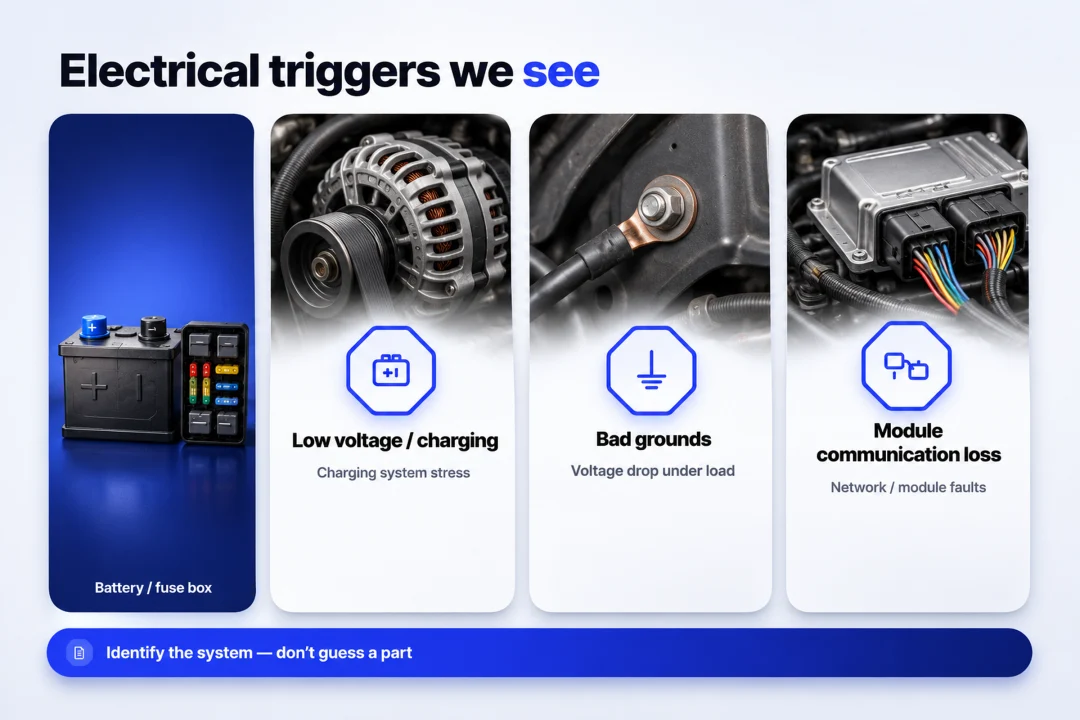
Electrical problems are a frequent hidden trigger:
- Low system voltage makes sensors and modules report nonsense; the ECM may limit power. If the battery light is on, see battery light on meaning. We diagnose and repair charging-system faults, including alternator diagnosis and repair, when tests point there.
- Bad grounds create intermittent reduced-power events that vanish at the shop — see voltage drop test / bad ground symptoms.
- Lost communication between modules (for example U-codes such as U0100) can force protective strategies — see U0100 lost communication.
Electrical diagnosis for these paths is covered on our auto electrical repair page.
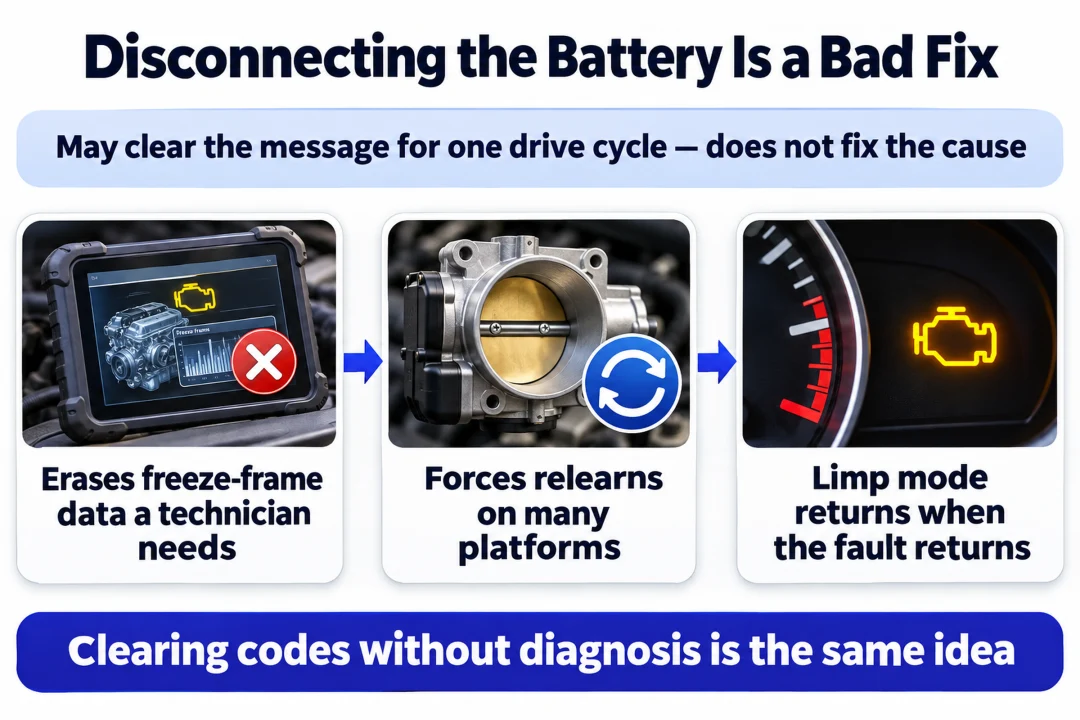
Why disconnecting the battery is a bad “fix”
Pulling the battery cable may clear the message for one drive cycle. It does not fix the cause. It can also:
- erase freeze-frame data a technician needs;
- force relearns (throttle, TPMS, windows, radio) on many platforms;
- return you to the same limp mode as soon as the fault returns.
Clearing codes without diagnosis is the same idea. The protective mode will come back if the trigger is still there.
How diagnosis starts
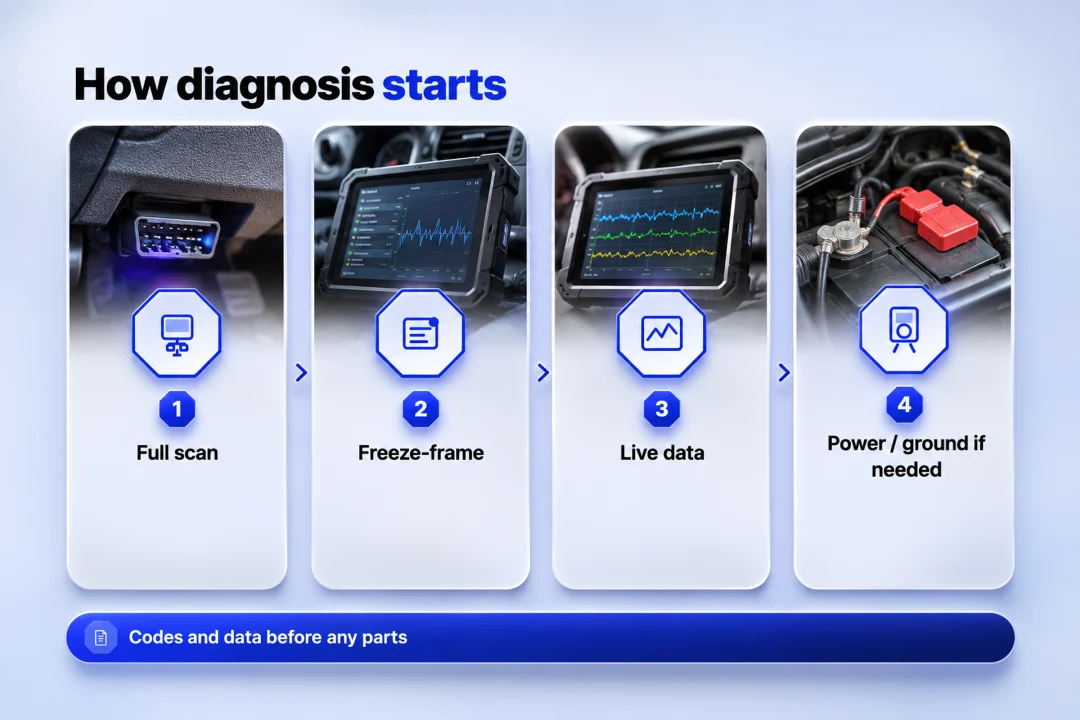
A practical starting sequence:
- Full module scan — not only the engine code a cheap reader shows.
- Freeze-frame — speed, load, temperature, voltage when reduced power set.
- Live data — throttle commands vs actual, sensor plausibility, fuel trims, misfire counters.
- Power and ground verification when voltage or intermittent behavior is in the story.
- Road test under controlled conditions when the fault is intermittent.
You get an explanation of what was found before further work. We work in-shop only, by appointment.
Booking notes
Please note:
- year, make, model, VIN;
- exact dash message wording if you remember it;
- whether a check engine or service engine soon light is on;
- whether power loss is constant or intermittent;
- any recent battery, charging, or software work.
Newer Audi, Mercedes, and BMW module programming, when required, is verified by VIN.
Reduced engine power FAQ
Is limp mode the same as a check engine light?
No. Limp / reduced power is a performance limit. A check engine or service engine soon light is a malfunction indicator. They often appear together but are not the same thing. General lamp behavior is in our check engine light article.
Can I drive in limp mode?
Only as far as you must to reach a safe place or the shop. Passing power and highway merges can be unsafe when torque is limited.
Does reduced engine power mean my transmission is failing?
Not by itself. Some faults involve transmission requests; many are engine, throttle, sensor, or electrical. Diagnosis identifies the system.
Will a code clear remove limp mode permanently?
No. If the trigger remains, the mode returns.
Can a bad alternator cause reduced engine power?
Yes. Charging faults and low voltage can push the ECM into protective strategies. We diagnose the charging system and repair the alternator when that is the cause.
Next steps
Seeing reduced engine power or limp mode? Book a diagnostic appointment at our Englewood shop. We work in-shop only, by appointment. Start with car diagnostics; for electrical and charging-related causes see auto electrical repair.
This article is general information, not a diagnosis of your vehicle. Do not ignore overheating or flashing check engine lights while driving in limp mode.