
Signs of a Bad O2 Sensor: Symptoms, Codes and What to Check
Bad O2 sensor symptoms are often quiet: a check engine light, fuel economy that slowly gets worse or an idle that is not as smooth as it used to be. Oxygen sensors report what is happening in the exhaust, and the engine computer uses that information to adjust the fuel mixture and to monitor the catalytic converter.
Its codes do not always mean the sensor failed: wiring, a connector, the heater circuit, an exhaust leak or a real mixture problem can produce them too. This guide covers typical signs, upstream vs downstream sensors, the common codes and how diagnosis separates the sensor from everything around it. It describes typical patterns, not findings from a particular customer's car.
Signs of a bad O2 sensor (what drivers usually notice first)
Typical signs of a bad O2 sensor include:
- A check engine light, often the first and sometimes the only sign;
- Higher fuel use, when the computer adjusts the mixture on a misleading signal;
- Rough or unstable idle;
- Hesitation or uneven running when accelerating;
- An exhaust smell, such as a stronger fuel or sulfur smell;
- Emissions readiness monitors that do not complete.
These are typical possibilities, not a fixed set. Many cars show only the warning light. Asking how to tell if an O2 sensor is bad from symptoms alone usually leads nowhere definite, because a vacuum leak, a fuel delivery problem or a misfire can feel the same. If misfires are part of the picture, our P0300 guide explains that code. For warning light basics, see our check engine light guide.
Upstream vs downstream oxygen sensors (bank 1 sensor 1 and sensor 2)
Most modern vehicles have at least two oxygen sensors per exhaust bank:
- The upstream oxygen sensor, called bank 1 sensor 1, sits before the catalytic converter. The computer uses it mainly to adjust the fuel mixture.
- The downstream oxygen sensor, called bank 1 sensor 2, sits after the converter. The computer typically uses it to judge how well the converter is working.
Bank 1 contains cylinder 1; engines with a second cylinder bank also have bank 2 sensors. Some upstream positions use air-fuel ratio sensors with different signal behavior.
A downstream sensor code is not automatically about the converter, and an upstream code is not automatically about the sensor. The position tells you which signal is involved, not what failed.
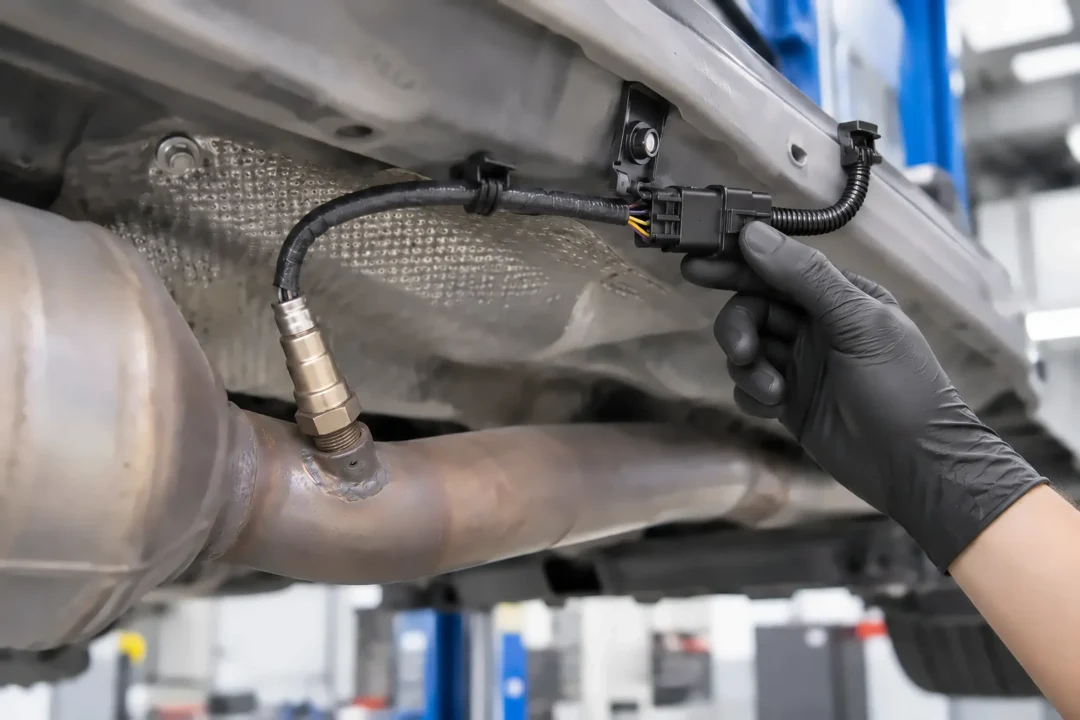
Illustrative in-shop inspection on a lift; not a customer's vehicle.
Related O2 sensor codes (heater, signal and circuit)
Oxygen sensors need to be hot to work, so most have a built-in heater. Codes typically fall into two groups:
Heater codes
- P0135 typically points to the heater circuit of bank 1 sensor 1, and P0141 to bank 1 sensor 2.
- P0155 and P0161 carry the same meaning for bank 2 sensors 1 and 2.
- P0030 and P0036 are related heater control circuit codes for bank 1 sensors 1 and 2 on many vehicles.
Signal and circuit codes
- P0130–P0134 typically cover bank 1 sensor 1: circuit (P0130), low voltage (P0131), high voltage (P0132), slow response (P0133) and no activity (P0134).
- P0136–P0138 identify bank 1 sensor 2 circuit, low-voltage and high-voltage faults, respectively.
- P2195 and P2270 identify biased/stuck-lean signals at bank 1 sensors 1 and 2; P2A00 concerns bank 1 sensor 1 range/performance.
Exact definitions depend on the manufacturer. A heater code often points to the heater circuit, which includes wiring, the connector and a fuse or relay as well as the sensor. A signal code may come from the sensor, its wiring, an exhaust leak near the sensor or a genuine lean or rich mixture. Our P0171 lean guide explains how mixture problems show up in fuel trim.
Bad O2 sensor vs a P0420 catalyst code
P0420 typically means the catalytic converter efficiency on bank 1 is below threshold; P0430 means the same on bank 2. The computer reaches that conclusion largely by comparing the upstream and downstream sensor signals.
That is why the two are often confused. A misleading downstream signal can contribute to P0420, but often P0420 reflects the converter's real condition or an exhaust leak. Our P0420 guide covers that code. The point here is simple: P0420 is not automatically a dead oxygen sensor, and replacing a sensor will not fix a worn converter.
Why swapping an O2 sensor from the parts store often fails
A new oxygen sensor cannot fix a damaged harness, a melted or corroded connector, a blown heater fuse or a poor ground. Wiring near the exhaust is exposed to heat and road debris, which makes it a common branch. An exhaust leak ahead of the sensor can also let outside air in and distort the reading.
When the sensor correctly reports a lean or rich condition, a new one reports the same thing, and the code comes back.
How we diagnose an O2 sensor problem in the shop
At eForce Automotive Service, car diagnostics for oxygen sensor symptoms follows the evidence:
- Scan and freeze frame. We read all codes, including fuel trim, misfire and catalyst codes, and the conditions when they set.
- Live sensor data. We review upstream and downstream signals and fuel trims to see whether a sensor responds normally or is reporting a real mixture problem.
- Heater circuit checks. For heater codes we test the circuit's power, ground and control, including fuses and connectors.
- Wiring and connector inspection. We inspect the harness near the exhaust for heat damage, chafing and corrosion. Confirmed wiring, connector and ground faults are repaired under auto electrical repair.
- Exhaust leak check. We look for leaks ahead of the sensor that could distort the signal.
- Conclusion. We explain whether the evidence points to the sensor, its circuit, the converter or another branch.
Our service for oxygen sensor codes is diagnosis, plus repair of confirmed wiring and connector faults. If diagnosis points to the sensor or converter itself, we explain the finding and next step; this article offers diagnosis, not replacement.
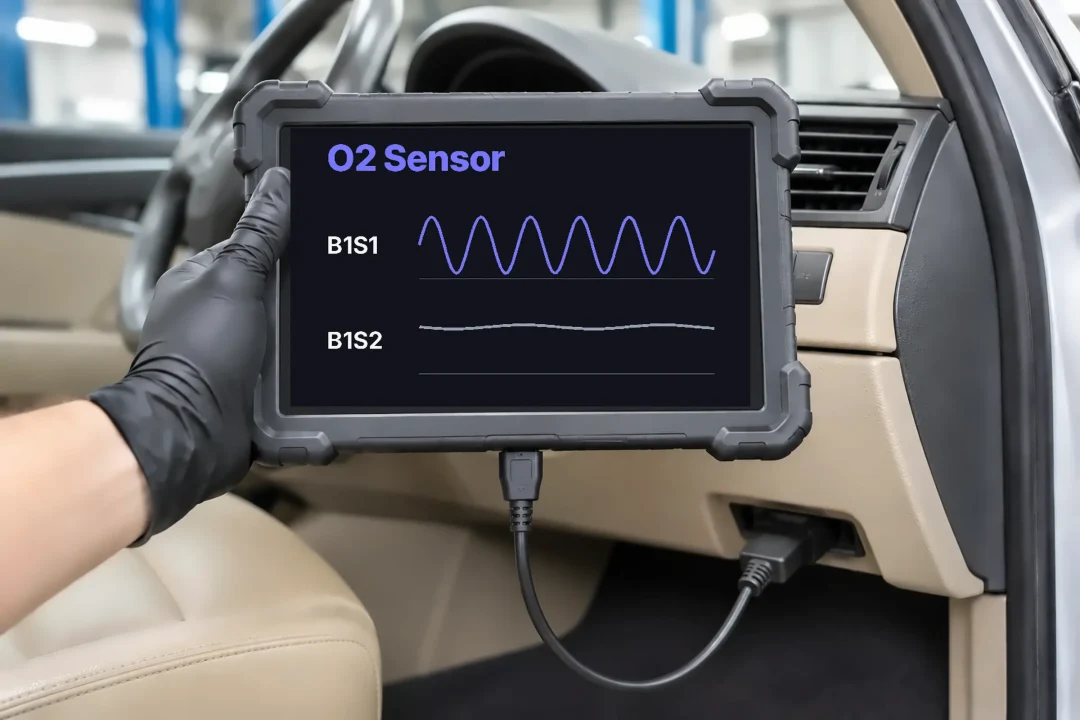
Illustrative scan tool screen; not data from a customer's vehicle.
Book through the phone number in the site header. We work in-shop only, by appointment, at 1713 W Baltic Pl, Englewood, CO 80110. See our services and service area.
FAQ
What are the most common signs of a bad O2 sensor?
A check engine light, higher fuel use, rough idle and hesitation. Other faults cause the same signs, so testing confirms the cause.
How do I tell a bad oxygen sensor from a P0420 catalyst problem?
P0420 typically means converter efficiency is below threshold, while sensor codes point to the sensor or its circuit. The two can be related, so live data and circuit checks separate them. Our P0420 guide explains the catalyst code.
What does a P0135 or P0141 code mean?
These typically point to the oxygen sensor heater circuit: P0135 for bank 1 sensor 1 and P0141 for bank 1 sensor 2. The fault can be in the heater, the wiring, the connector or a fuse.
Can wiring or a connector cause the same symptoms as a bad O2 sensor?
Yes. Damaged wiring, a corroded connector or a poor ground can set the same codes and symptoms. That is a typical branch, especially near the exhaust.
Will replacing the oxygen sensor always fix the code?
No. A new sensor helps only when the sensor itself failed. Diagnosis confirms the cause first; our offer here is diagnosis, not sensor replacement.
How do I book O2 sensor diagnosis in Englewood?
Call the number in the site header to set an in-shop appointment. Mention all stored codes and any change in fuel use.
General information, not a diagnosis of your vehicle. Exhaust parts get very hot; leave testing to properly equipped technicians.