
P0420 Code: Catalyst System Efficiency Below Threshold — What It Means
A check engine light with a P0420 code is one of the most common mid-tail diagnostic trouble codes drivers see. The official description is “Catalyst System Efficiency Below Threshold (Bank 1).” In plain language, the engine computer has decided that the catalytic converter on bank 1 is not cleaning the exhaust as well as it should.
This guide explains what P0420 means, how the ECM compares oxygen sensor readings, common causes, why clearing the code or pouring in a cleaner often fails, and what a real diagnostic checks. It is general information, not a diagnosis of your vehicle. Our shop is in Englewood, Colorado, serving the Denver and south Denver metro area, and we handle check engine light diagnostics by appointment.
Quick answer: what P0420 means in plain language
- What it means: the ECM sees that the catalyst on bank 1 is less efficient than the expected threshold.
- What it does not mean by itself: it does not automatically mean “replace the catalytic converter” or “replace the O2 sensors.”
- Bank 1: the side of the engine that contains cylinder 1. On many four-cylinder engines there is only one bank.
- Related light: P0420 turns on the check engine light. For what that light means in general, see our guide to a check engine light on.
How the ECM compares upstream and downstream O2 readings
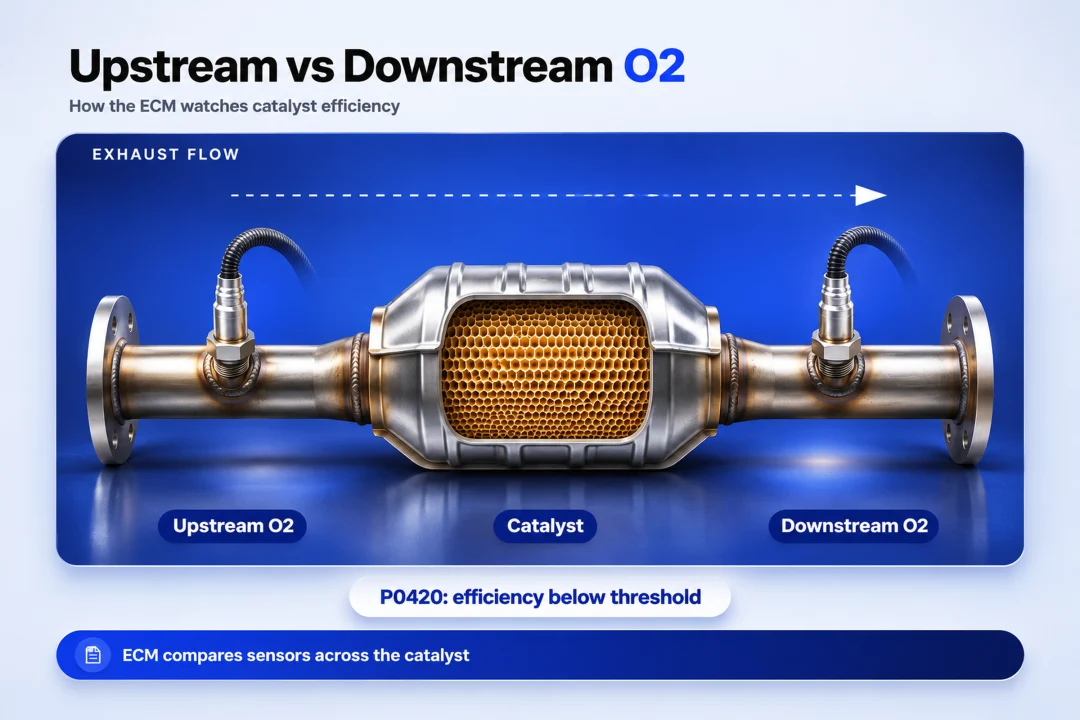
Modern gasoline engines use oxygen sensors (O2 sensors) before and after the catalytic converter.
| Sensor | Typical location | What the ECM expects |
|---|---|---|
| Upstream (pre-cat) | Before the catalyst | Active switching as the mixture adjusts |
| Downstream (post-cat) | After the catalyst | A more stable signal if the catalyst is working |
The ECM compares those signals over time. A healthy catalyst smooths out the exhaust chemistry, so the downstream reading should look quieter than the upstream one. When the downstream pattern starts to look too much like the upstream pattern, the computer may set P0420 — catalyst system efficiency below threshold.
That comparison is a monitor, not a parts label. A bad downstream sensor, wiring fault, exhaust leak, or unresolved misfire can make the numbers look like a weak catalyst even when the converter itself is fine.
Common causes — diagnosis, not parts guessing
These are frequent contributors. Tests show which one applies; guessing parts by the code alone often wastes money.
- Aging or damaged catalytic converter — heat, age, contamination, or damage from earlier misfires can reduce efficiency.
- O2 sensor or wiring faults — a slow, biased, or shorted sensor, or a damaged harness, can distort the comparison. Bad O2 sensor symptoms and O2 sensor codes often overlap with catalyst codes.
- Exhaust leaks ahead of or around a sensor — false air changes the readings the ECM uses.
- Unresolved misfires or rich/lean conditions — raw fuel or excess oxygen can damage the catalyst over time and also skew monitors.
- Recent repairs without completing monitors — a new sensor or exhaust part may need drive cycles before the monitor runs correctly.
eForce diagnoses the cause of the check engine light. We do not sell or promise catalytic converter or O2 sensor replacement as a standalone “fix the code” service. If the diagnostic points to a non-electrical part, we explain what we found so you can decide next steps.
Why a code clear or “catalytic cleaner” often fails
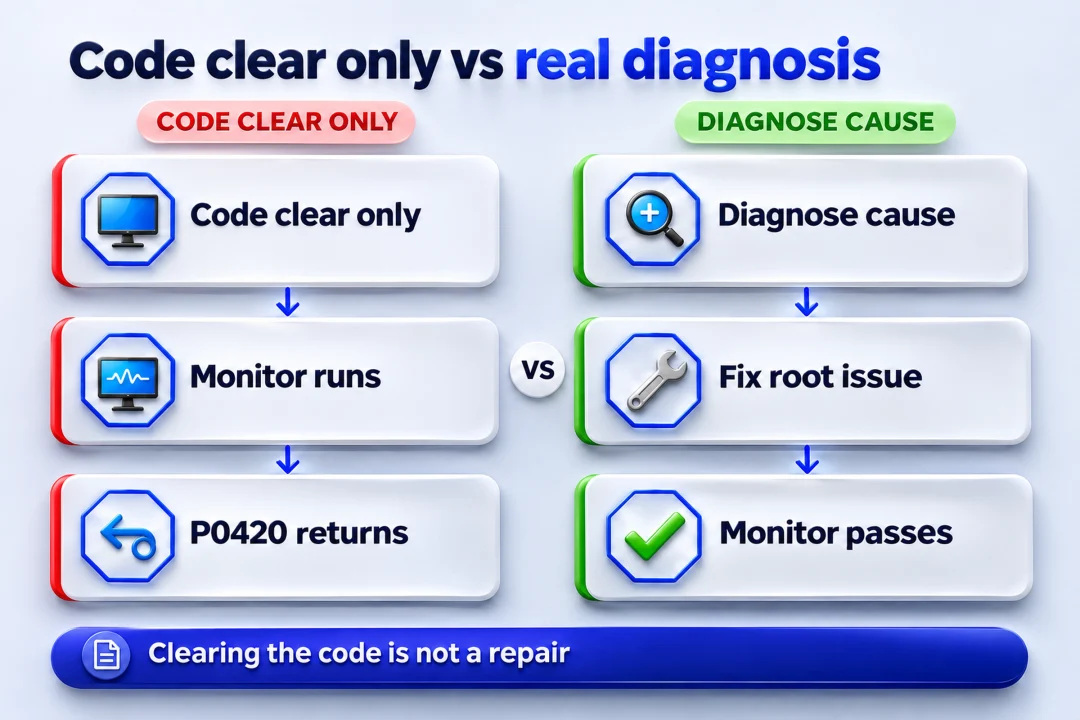
Clearing the code with a cheap scanner turns the light off until the monitor runs again. If the underlying condition is still there, P0420 usually returns. That is not a repair.
Fuel-system or “catalytic” cleaners sometimes help only when the root issue is mild contamination and the converter is still within range. They do nothing for a dead sensor, a wiring fault, an exhaust leak, or a converter that has already failed the efficiency threshold. Treating the light as the problem, instead of the cause, is how drivers end up buying the same parts twice.
What a real diagnostic checks
At our Englewood shop, a proper diagnostic for a catalytic converter check engine light and related oxygen sensor check engine light complaints typically includes:
- Full system scan — stored, pending, and permanent codes across modules, not only the engine code you already saw.
- Freeze-frame and readiness — what the engine was doing when P0420 set, and which monitors have completed.
- Fuel trims and live data — rich/lean clues that point away from (or toward) the catalyst itself.
- O2 / air-fuel sensor behavior — upstream vs downstream patterns under controlled conditions.
- Visual and smoke or leak checks where exhaust leaks are suspected.
- Electrical checks when sensor supply, ground, or signal wiring is in doubt — see our auto electrical diagnosis page.
You get an explanation of what was found before any further work. Complex electrical or multi-system faults can take more than the initial diagnostic window; the technician discusses that with you before continuing.
Related codes
| Code | Rough meaning | How it relates |
|---|---|---|
| P0430 | Catalyst efficiency below threshold, bank 2 | Same idea on the other bank (V6/V8 and similar) |
| P013x / P015x | O2 / A/F sensor circuit or response | Sensor or wiring may be the real issue behind a catalyst code |
| P0300 and cylinder misfires | Random or specific misfire | Unfixed misfires can damage catalysts and distort monitors |
If the check engine light is flashing, that usually points to an active misfire, not a “catalyst only” story. See our check engine light guide for steady vs flashing behavior. Multiple warning lights at once can also point to voltage or communication issues; see dashboard warning lights and U0100 lost communication.
What to tell the shop when you book
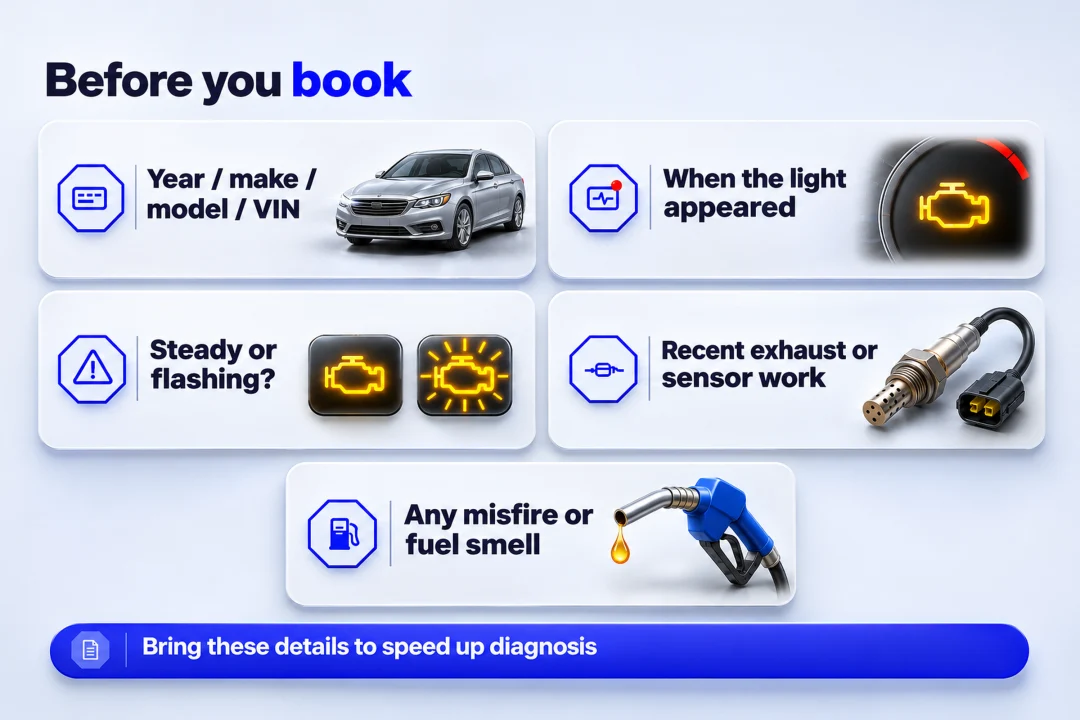
Bring or note:
- year, make, model, and VIN;
- when the light first appeared and whether it is steady or flashing;
- any recent work (sensors, exhaust, tune-ups, battery);
- fuel type and any additives used;
- whether power feels reduced, or you smell fuel or sulfur.
We work in-shop only, by appointment, on all makes, with a focus on European and German vehicles among others. Module-related work on newer Audi, Mercedes, and BMW platforms is verified by VIN when programming is involved.
P0420 FAQ
Can I drive with a P0420 code?
Often the car still drives, but that does not mean the problem is harmless. A failing catalyst or an unresolved misfire can get worse. If the light is flashing, treat it as urgent — see our check engine light guide.
Does P0420 always mean a bad catalytic converter?
No. O2 sensor faults, wiring problems, exhaust leaks, and fuel or misfire issues can set the same code. Diagnosis separates those causes.
Will disconnecting the battery clear P0420 for good?
No. It may clear the light temporarily. When the monitor runs again, the code returns if the condition remains. Battery disconnects can also trigger relearn needs on some vehicles.
Can a bad battery or low voltage cause weird catalyst codes?
Low system voltage can cause odd module behavior and communication faults. It is less often the direct cause of a pure P0420, but a full scan still matters. If the battery light is also on, see our battery light guide.
Do you replace catalytic converters or O2 sensors at eForce?
We diagnose why the check engine light and P0420 set. If the cause is electrical (sensor circuit, ground, wiring), we diagnose and repair that circuit. Non-electrical part replacement (for example the catalytic converter itself) is not promised from the code alone; we tell you what the tests show.
Next steps
If your check engine light is on with a P0420 code, book a diagnostic appointment at our Englewood shop. We work in-shop only, by appointment. Start with our car diagnostics page for how a check engine light diagnostic is structured.
This article is general information, not a diagnosis of your vehicle. Exhaust systems get hot; do not probe sensors or exhaust parts unless you know how to do it safely.