
P0300 Random Misfire: What the Code Means and What to Check
A P0300 code means the engine computer detected a random or multiple-cylinder misfire. Unlike a cylinder-specific code such as P0301 (cylinder 1), P0300 says the misfires are not locked to one cylinder — or that several cylinders are involved.
This guide covers what P0300 means, the engine misfire symptoms drivers notice, why a flashing check engine light often appears with it, which cause families we separate in diagnosis, and why replacing coils or plugs by guesswork fails. It is general information, not a diagnosis of your vehicle. Our shop is in Englewood, Colorado, serving the Denver and south Denver metro area, and we handle car diagnostics by appointment.
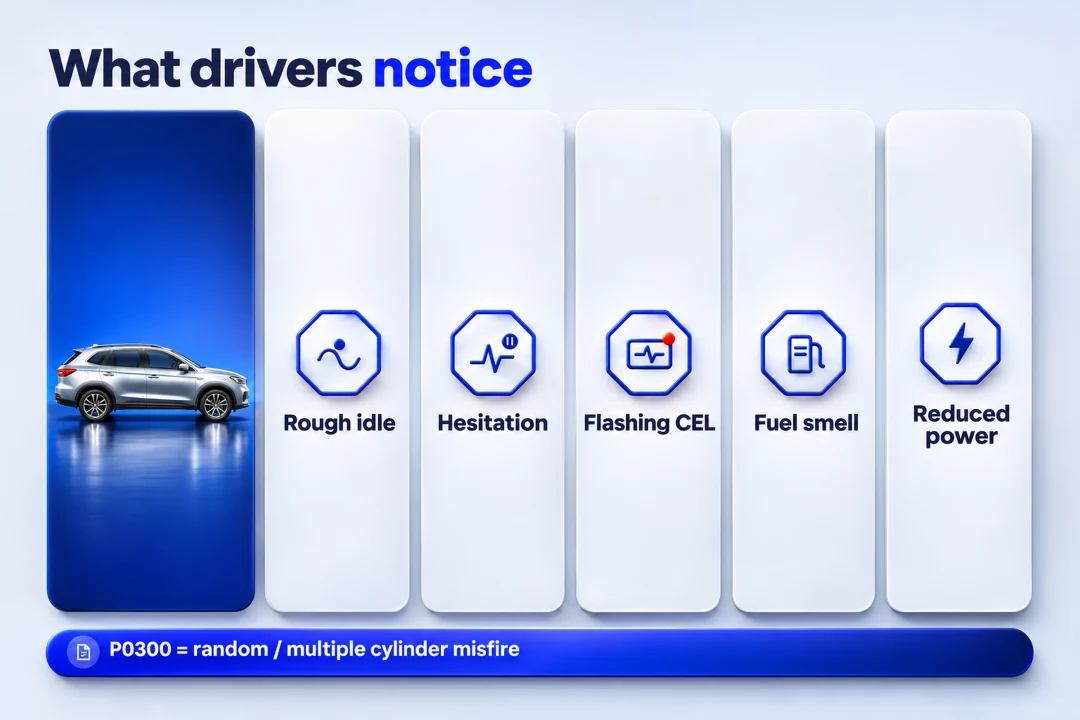
Quick answer: P0300 = random / multiple cylinder misfire detected
- What it means: combustion is incomplete or missing on more than one cylinder, or the pattern is not pinned to a single cylinder.
- Why it matters: raw fuel can overheat and damage the catalytic converter; drivability can drop suddenly.
- Flashing CEL: a flashing check engine light usually means an active misfire that needs attention now — details on steady vs flashing are in our check engine light guide. We do not treat “flashing CEL” as a separate article topic here.
- Reduced power: some vehicles also enter a protective reduced-power or limp mode when misfire is severe.
Symptoms drivers notice
Common engine misfire symptoms with a P0300 misfire include:
- rough idle or a shake that comes and goes;
- hesitation or stumble under acceleration;
- a flashing check engine light during the misfire event;
- a fuel or sulfur smell from the exhaust;
- higher fuel use;
- a feeling of reduced engine power, sometimes with a message on the dash.
Symptoms can be intermittent. Notes on when it happens (cold start, hot restart, highway load, after rain) help the diagnostic.
Why flashing CEL and P0300 often travel together
The check engine light flashes when the ECM decides misfire is severe enough to risk catalyst damage. P0300 (or a cylinder-specific P030x) is frequently stored at the same time.
That combination is a priority: keep driving only as far as you must to get somewhere safe, and avoid heavy throttle. For the general meaning of the lamp and what to do when it flashes, use the check engine light on article — this post stays focused on the P0300 code itself.
Electrical and ignition-side causes we diagnose vs fuel / mechanical
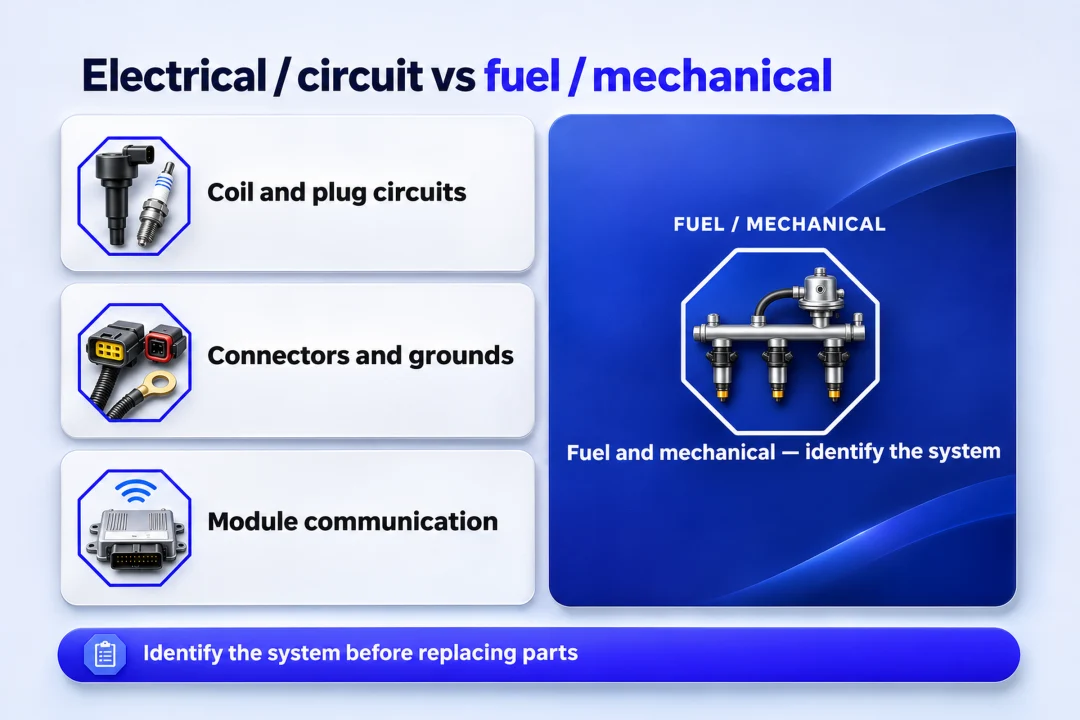
eForce focuses on electrical diagnosis and related systems. For a random misfire we separate cause families; we identify the system rather than promising a single repair type.
| Family | Examples | What we do |
|---|---|---|
| Electrical / ignition circuit | Coil primary/secondary circuit faults, connector issues, shared grounds, harness damage | Diagnose and repair circuits, voltage and grounds; see auto electrical repair |
| Module / communication | Ignition or ECM communication glitches, low-voltage dropouts | Scan all modules; see U0100 when communication codes appear |
| Fuel / ignition parts after diagnosis | Injectors (when the fault is the injector), plus coils and spark plugs when those are the cause; compression, timing, vacuum leaks identified separately | We replace coils, spark plugs, and injectors when diagnosis points to them; other mechanical causes are explained |
After we confirm the cause, eForce replaces coils, spark plugs, and injectors in-house when those parts are at fault. Guessing coils or plugs without diagnosis still fails — the point is to prove the circuit and the part first, then replace what failed.
How misfire diagnosis is done
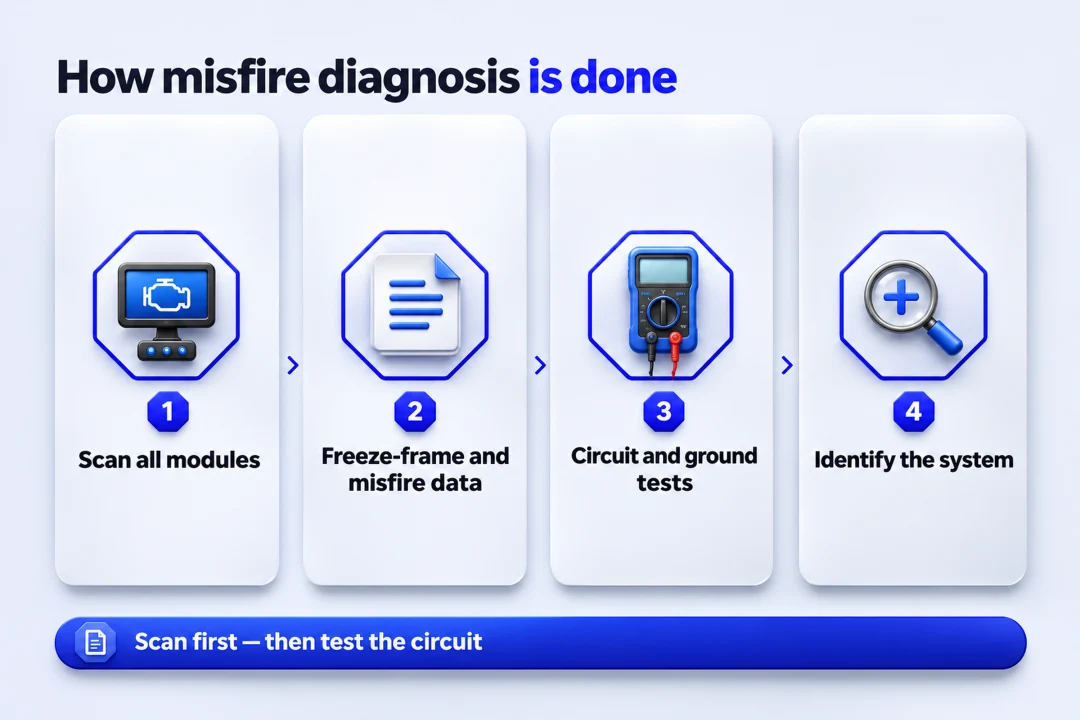
A structured misfire diagnostic typically includes:
- Full scan — P0300 plus any cylinder-specific codes, fuel trim codes, cam/crank correlation, and communication codes.
- Freeze-frame — RPM, load, temperature, and fuel trims when the misfire set.
- Mode 6 / misfire counters where supported — which cylinders contribute.
- Relative contribution / power balance style checks as the platform allows.
- Ignition circuit checks — coil command, power, ground, and signal integrity.
- Scope or waveform work when a circuit or sensor pattern needs proof, not a parts swap.
- Voltage and ground verification under load — a bad ground can mimic random faults; see our voltage drop test guide.
If the car also will not start or cranks poorly, related starting-system context is in car won't start.
Why replacing parts by guesswork fails
P0300 is a detection code, not a parts list. Replacing all coils, all plugs, or a random sensor because a forum thread suggested it often fails when the real issue is:
- a shared power or ground fault;
- a damaged connector or harness section;
- a fuel delivery or mechanical problem on more than one cylinder;
- low system voltage that makes modules and coils misbehave.
Guesswork also risks damaging the catalyst if the misfire continues. Diagnosis first is cheaper than a bag of unused parts.
Booking notes
When you book, note:
- year, make, model, VIN;
- whether the check engine light is steady or flashing;
- when the shake or hesitation happens;
- any recent coil, plug, battery, or software work;
- whether a reduced-power message appeared.
We work in-shop only, by appointment, on all makes. Newer Audi, Mercedes, and BMW module work is verified by VIN when programming is required.
P0300 FAQ
Is P0300 the same as a single-cylinder misfire code?
No. P0301–P0312 (typical range) point at a specific cylinder. P0300 means random or multiple-cylinder misfire detection.
Can I keep driving with a flashing check engine light and P0300?
Treat a flashing light as urgent. Continuing to drive under load can damage the catalytic converter. Get the car somewhere safe and arrange diagnosis.
Does P0300 always mean bad spark plugs?
No. Plugs are one possibility. Circuits, grounds, fuel, mechanical issues, and module problems can all produce a random misfire.
Can a bad ground cause a random misfire?
Yes. Shared ignition or ECM grounds with high resistance can create intermittent multi-cylinder symptoms. That is why voltage drop testing matters.
Will clearing the code fix the misfire?
No. Clearing only resets the lamp until the condition returns. The misfire cause has to be found and corrected.
Next steps
If you have a P0300 code or a flashing check engine light with misfire symptoms, book a diagnostic appointment at our Englewood shop. We work in-shop only, by appointment. See car diagnostics and auto electrical diagnosis for how we approach electrical and circuit-side faults. Multiple dashboard warnings at once are covered in our dashboard warning lights guide.
This article is general information, not a diagnosis of your vehicle. Ignition and fuel systems can be hazardous; do not probe live circuits unless you know how to do it safely.