
P0301 Code: Cylinder 1 Misfire — What It Means and What to Check
A P0301 code means the engine computer detected a misfire in cylinder 1. A misfire is a combustion event that did not happen properly, and the computer usually notices it as a small, uneven change in crankshaft speed. The code tells you where the misfire was counted, not which part caused it.
That makes P0301 more specific than a random misfire code, but it still does not name a coil, spark plug or injector. This guide explains what a cylinder 1 misfire typically means, how it differs from P0300 and the other cylinder codes, the common cause families and how diagnosis finds the fault. It describes typical patterns, not findings from a particular customer's car.
What a P0301 code means (cylinder 1 misfire)
Cylinder 1 misfire detected is the plain-English wording most scan tools show for P0301. The computer counted enough misfires on that cylinder to cross its threshold for storing the code.
Which cylinder is number 1 depends on the engine. Manufacturers number cylinders differently across inline and V-type designs, so there is no universal rule such as "first on the left." Diagnosis starts by confirming the correct cylinder from the vehicle's service information, because working on the wrong one wastes time and parts.
A single-cylinder code narrows the search, but it does not mean there is only one possible cause. Ignition, fuel, electrical and mechanical problems can all show up on one cylinder.
P0301 vs P0300 (and P0302–P0304)
P0300 means a random or multiple-cylinder misfire: the computer sees misfires that are not locked to one cylinder. Our P0300 random misfire guide covers that code and why a flashing check engine light often comes with it.
P0301 means the misfire is identified on cylinder 1. P0302, P0303 and P0304 carry the same meaning for cylinders 2, 3 and 4, and the pattern continues on engines with more cylinders. The diagnostic logic in this article applies to each of them; a cylinder 3 misfire is approached the same way as a cylinder 1 misfire.
Codes can also appear together, for example P0301 with P0300, or several cylinder codes at once. When more than one cylinder is involved, a shared cause such as a common power supply, ground or fuel condition becomes more likely than several separate failed parts. That is a typical diagnostic direction, not a rule.
Typical symptoms of a cylinder 1 misfire
Possible P0301 symptoms include:
- a shake or rough idle, sometimes worse when the engine is cold;
- hesitation or a stumble when accelerating;
- a check engine light that may be steady or flashing;
- higher fuel use;
- a fuel smell from the exhaust;
- in some cases, reduced power or a limp mode message.
Not every vehicle shows all of these, and a mild misfire may only set the light. A flashing check engine light usually means an active misfire severe enough to risk catalytic converter damage. Our check engine light guide explains steady versus flashing, and the reduced engine power guide covers limp mode if a power warning appears.
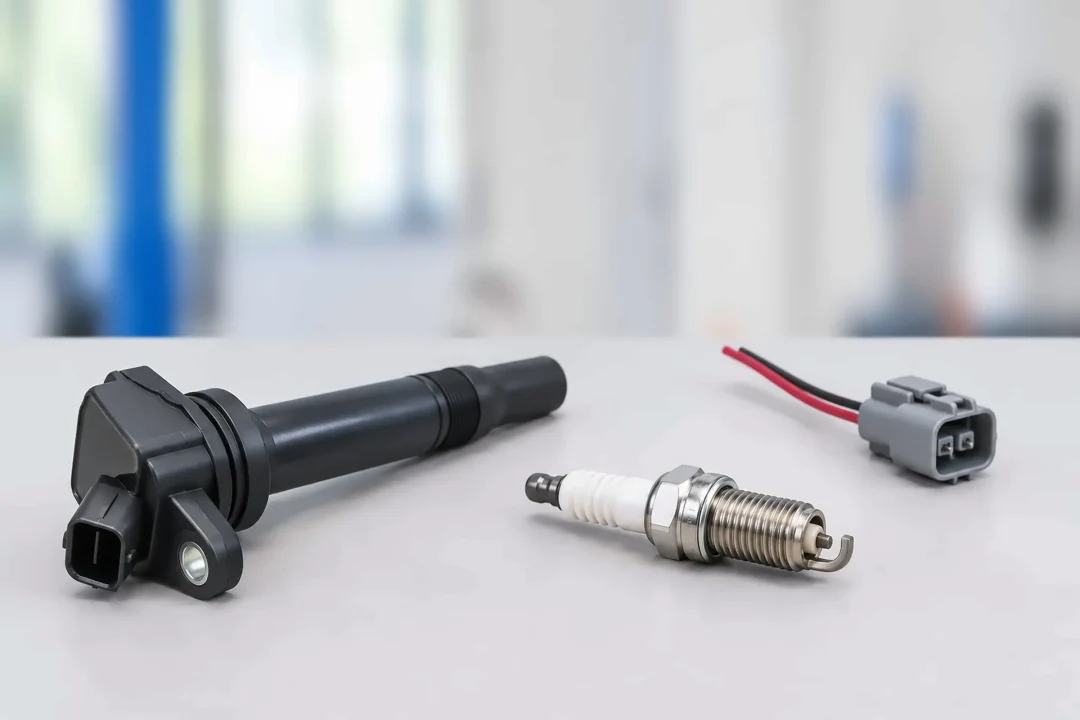
Illustrative component inspection; no failed part is implied.
Common cause families on one cylinder
Typical P0301 causes fall into several families:
- Ignition coil and its circuit. A coil that weakens, or a fault in its control or power wiring, can stop the spark on one cylinder. A coil circuit code such as P0351 (coil A, often cylinder 1 on many layouts) may appear alongside, depending on the platform.
- Spark plug. A worn, fouled or damaged plug can misfire under load or at idle. Spark plug symptoms are covered in more detail in a separate guide.
- Fuel injector and its circuit. An injector that does not deliver fuel correctly, or a wiring fault, can cause a single-cylinder misfire. A circuit code such as P0201 (injector circuit, cylinder 1) may appear in that case.
- Connectors, wiring and grounds. Damaged harness sections, loose terminals or a weak ground can affect one coil or injector. Our voltage drop and bad ground guide explains why a connection can look fine and still fail under load.
- Mechanical causes. Low compression, valve or gasket problems and similar faults are a diagnostic branch. We identify them and explain the next step; we do not present them as our routine repair work.
After diagnosis, eForce replaces ignition coils, spark plugs and fuel injectors and repairs wiring and grounds when tests confirm those faults.
Why swapping a parts-store coil or a full plug set often fails
A new coil does not fix a damaged injector connector, and a full set of plugs does not fix a coil circuit fault. Without proving the cause on cylinder 1, it is easy to replace the wrong part and keep the misfire.
Moving parts between cylinders to see whether the misfire follows can be a useful professional technique, but on its own it does not prove a circuit, injector or mechanical fault. It can also mislead when a misfire is intermittent. Clearing the code after a swap only resets the counter; it does not confirm a repair.
How we diagnose a P0301 in the shop
At eForce Automotive Service, car diagnostics for a cylinder 1 misfire follows the evidence:
- Full scan and freeze frame. We read all codes, including coil, injector, fuel trim and other misfire codes, and the conditions when P0301 set.
- Misfire data by cylinder. Where the platform supports it, we review misfire counters and cylinder contribution data to confirm cylinder 1 and how often it misfires.
- Ignition checks on that cylinder. We inspect the coil, spark plug and their circuit, and test control, power and ground.
- Fuel and injector checks. We verify injector operation and its wiring on the affected cylinder.
- Wiring and grounds. Circuit faults are traced and repaired under auto electrical repair.
- Mechanical checks when indicated. If ignition and fuel test good, we look at mechanical causes and explain the findings.
These are professional steps, not a home procedure. Working around ignition systems and running engines carries real risk.
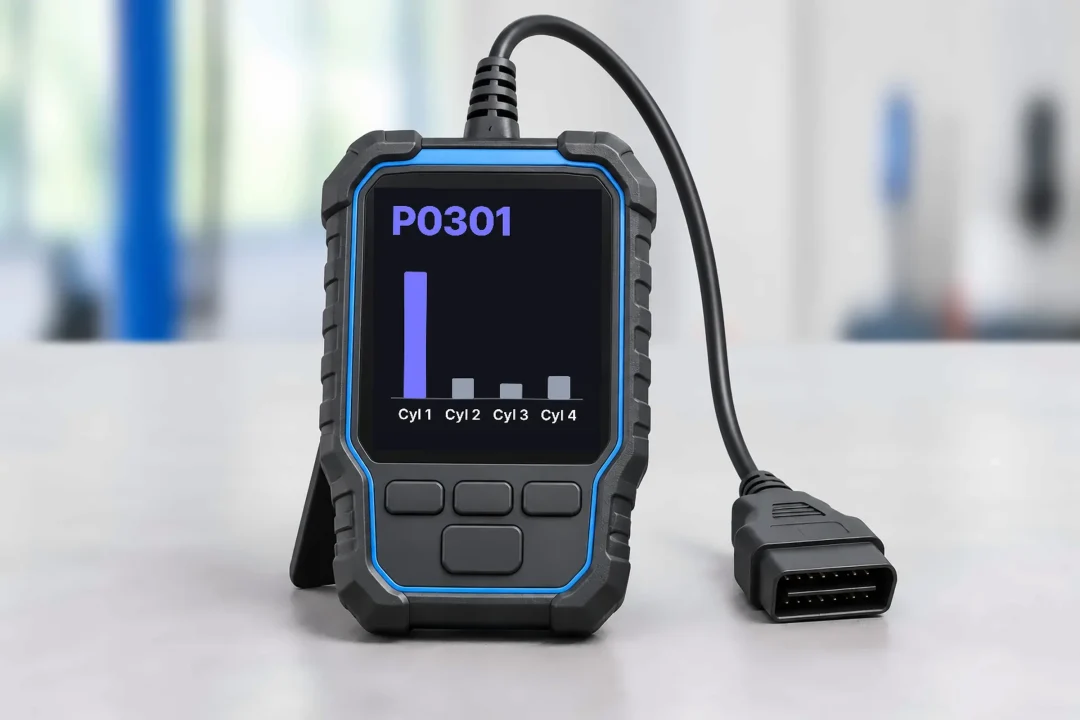
Illustrative scan screen; not data from a customer's vehicle.
Book through the phone number in the site header. We work in-shop only, by appointment, at 1713 W Baltic Pl, Englewood, CO 80110. See our services and service area.
FAQ
What does a P0301 code mean?
It means the engine computer detected a misfire in cylinder 1. The code tells you where the misfire happens, not which part failed.
Is P0301 the same as a P0300 random misfire?
No. P0300 means misfires that are random or spread across several cylinders. P0301 points to cylinder 1 specifically, though both codes can appear together.
Can I keep driving with a P0301 code?
Treat it with caution. If the check engine light is flashing or the engine shakes badly, stop driving as soon as it is safe, because continued misfire can damage the catalytic converter. Even a steady light should be diagnosed soon.
What typically causes a cylinder 1 misfire?
Typical cause families are the ignition coil, spark plug, fuel injector, their wiring and grounds, and mechanical faults. Testing on that cylinder decides which one applies.
Will a new spark plug or ignition coil always fix P0301?
No. A new part fixes the misfire only if that part caused it. Circuit, injector or mechanical faults will remain after a plug or coil swap.
How do I book diagnosis for a P0301 in Englewood?
Call the number in the site header to set an in-shop appointment. Mention whether the light is steady or flashing and any recent ignition work.
General information, not a diagnosis of your vehicle. Ignition systems carry high voltage; leave live-circuit testing to properly equipped technicians.