
Bad Ground Symptoms: How a Voltage Drop Test Finds Them
Some electrical problems make no sense at first. The headlights flicker, a gauge jumps, a warning light comes and goes, and the battery tests fine. Very often the cause is not a failed part at all but a bad connection, and the most common one is a bad ground.
This guide explains what a ground does, the symptoms of a bad ground, what a voltage drop test is and why it finds what a simple battery test misses. It is general information, not a diagnosis of your vehicle. Our shop is in Englewood, Colorado, and we handle auto electrical diagnosis by appointment.
Quick answers
- What a bad ground does: it adds resistance to the return path of the current, so parts get less voltage than they need.
- Typical symptoms: flickering or dim lights, jumpy gauges, several warning lights, slow crank, random module faults.
- Why a battery test misses it: a battery test checks the battery, not the connections between the battery and everything else.
- How it is found: a voltage drop test measures how much voltage a wire or connection loses while current flows through it.
What a ground does and why one bad ground affects several systems
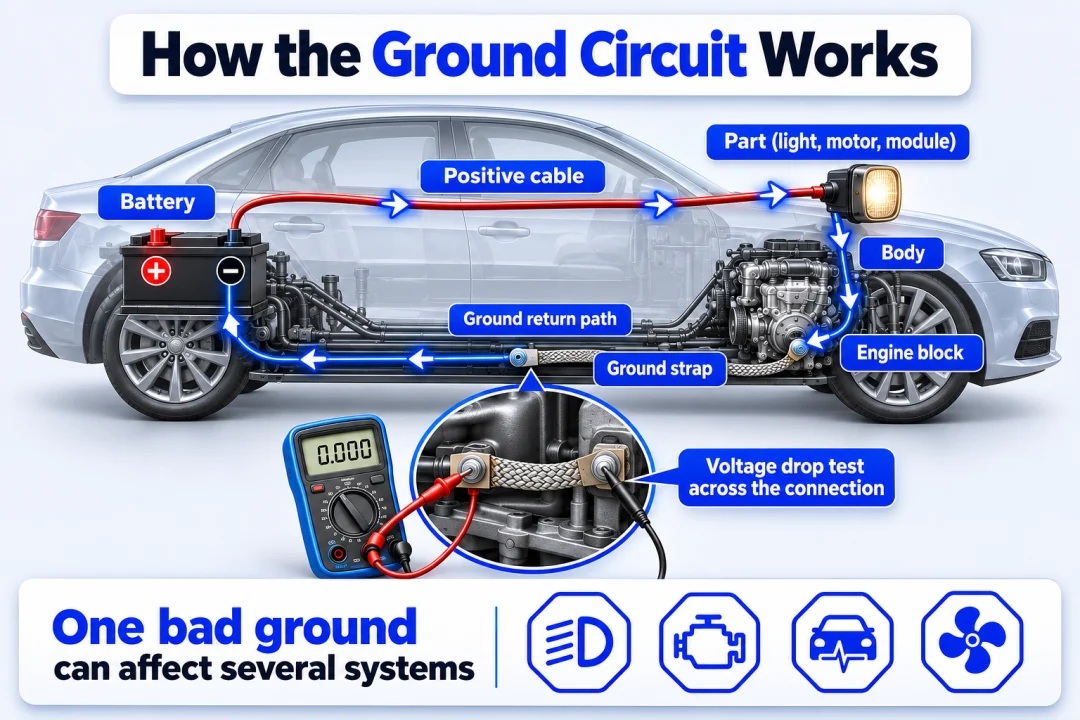
Every electrical circuit is a loop. Current leaves the battery's positive side, runs through the part, such as a light, a motor or a module, and returns to the battery's negative side. In a car, most of that return path is the ground: the engine block, the body and the cables and straps that tie them to the battery.
Because many circuits share the same grounds, one bad ground affects many things at once. A corroded engine ground strap can affect starting, charging and the modules grounded to the engine. A loose body ground can make lights, gauges and modules in one area act up together. That is why ground problems look like "everything is going wrong" rather than one broken part.
Symptoms of a bad ground or high-resistance connection
Common bad ground symptoms in a car include:
- Headlights flickering or dim, or lights that change brightness when something else switches on;
- gauges that jump, drop to zero or read wrong at times;
- several warning lights at once, often coming and going; see our guide to dashboard warning lights;
- slow cranking or a no-start even with a good battery; see why a car won't start;
- random module faults and communication codes that appear and disappear; see our guide to U0100 and lost communication codes;
- problems that change with temperature, bumps, rain or engine movement.
Engine ground wire symptoms in particular often show up during cranking, when the starter draws the most current through that path.
What a voltage drop test is
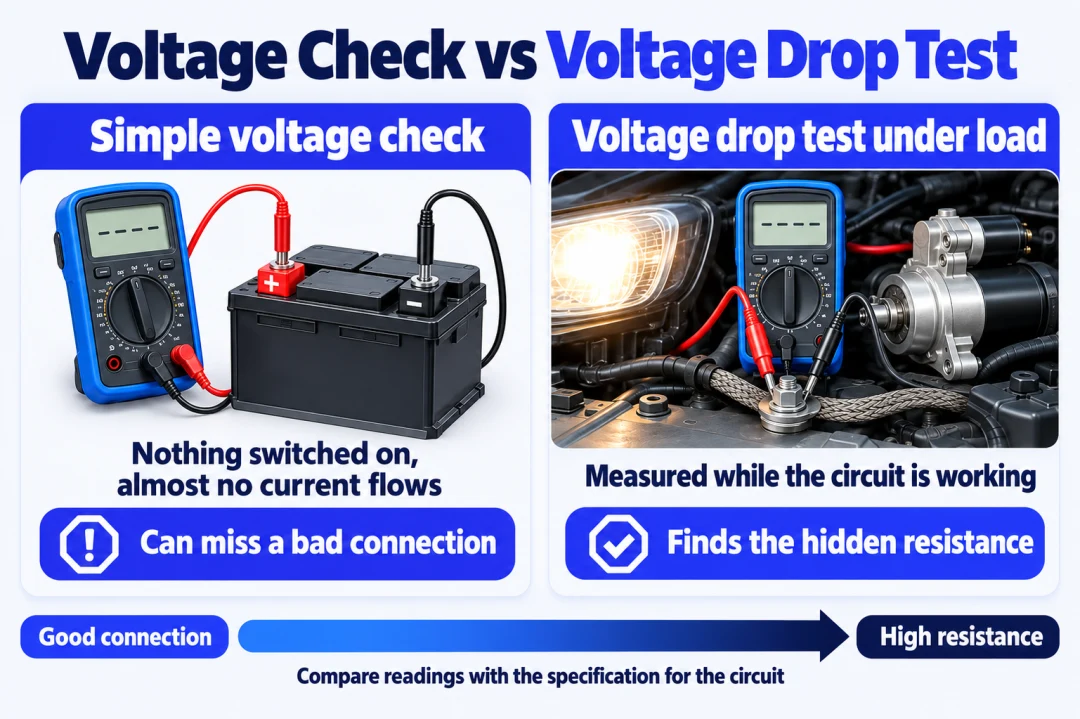
A voltage drop test measures how much voltage is lost across a wire, a connection or a ground while the circuit is working. A good connection loses very little. A corroded, loose or damaged one loses more, and the part at the end of the circuit gets less voltage than it should.
The key is "while the circuit is working". A connection with some corrosion can pass a simple voltage check with nothing switched on, because almost no current flows. Put a real load on it, such as cranking the engine or switching on the headlights, and the same connection drops voltage. That is the difference a voltage drop test catches and a basic voltage or battery test misses.
What counts as an acceptable drop depends on the circuit and the manufacturer's specification, so we compare readings with the specification for the circuit rather than one universal number.
Where problems usually hide
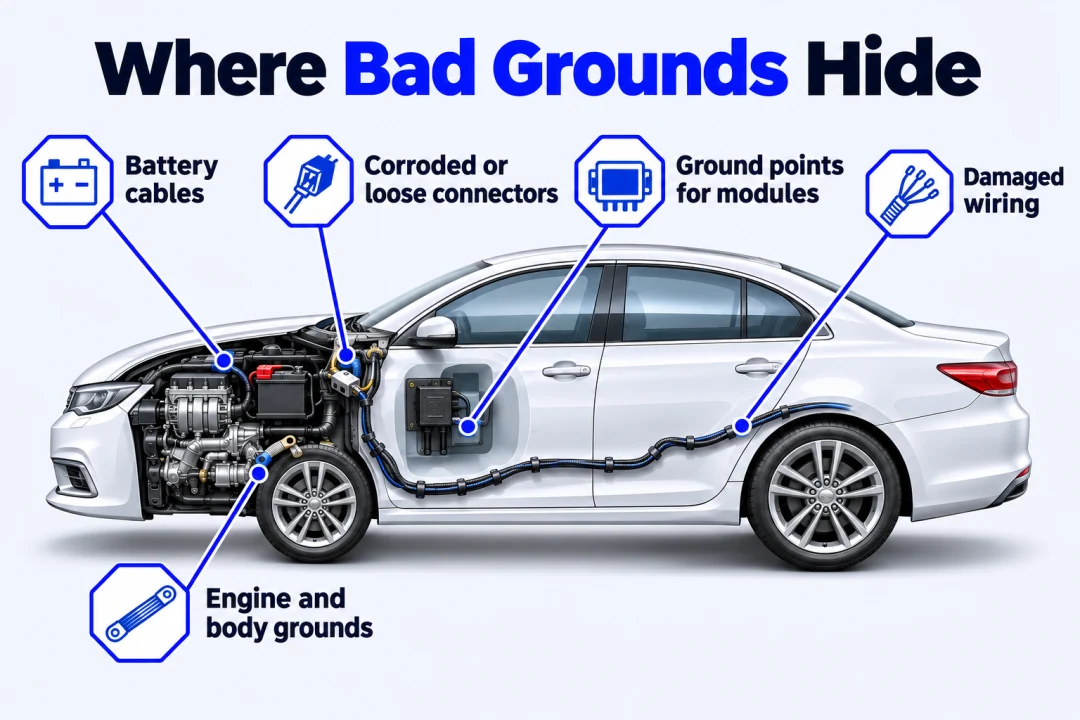
- Engine and body grounds: straps and cables between the engine, the body and the battery.
- Battery cables: the cable ends, crimps and terminals, including corrosion hidden under the insulation.
- Corroded or loose connectors: especially those exposed to water, road salt and heat.
- Damaged wiring: chafed, pinched or broken wires, often where a harness moves or rubs.
- Ground points for modules: a module with a poor ground can behave erratically or drop off the network.
Why parts swapping fails on intermittent electrical faults
When the fault comes and goes, it is tempting to replace whatever part is named in a code or seems to be acting up: a battery, a sensor, a module. If the real cause is a bad ground or connection, the new part gets the same poor voltage and acts up the same way. The money is spent and the fault is still there.
Intermittent faults also hide. If the car behaves normally at the shop, there is nothing to see. That is why notes from you help: when it happens, in what weather, after which bumps or at which temperature. It is also why testing under load matters more than a quick look. For other early warning signs, see our guide to car electrical problems and their symptoms.
How we trace it
At our Englewood shop the diagnosis follows the circuit:
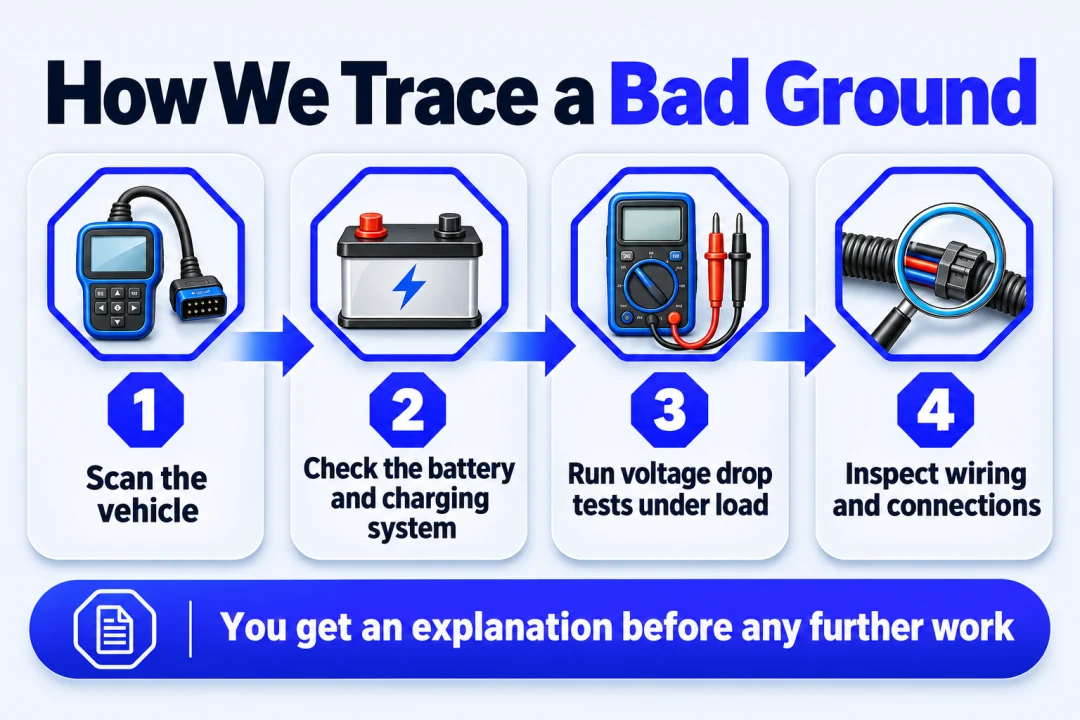
- Scan the vehicle for stored and current codes in all modules. See our car diagnostics page.
- Check the battery and charging system, so we know the source is good. If the battery light is on or the charging voltage is wrong, see our guide to battery light on meaning.
- Run voltage drop tests on the power and ground sides of the affected circuits, under load.
- Inspect wiring and connections the readings point to, including grounds, connectors and damaged wiring.
You get an explanation of what was found and what it means before any further work. If the battery dies while the car is parked, the related test is different; our parasitic draw test guide explains it. Complex electrical faults can take time to trace, and the technician will discuss further diagnostic work with you before going ahead.
Bad ground and voltage drop FAQ
Can a bad ground cause a no-start?
Yes. The starter draws a lot of current, and a bad engine or battery ground can drop enough voltage to make it crank slowly or not at all, even with a good battery.
Can a bad ground set warning lights or codes?
Yes. Modules that get poor voltage or a poor ground can log faults, including communication codes, and turn on warning lights, often several at once and often on and off.
Why do my headlights flicker?
Flickering headlights can come from a loose or corroded connection, a bad ground, a charging problem or a switch or module fault. A voltage drop test and a charging check help separate these causes. If the battery light is on at the same time, see our battery light guide.
Is a voltage drop test the same as a battery test?
No. A battery test checks the battery. A voltage drop test checks the wires, connections and grounds between the battery and the parts it powers, while current is flowing.
Why are intermittent electrical problems hard to find?
The fault may only appear with heat, moisture, vibration or a certain load, and the car can behave normally during a check. Notes on when it happens and testing under load make the difference.
Next steps
Flickering lights or electrical faults that come and go? Book an appointment at our Englewood shop for an electrical diagnosis. We work in-shop only, by appointment. Our auto electrical repair page explains what else we diagnose.
This article is general information, not a diagnosis of your vehicle. Battery and starter circuits carry high current; do not disconnect or probe them unless you know how to do it safely.