
P0325 Code: Knock Sensor 1 Circuit Malfunction (Bank 1 or Single Sensor)
A P0325 code means the engine computer found an electrical fault in the circuit of knock sensor 1. The SAE name is "Knock Sensor 1 Circuit (Bank 1 or Single Sensor)." Bank 1 is the side of the engine that contains cylinder number 1, and "single sensor" covers engines that have only one knock sensor. Some people search it as "P0325 knock sensor," and it is the same thing.
The important part is what the code does not say. P0325 is about the knock sensor circuit, not about the engine knocking. The computer is saying that it cannot rely on the signal from the sensor. A faulty circuit and real engine knock are two different things with different causes, and mixing them up leads to the wrong repair. This guide explains what P0325 typically means, how it differs from the codes next to it, what usually causes it and how a shop separates a circuit problem from a sensor problem. It describes typical patterns, not findings from a particular customer's car.
What a P0325 code means
The engine computer (PCM) watches the signal from the knock sensor. When that signal is missing, stuck, out of range or does not make sense for the engine speed and load, the computer stores P0325 and usually turns on the check engine light. In short, this is a knock sensor circuit code, not a verdict on the engine.
The code names a circuit, not a part. The fault can be in the sensor, in the wiring or connector, in how the sensor is mounted, in electrical interference or, rarely, in the computer. If the wording on your scan tool differs a little from the generic name, the manufacturer's service information is the final word on sensor labels and banks.
What a knock sensor does
Knock, also called detonation or pinging, is an uncontrolled combustion event that can happen under load. Over time it can damage an engine. The knock sensor is the engine's listener for it. Most knock sensors are piezoelectric: a small element inside makes a tiny voltage when it is vibrated. The sensor is mounted on the engine block, the cylinder head or near the intake, so it picks up vibration through the metal.
The computer filters that signal and watches it during the moment each cylinder fires. If it hears a pattern that looks like knock, it pulls the ignition timing back to stop it, usually without the driver noticing. That is a healthy system doing its job, and no code is stored.
Because the sensor makes its own signal, it also depends on good contact with the engine. Designs and locations differ from one engine to the next, so there is no one layout that fits every vehicle.
P0325 vs P0326, P0327/P0328 and P0330
These codes describe the same circuit in different ways, or a second sensor:
| Code | SAE name | What it points to |
|---|---|---|
| P0325 | Knock Sensor 1 Circuit (Bank 1 or Single Sensor) | A general fault in the circuit of sensor 1 |
| P0326 | Knock Sensor 1 Circuit Range/Performance | A signal is present but does not look right |
| P0327 | Knock Sensor 1 Circuit Low | The signal is lower than expected |
| P0328 | Knock Sensor 1 Circuit High | The signal is higher than expected |
| P0330 | Knock Sensor 2 Circuit (Bank 2) | The same kind of fault on the second sensor, on the other side of the engine |
If codes for both banks appear together, something shared, such as a common harness section, a connector, a ground or the computer, is worth checking. If only one bank is affected, the cause is more often local to that sensor and its wiring. These are typical patterns, and the manufacturer's definitions can differ from the generic ones.
A faulty knock sensor circuit vs real engine knock
P0325 does not mean the engine is knocking:
- A circuit fault means the computer cannot trust the signal. It may be missing because of an open circuit, shorted, noisy, or too flat or too loud for what the computer expects.
- Real engine knock is combustion that is out of control. A working knock system handles it by pulling timing, and no code is set.
The two can also be linked in the other direction. Heavy mechanical noise, such as a loose accessory or a bracket, can make the sensor signal look abnormal and set a performance-type code. So a knock-related code does not always mean the sensor is bad, and the diagnosis asks whether the sensor is wrong or the engine is genuinely noisy.
Real knock has its own causes, such as fuel with a lower octane rating than the engine needs, carbon build-up, overheating or a lean mixture. It is a separate subject from this code. If you want an example of how a knock and valve-timing complaint is worked through, see our engine knock and valve timing diagnosis case.
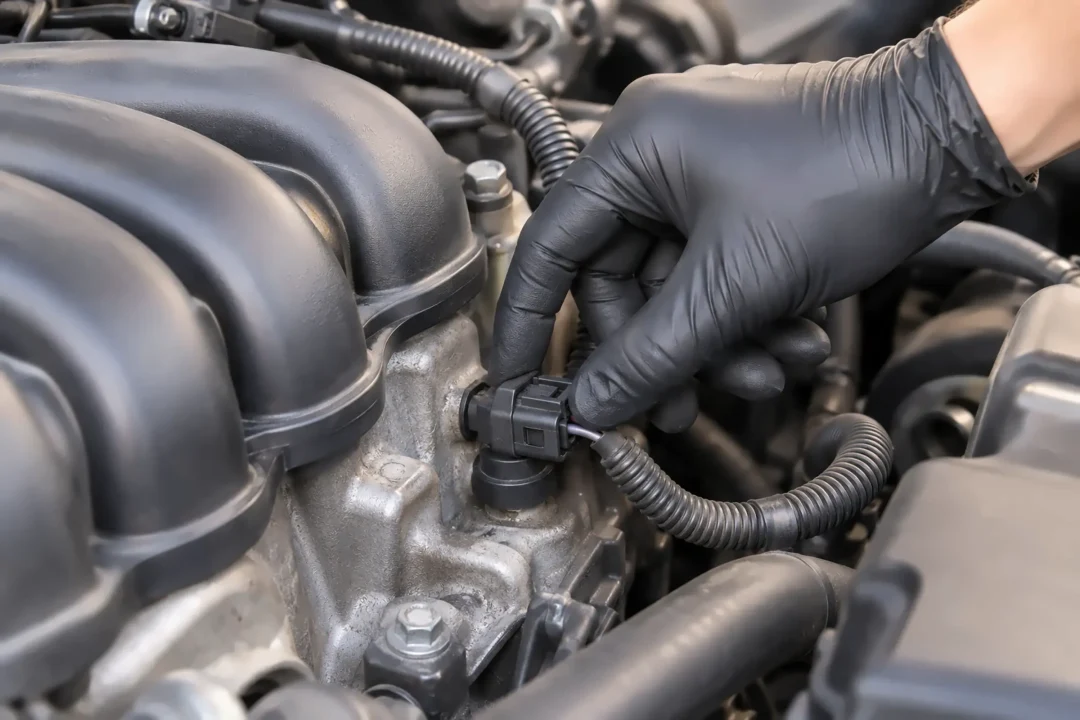
Illustrative in-shop inspection; not a customer's vehicle.
Typical symptoms of a P0325
Often the check engine light is the only sign. Typical symptoms and effects include:
- A steady check engine light. Our check engine light guide explains what to do when it comes on.
- Reduced power or a flat feel, because the computer may use a more cautious, retarded ignition timing when it cannot rely on the sensor. Our reduced engine power guide covers what that can mean.
- A small drop in fuel economy or some hesitation under load.
- In some cases, audible pinging, especially under load on lower-octane fuel or in hot weather, because the engine's protection is not working as designed.
Many drivers notice nothing besides the light. That does not mean it is safe to ignore. With no working knock protection, an engine that is prone to knock has less of a safety net, and extended hard driving adds to the risk. We cannot say a car is fine to drive without looking at it. If the engine pings, ease off the throttle and have it checked.
Safe things to note first
These are typical, low-risk steps, not a repair procedure:
- Get the code read and write it down, with whether it is stored, pending or intermittent. Try not to clear it repeatedly to see if it stays away, since clearing erases freeze-frame data the technician will want.
- Note when the light came on. Did it follow a fill-up, a repair, an oil or coolant leak or a stretch of rough weather?
- Think about fuel. If you recently used a lower grade than the manufacturer recommends, mention it, along with any pinging under load.
- Look with the engine off and cool for harnesses that are hanging loose or rubbing, signs of rodents, and oil or coolant pooling near the top of the engine. Do not pry or force connectors.
- Do not disconnect the sensor to "test" it, and do not spray cleaners into connectors.
Typical causes (not a diagnosis)
The typical causes fall into several families. Which one applies depends on the engine and the testing:
- The sensor itself. An internal failure, a cracked housing or contamination by oil or coolant can stop it from producing a good signal. A bad knock sensor is one possible finding, and only testing shows it.
- Wiring and connector. Chafed, melted or broken wires, a corroded or oil-soaked connector, damaged shielding, or an open or high-resistance circuit are typical. Heat and vibration near the engine make this family common. For wiring and connector repair after a diagnosis, see our auto electrical repair page.
- Mounting. A sensor that is loose, not seated flat, or has debris, rust or sealant between it and the block cannot pass on vibration properly. Hardware from a past repair can matter too.
- Electrical interference. Ignition noise, a poor ground or noise from the charging system can disturb a small signal, especially if wiring runs close to high-voltage ignition parts.
- Mechanical noise that confuses the sensor. Loose brackets or heat shields, or other engine noise, can look like a fault.
- The computer. The input in the engine computer can fail, but this is rare and is considered only after everything else is checked.
The list is not ranked. It would be wrong to say it is "usually the sensor," since many cases come down to wiring, a connector or mounting. How easy the sensor is to reach depends on the engine, and on some it sits under other parts. That is one more reason to diagnose before anything is replaced, and we make no promise about the scope of work for reaching it. The same idea of a sensor and its circuit applies to the crankshaft position sensor, which our P0335 guide walks through.
How we diagnose a P0325 in the shop
At eForce Automotive Service, car diagnostics for a knock sensor circuit code follows the data:
- Scan and freeze frame. We read all stored codes, check whether the code is current or history and look at the conditions when P0325 set. Related misfire or sensor codes change the plan.
- Live data. We watch the knock sensor signal, any timing pulled back for knock, engine speed, load and temperature. A signal that never responds, or sits at an extreme value, points to an electrical fault.
- Service information. Wiring diagrams and the expected sensor type matter, because some sensors have different electrical values.
- Visual inspection. We look at the connector, the routing of the harness and any signs of oil or coolant, rubbing or heat damage, as far as access allows.
- Circuit tests. We test the circuit for continuity, shorts, the reference and the ground, and where it helps we look at the signal on an oscilloscope. A gentle wiggle test of the harness can find an intermittent fault. A light tap near the sensor, done as the procedure allows, shows whether the signal responds.
- Mounting and noise. We confirm that the sensor is seated as it should be, and we rule out real engine noise or interference that would confuse it.
- Decide whether it is the circuit or the sensor. The result is a recommendation based on what we measured.
For the sensor itself, our role is diagnosis: we tell you what the data shows and what the next step is. We do not promise replacing the knock sensor in advance. Confirmed wiring and connector faults are handled after the diagnosis.
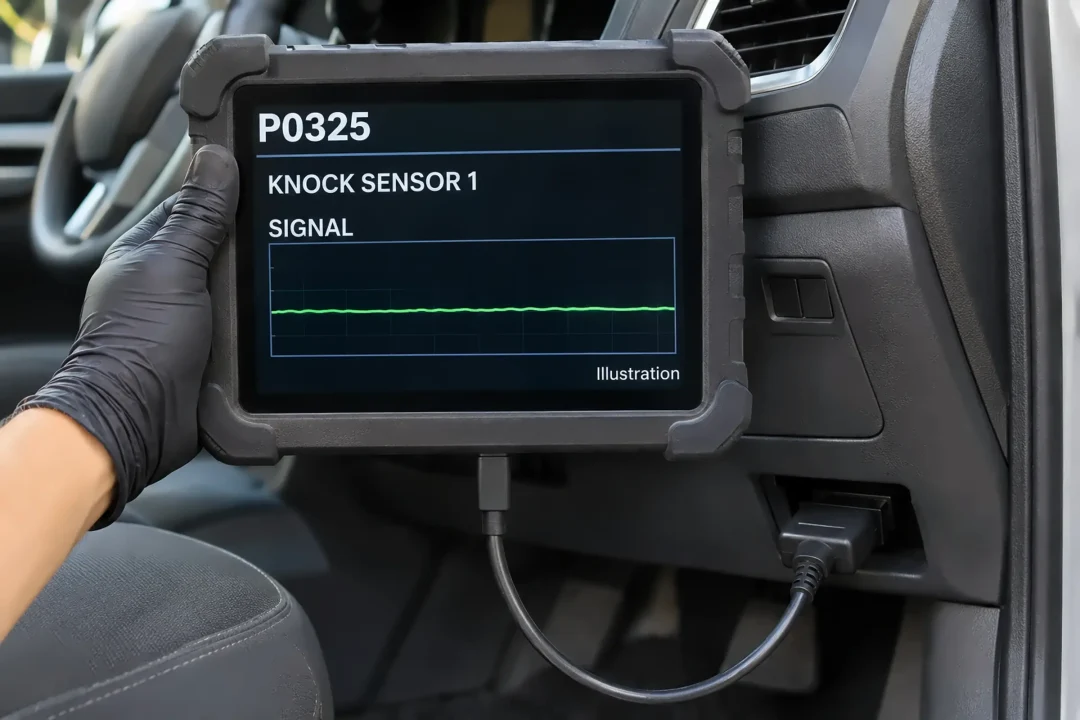
Illustrative scan tool screen; not data from a customer's vehicle.
Booking is by phone, using the number in the site header. We work in-shop only, by appointment, at 1713 W Baltic Pl, Englewood, CO 80110. See our service area for the cities we serve.
FAQ
What does a P0325 code mean?
It means the engine computer found a fault in the circuit of knock sensor 1, on bank 1 or on an engine with a single sensor. The code names a circuit, not a failed part, and the check engine light is often the only sign.
Does P0325 mean my engine is knocking?
No. It is a code about the sensor's circuit, not about the engine. Real knock is a separate matter that is diagnosed on its own, and a working system handles it without storing a code.
Is P0325 the same as P0330?
No. P0325 is for knock sensor 1, on bank 1 or on a single-sensor engine. P0330 is for knock sensor 2 on bank 2.
Will replacing the knock sensor always fix P0325?
Only if diagnosis shows the sensor is at fault. The cause can also be wiring, a connector, mounting or interference. We do not promise replacing the part in advance.
How do I book a P0325 diagnosis in Englewood?
Call the number in the site header to set an in-shop appointment. Tell us when the code appears, any pinging you have heard and any other codes you know about.
General information, not a diagnosis of your vehicle. Do not disconnect the sensor or use additives as a fix.