
Signs of a Bad Ignition Coil: Symptoms, Causes and What to Check
Bad ignition coil symptoms usually show up as a misfire: a shake at idle, a stumble when you accelerate or a check engine light that appears without warning. The trouble is that a worn spark plug, a fuel injector or a wiring fault can feel exactly the same from the driver's seat.
This guide covers the typical signs of a bad ignition coil, how a coil differs from a plug or an injector, which codes can come with it and how diagnosis confirms the coil before anything is replaced. It describes typical patterns, not findings from a particular customer's car.
Signs of a bad ignition coil (what drivers usually notice first)
Typical signs of a bad ignition coil include:
- Rough idle. The engine shakes or sounds uneven at a stop.
- Misfires under load. A jerk or hesitation when climbing a hill, merging or accelerating hard.
- Loss of power. The car feels weaker than usual; some vehicles reduce power to protect the engine.
- Hard starting. The engine cranks longer before it runs smoothly.
- A check engine light. It may be steady, or flashing during an active misfire.
- A fuel smell from the exhaust, because fuel in the misfiring cylinder does not burn completely.
- Higher fuel use over time.
These are typical possibilities, not a fixed set. A failing coil often acts up first when the engine is hot, in damp weather or under heavy load, and then seems fine again. That pattern is a useful clue, but it is not proof on its own. If a power warning appears, our reduced engine power guide explains what limp mode means.
Bad ignition coil vs a bad spark plug (and vs an injector)
Each part has a different job. The ignition coil turns battery voltage into the high voltage needed for a spark. The spark plug uses that voltage to create the spark inside the cylinder. The fuel injector delivers the fuel the spark ignites. If any of them fails, the cylinder can misfire, which is why the complaints overlap.
Some differences are typical, though none is reliable by itself. A coil can fail suddenly or only when hot, while a plug usually wears gradually. A coil fault may come with a coil circuit code. An injector problem may show injector circuit or fuel trim codes instead. A worn plug can also put extra strain on a coil, so the two are sometimes linked.
Telling them apart takes testing on the affected cylinder, not a guess based on how the car feels.
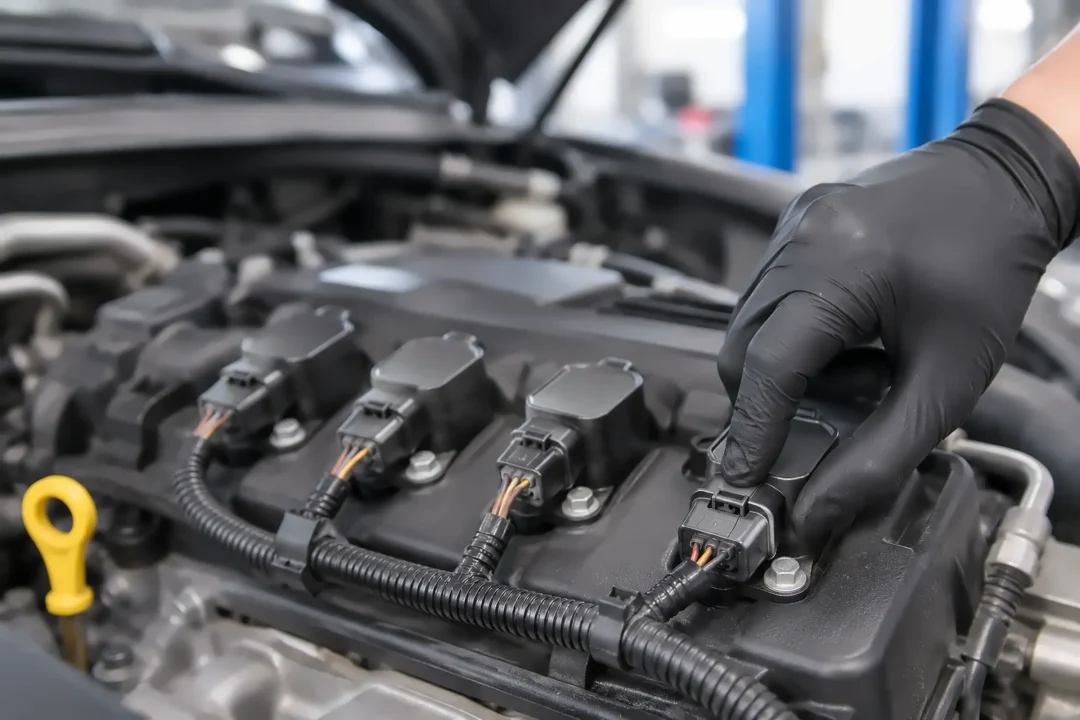
Illustrative in-shop inspection; not a customer's vehicle.
Warning lights and related codes
When misfires cross the engine computer's threshold, it stores a code and turns on the check engine light. Our check engine light guide explains what to do when the lamp is steady or flashing. A flashing light usually means an active misfire that can damage the catalytic converter, so treat it as urgent.
Codes often linked to a coil problem include:
- P0300, a random or multiple-cylinder misfire, covered in our P0300 guide;
- P0301, a misfire on cylinder 1, and P0302–P0304, the same meaning on other cylinders;
- P0351 and P0352, which typically point to the circuit of ignition coil A or coil B. Which cylinder each coil letter serves depends on the engine.
A misfire code says where misfires were counted, not that the coil failed. A coil circuit code points to the coil's electrical circuit, which includes wiring, the connector and the control signal as well as the coil itself. Neither code alone is a reason to buy a coil.
Why swapping a parts-store coil often fails
A new coil does not repair a damaged connector, a chafed wire or a weak ground. It will not fix a worn plug, a leaking plug boot or a misfire caused by an injector. Without linking the misfire to a specific cylinder and checking that cylinder's circuit, it is easy to replace the wrong part and keep the problem.
Engines use different coil designs. Many have an individual coil on each plug; some use a coil pack that serves several cylinders from one housing. With a coil pack, a fault may affect more than one cylinder, which can look like a wider problem. The design changes how diagnosis is done, not the need to confirm the cause first.
Clearing the code after a swap only resets the counter. It does not prove the repair worked, especially when the misfire is intermittent.
How we confirm an ignition coil problem in the shop
At eForce Automotive Service, car diagnostics for coil symptoms follows the evidence:
- Scan and freeze frame. We read misfire, coil circuit, injector and fuel trim codes and the conditions when they were stored.
- Misfire data by cylinder. Where the platform supports it, we review misfire counters to find which cylinders are affected and when.
- Inspect the coil and its neighbors. On the affected cylinder we check the coil, its boot, the spark plug and the plug well.
- Test the circuit. We check the coil's power, ground and control signal, and the connector and harness. Circuit faults are repaired under auto electrical repair; our voltage drop and bad ground guide explains why a connection can look fine and still fail under load.
- Replace what is confirmed. We replace ignition coils, spark plugs or fuel injectors when tests point to them, then verify the misfire is gone.
Coil replacement at our shop follows diagnosis. We do not replace a full set by default. If the tests point to a mechanical cause, we explain the findings and the next step. These are professional steps, not a home procedure; ignition systems carry high voltage.
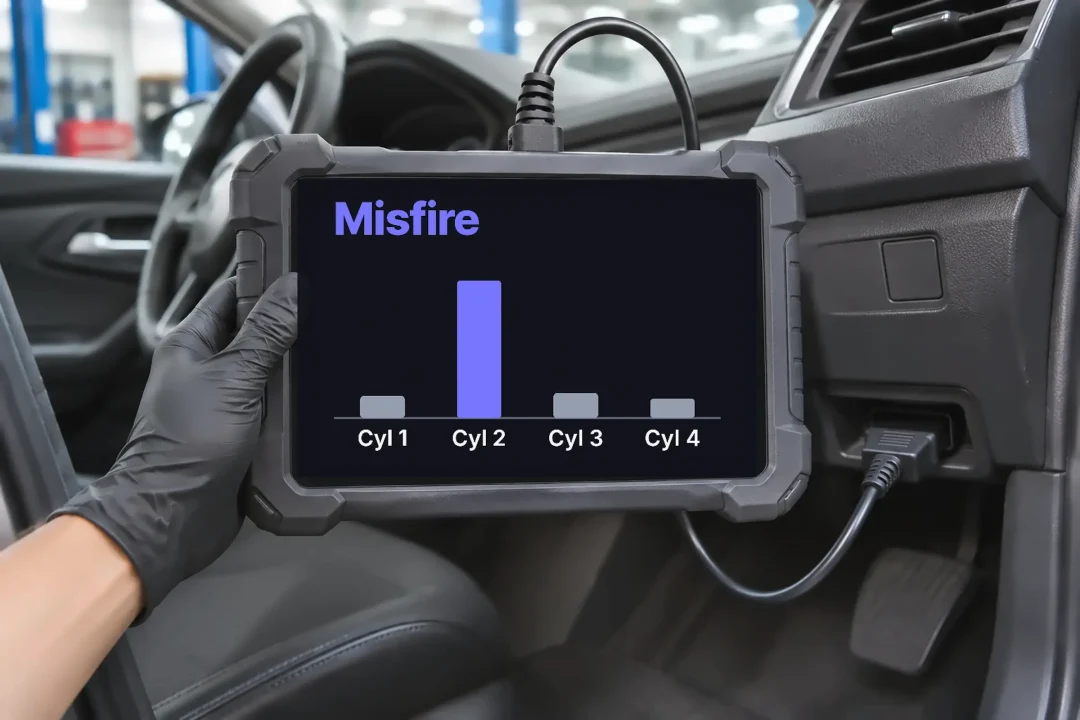
Illustrative scan tool screen; not data from a customer's vehicle.
Book through the phone number in the site header. We work in-shop only, by appointment, at 1713 W Baltic Pl, Englewood, CO 80110. See our services and service area.
FAQ
What are the most common signs of a bad ignition coil?
Typical signs are rough idle, misfires or hesitation under load, loss of power, hard starting and a check engine light. A plug, injector or wiring fault can cause the same signs, so testing confirms the cause.
How do I tell a bad ignition coil from a bad spark plug?
From the driver's seat, often you cannot. Coils may fail suddenly or only when hot and may set a coil circuit code, while plugs usually wear gradually. Testing on the affected cylinder separates them.
Can a bad ignition coil cause a misfire or a P0300 / P0301 code?
Yes, a failing coil is a typical cause of a misfire, which can set P0300, P0301 or another cylinder code. It is not the only cause, so the code alone does not prove the coil failed.
What is a P0351 or P0352 code?
These typically point to the circuit of ignition coil A or coil B. The fault can be in the coil, the connector, the wiring or the control signal, so the circuit is tested before a part is replaced.
Will replacing one coil or a full set always fix the problem?
No. A new coil fixes the misfire only when the coil caused it. If a plug, injector, wiring or mechanical fault is involved, the symptoms come back.
How do I book ignition coil or misfire diagnosis in Englewood?
Call the number in the site header to set an in-shop appointment. Mention when the symptoms happen and whether the check engine light is steady or flashing.
General information, not a diagnosis of your vehicle. Ignition systems carry high voltage; leave testing to properly equipped technicians.