
Signs of a Bad Fuel Injector: Symptoms, Causes and What to Check
Bad fuel injector symptoms can look like many other engine problems: a rough idle, a misfire, a fuel smell or a check engine light. An injector that is clogged, leaking or not getting the right electrical signal can cause any of them, but so can an ignition coil, a spark plug or a wiring fault.
This guide covers the typical signs of a bad fuel injector, the difference between clogged, leaking and electrical injector faults, how injector problems differ from coil and plug problems and how diagnosis confirms the cause. It describes typical patterns on gasoline engines, not findings from a particular customer's car.
Signs of a bad fuel injector (what drivers usually notice first)
Typical signs of a bad fuel injector include:
- Rough idle. The engine shakes or runs unevenly at a stop.
- Misfires. A stumble or hesitation, often on one cylinder.
- A fuel smell, around the engine or from the exhaust.
- Higher fuel use than usual.
- Hard starting, especially after the car has been parked.
- A check engine light, steady or flashing.
- Weaker acceleration, and on some vehicles a reduced-power warning.
These are typical possibilities, not a fixed set. A single faulty injector may cause only a mild shake at idle, while other faults cause several of these at once. If a power warning appears, our reduced engine power guide explains limp mode.
A strong raw fuel smell near the engine is a safety concern. Do not keep driving or start the engine repeatedly to find the source; have the car checked.
Clogged vs leaking vs an electrical injector fault
Injector problems typically fall into three families:
- Clogged or restricted. Deposits reduce or distort the spray, so the cylinder gets too little fuel. Typical results are a misfire, hesitation or a lean condition. A lean code such as P0171 can be one outcome; our P0171 guide explains that code.
- Leaking. An injector that drips or does not close fully adds fuel when it should not. Typical results are a fuel smell, hard starting after parking, rough running or a rich condition.
- Electrical. An open or short in the injector winding, the connector or the wiring stops the injector from working as commanded. This family often sets an injector circuit code.
These are cause families, not a ranking. Diagnosis decides which one applies, and sometimes the injector itself is fine while the problem is in its circuit or fuel supply.
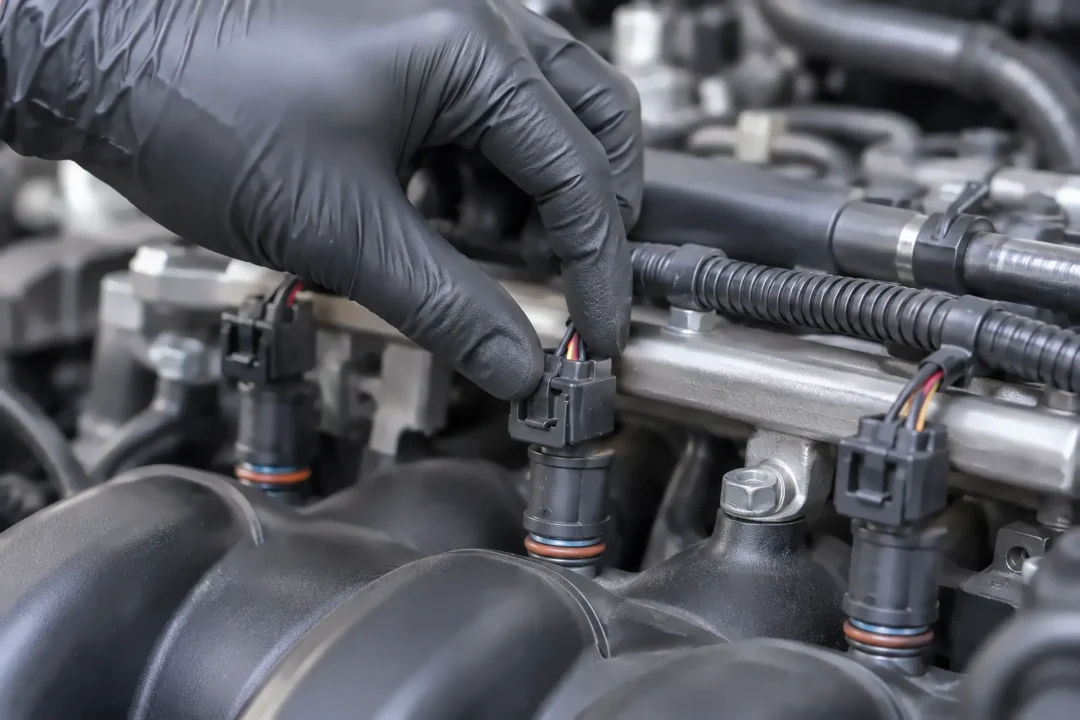
Illustrative in-shop inspection; not a customer's vehicle.
Bad fuel injector vs a bad coil or spark plug
A cylinder needs air, fuel and a spark at the right moment. The ignition coil supplies high voltage, the spark plug creates the spark and the fuel injector delivers the fuel. A fault in any of them can cause a misfire on the same cylinder, so the complaint alone does not point to one part.
Some differences are typical, though not reliable on their own. Injector faults are more often linked to fuel smell, fuel trim codes or injector circuit codes. Coil faults are more often linked to coil circuit codes or misfires that appear when hot. Plugs usually wear gradually.
Warning lights and related codes
A misfire or fuel trim problem can turn on the check engine light; our check engine light guide explains steady versus flashing. Codes often linked to injector faults include:
- P0300 and P0301–P0304 misfire codes; see our P0300 guide;
- P0200, which typically describes an injector circuit fault in general, and P0201, which typically points to the injector circuit for cylinder 1 (later numbers follow the other cylinders);
- P0171, too lean on bank 1, and P0172, too rich on bank 1, as possible related fuel trim codes.
None of these codes alone proves an injector failed. A circuit code can come from wiring; a lean or rich code has several cause families.
Why an injector cleaner or a parts-store swap often fails
A bottle of fuel additive does not test the injector's wiring, connector or the injector's ability to open and close correctly. It will not fix an electrical fault or a leaking injector, and it is not a substitute for finding out why the symptom started.
Replacing one injector, or a full set, without diagnosis has similar risks. If the real cause is a wiring fault, an ignition problem or a fuel supply issue, new injectors leave it in place. Removing a fuel rail also involves pressurized fuel, which is not a home experiment.
How we confirm a fuel injector problem in the shop
At eForce Automotive Service, car diagnostics for injector symptoms follows the evidence:
- Scan and freeze frame. We read misfire, injector circuit and fuel trim codes and the conditions when they set.
- Live data by cylinder. Where the platform supports it, we review misfire counts and fuel trim data to narrow down the affected cylinder or bank.
- Circuit and connector checks. We test the injector's power and control signal, the connector and the harness. Circuit faults are repaired under auto electrical repair.
- Injector checks. We evaluate the suspected injector's operation with appropriate shop equipment.
- Separate ignition and other causes. We check the coil and plug on the same cylinder so the right part is identified.
- Replace what is confirmed. We replace fuel injectors, and repair injector wiring and grounds, when tests point to them. If testing points to fuel supply or a mechanical cause, we explain the findings and the next step.
Illustrative scan tool screen; not data from a customer's vehicle.
Book through the phone number in the site header. We work in-shop only, by appointment, at 1713 W Baltic Pl, Englewood, CO 80110. See our services and service area.
FAQ
What are typical signs of a bad fuel injector?
Typical signs are rough idle, misfires, a fuel smell, higher fuel use, hard starting and a check engine light. Coils, plugs and wiring can cause similar signs, so testing confirms the cause.
How do I tell a clogged injector from a leaking one?
A clogged injector typically delivers too little fuel and may lead to a misfire or a lean condition. A leaking injector typically adds fuel when it should not, with a fuel smell or a rich condition. Testing confirms which applies.
Can a bad fuel injector cause a misfire or a P0171 / P0172 code?
Yes, those are typical links: a clogged injector can contribute to a lean code and a leaking one to a rich code. Neither code proves an injector failed, because each has several possible causes.
Will an injector cleaner fix the problem?
Not as a general repair or a replacement for diagnosis. A cleaner cannot fix an electrical fault or a leaking injector.
Will replacing one injector or a full set always fix it?
No. New injectors help only when the injectors caused the problem. Wiring, ignition or fuel supply faults remain after a swap.
How do I book fuel injector or misfire diagnosis in Englewood?
Call the number in the site header to set an in-shop appointment. Mention any fuel smell and when the symptoms happen.
General information, not a diagnosis of your vehicle. Fuel systems operate under pressure and fuel is flammable; leave testing to properly equipped technicians.